

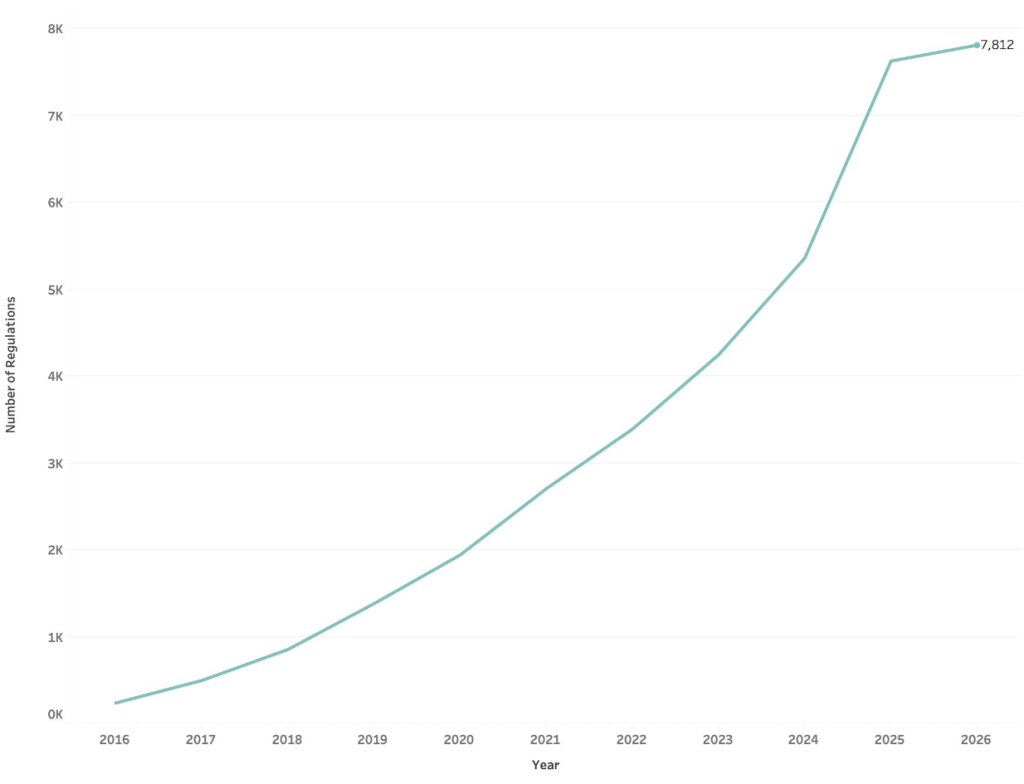
Does it feel like there are more sustainability regulations than ever to contend with? You’re not imagining it. More than 2,000 new environmental regulations were introduced globally in 2025, according to Datamaran, a provider of risk and governance tools.
The flood of proposed and implemented new policies is changing the way that sustainability teams operate. With that in mind, Trellis spoke with the team behind Datamaran’s annual ESG Regulations to Watch report to get their take on the forces behind the increase, and which U.S. and European regulations that sustainability professionals should be keeping an eye on.
Growth in environmental regulations
The big picture
One counter-intuitive reason for the proliferating new laws are the attempts by governments to simplify the regulatory landscape, noted Donato Calace, a Datamaran senior vice president focused on partnerships and innovation. “Policymakers may promise deregulation, but the trick is that deregulation is delivered through more regulation, because you need a new act to deregulate what was there before,” he said.
Regulatory pressure is nothing new for companies, added Calace. But in the past it’s been more prevalent in cybersecurity, product safety and other areas. Often understaffed sustainability teams haven’t yet acquired the resources needed to deal with the challenge. One leader at a well-known finance-sector business recently confided to Trellis that their company was likely not in compliance in some territories — they just didn’t know which ones.
“It’s a governance and ownership problem,” said Calace. “That’s the most painful part.”
U.S. regulations to watch
The PROTECT USA Act would put the U.S. on a collision course with the European Union by barring many large companies from complying with the bloc’s Corporate Sustainability Due Diligence Directive, which requires major businesses to address environmental harms in supply chains. The act is definitely one to watch, but at present appears stalled: It has not been considered by committee since being introduced in the Senate around a year ago. GovTrack, an independent legislation monitoring service, gives the bill a 4 percent chance of being enacted.
State initiatives will likely have a bigger impact. Last December, New York implemented a mandatory emissions reporting program that requires reports of 2026 emissions to be filed in June 2027. California, Colorado, Oregon and Washington already have related rules, some dating back more than a decade. Illinois and New Jersey are among the states that have recently considered joining them. Experts in environmental policy note that the new activity is in part a response to President Trump’s proposed repeal of federal reporting regulations.
One unhappy irony is that the repeal of the federal regulations might therefore trigger a patchwork of replacements at the state level. According to an analysis by the free-market-oriented R Street Institute, this would increase costs for companies, i.e., the exact opposite of the Trump administration’s stated reason for repealing the federal rules.
European regulations to watch
European regulators have been as busy as ever. There are upcoming compliance deadlines for new regulation on digital passports for detergents and battery sustainability, as well as plans to simplify climate reporting requirements for financial institutions.
Calace also recommended monitoring the Industrial Accelerator Act (IAA), proposed earlier this month, which would introduce low-carbon requirements for steel, cement and aluminum used in public projects. In addition, government purchases of battery storage systems, solar technologies, heat pumps and other clean energy technologies would be subject to made-in-the-E.U. requirements. Manufacturers in these sectors would benefit but might have to reconfigure supply chains to qualify, noted lawyers at Latham & Watkins in a recent analysis.
The act would complement the E.U.’s Carbon Border Adjustment Mechanism, a recently implemented regulation that is already shaping global decarbonization strategies, in supporting European companies that work on climate solutions, rather than penalizing heavy emitters, as earlier E.U. climate legislation has done.
“It’s the first time the E.U. is not using sticks,” said Calace of the IAA. “It’s using carrots.” He called it the bloc’s “IRA moment,” referring to the Inflation Reduction Act, the Biden administration’s groundbreaking climate legislation that provided tax breaks and other incentives for climate solutions, which was largely dismantled by the current occupant of the White House.