.png "The Hyperscaler AI Arms Race: Reshaping Global Cloud Infrastructure")
The major cloud hyperscalers—primarily Amazon, Google and Microsoft—are currently engaged in an infrastructure arms race of an unprecedented scale.
Driven almost entirely by the explosive adoption and scaling of artificial intelligence, this massive pivot is fundamentally altering capital allocation and the geographic footprint of global data centers. Let’s take a look at AI-related investments, notable projects, GPUs-as-a-Service, and why hyperscalers lease from neoclouds.
This analysis is powered by proprietary data you can only get in TeleGeography’s Cloud and WAN Research Service.
Hyperscaler AI investments
Industry projections indicate a giant surge in investment, with total hyperscaler capital expenditure (CapEx) expected to reach a staggering $600 to $700 billion in 2026. This represents a 40% to 50% increase over 2025 investment levels.
Crucially, the nature of this spending has shifted. Financial analysts estimate that roughly 75% of this total CapEx is being directed specifically toward AI infrastructure, heavily outpacing investments in traditional cloud computing architecture.
While tech giants are actively retrofitting existing cloud data centers to accommodate baseline AI growth, the vast majority of heavy investment is being poured into giant, new “greenfield” AI data centers. Purpose-built facilities are largely required because AI workloads demand significantly higher power densities, specialized liquid cooling, and reinforced architecture for heavy GPU clusters.
Some of the largest projects include:
- Amazon (AWS): Project Rainier (Indiana), Louisiana, Mississippi
- Google: Columbus (OH), Omaha (NE), Texas, Oklahoma, Visakhapatnam (India)
- Microsoft: Fairwater Campus (Mount Pleasant, WI), Atlanta (GA), Narvik (Norway), Loughton (U.K.)
Project Stargate
Another highly publicized AI initiative is Project Stargate. Backed by an enormous $500 billion investment, this joint venture between OpenAI, SoftBank, Oracle, and MGX (an Abu Dhabi investment firm) aims to build a network of data centers specifically designed to train and operate advanced AI models. Oracle is spearheading the flagship Stargate campus in Abilene, Texas, while OpenAI and its partners are developing a second site in Port Washington, Wisconsin—about an hour north of Microsoft’s Fairwater campus.
This arrangement often raises a few questions: Isn’t Microsoft OpenAI’s primary partner, and doesn’t OpenAI run on Microsoft’s cloud? If so, why is Oracle leading the Stargate build instead of Microsoft, and why is Amazon involved in OpenAI’s recent funding?
While rumors in 2024 suggested Microsoft would exclusively build OpenAI’s data centers, Oracle ultimately displaced them as the primary infrastructure builder for the Stargate initiative. Despite this shift in physical construction, Microsoft Azure remains the exclusive cloud provider for OpenAI’s first-party products and its “stateless APIs” (the underlying technology developers use to access the models).
AI and GPU compute-as-a-service
Let’s provide a bit more detail about this arms race. The 2020s have witnessed a surge of interest in AI, mirroring the initial hype and rise of cloud computing in the 2000s. Just as cloud computing revolutionized how businesses store, access, and process data, AI is being marketed for its potential to transform industries by automating tasks, improving decision-making, and enhancing overall accuracy and precision.
At the heart of this revolution are GPUs (Graphics Processing Units). Originally designed for rendering graphics, GPUs have become the cornerstone of modern AI computation. They are an essential part of an AI “cluster,” acting as server accelerators that process multiple calculations simultaneously—often one to two orders of magnitude faster than an average CPU. This processing power is critical during the AI model training phase.
Neoclouds
While GPU services are hardly new—AWS and Microsoft have offered GPU compute services for the better part of a decade, with Google joining slightly later—the landscape is shifting. Today, all major Cloud Service Providers (CSPs), including Oracle, IBM, Alibaba, and OVH, offer GPU compute. However, a new wave of specialist cloud providers has emerged, offering GPUs-as-a-Service (GPUaaS). These “neoclouds” grant anyone access to the hardware needed to train their own models or run inferences.
Surprisingly, some of the biggest customers for these GPUaaS providers are the hyperscalers themselves, specifically Microsoft and Google.
GPUaaS Provider Cloud Regions
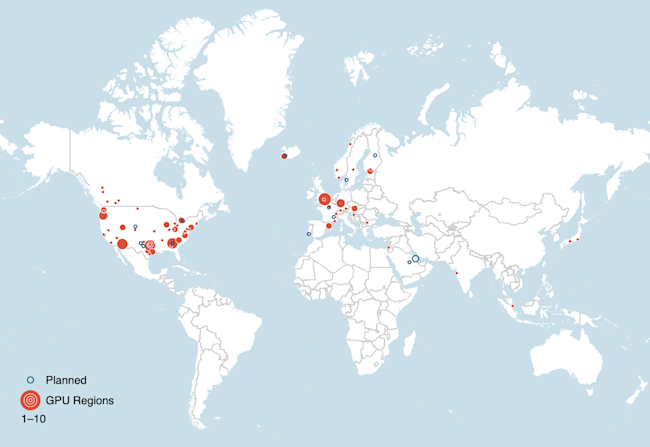
Note: Data include 18 major GPUaaS focused cloud providers such as CoreWeave, Nebius, and Nscale. This is not an exhaustive list of specialist GPUaaS providers. Data as of Q1 2026.
Why trillion-dollar titans lease from neoclouds
It may seem completely counterintuitive that tech giants would need to lease compute from much smaller providers like CoreWeave or Lambda. However, the generative AI boom created physical and supply-chain bottlenecks that even the hyperscalers couldn’t solve alone. To keep up with insatiable demand, Microsoft and Google adopted a symbiotic strategy, relying on GPUaaS providers for several strategic, technical, and economic reasons:
Speed to deployment and power bottlenecks
Building a massive, traditional hyperscale data center from scratch takes two to four years, and securing the massive power agreements and grid access required for AI is incredibly difficult. Many GPUaaS providers bypass this by retrofitting facilities originally built for high-density applications, like cryptocurrency mining. These sites already possess the two things AI needs most: massive power capacity (often hundreds of megawatts) and advanced thermal management. Because neoclouds focus solely on AI, they can deploy a cluster of 80,000 GPUs in weeks—a pace hyperscalers cannot match with their legacy infrastructure.
Purpose-built AI architecture vs. legacy overhead
Hyperscale clouds are built to do everything, from hosting simple web apps to running massive enterprise databases. Consequently, their infrastructure relies heavily on virtualization and complex networking protocols, which adds a “tax” on performance. Training large language models (LLMs) requires bare-metal performance, hyper-fast interconnects (like InfiniBand), and minimal latency. GPUaaS providers build their network topology and storage architectures strictly for AI, yielding higher hardware utilization compared to the generalized architectures of Azure or Google Cloud Platform (GCP).
Strategic defense and client retention
Microsoft and Google have massive commitments to premier AI partners like OpenAI and Anthropic. When Azure couldn’t spin up GPU capacity fast enough to meet OpenAI’s exploding needs for ChatGPT and GPT-4, Microsoft leased immense capacity from CoreWeave and Lambda Labs to bridge the gap. Google similarly has partnered with CoreWeave for OpenAI’s multi-cloud workloads. By leasing from neoclouds, hyperscalers can white-label this compute or pass it seamlessly to clients, ensuring their biggest customers don’t defect to a rival cloud due to capacity limits.
Financial de-risking (CapEx offloading)
AI hardware evolves at breakneck speed; today’s $30,000 GPU might be heavily depreciated in just a few years. By leasing capacity, hyperscalers shift billions of dollars from capital expenditure (CapEx) to operational expenditure (OpEx). If AI demand suddenly cools, the specialized neoclouds—not Microsoft or Google—would be left holding depreciating hardware on their balance sheets.
The NVIDIA allocation strategy
NVIDIA holds the keys to the AI hardware revolution. To prevent the “Big 3” (AWS, Azure, GCP) from monopolizing the market—and to hedge against these hyperscalers developing competing custom silicon (like Google’s TPUs and Microsoft’s Maia)—NVIDIA actively diversifies its customer base. NVIDIA strategically invests in and allocates its most advanced chips (like the H100, H200, and GB200) to neoclouds like CoreWeave. If Microsoft and Google want rapid access to this highly sought-after silicon, they are forced to strike multi-billion-dollar leasing deals with the providers NVIDIA favors.
GPUaaS Provider Deployment Map
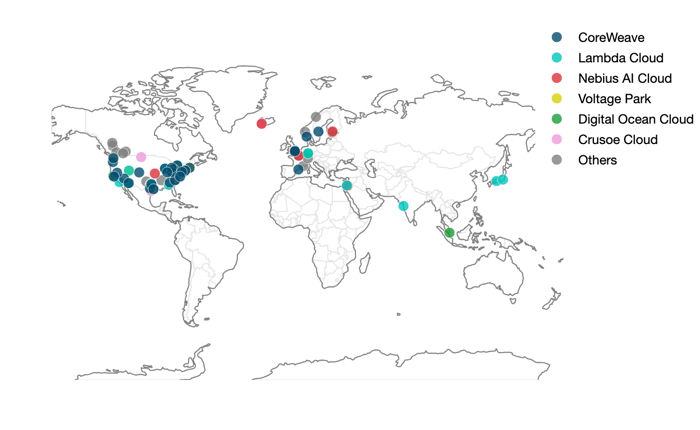
Note: Data include 18 major GPUaaS focused cloud providers such as CoreWeave, Lambda, and Nebius. This is not an exhaustive list of specialist GPUaaS providers. Data as of Q1 2026.
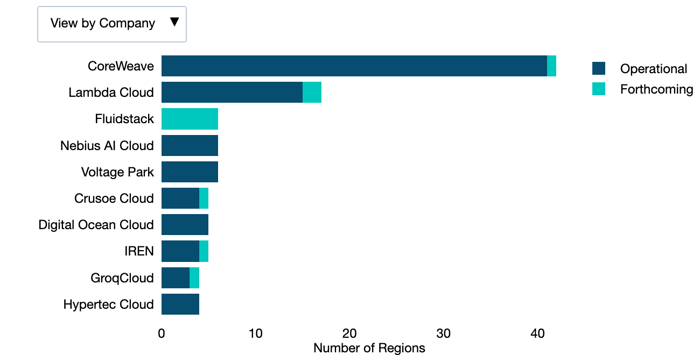
In terms of investment and infrastructure, CoreWeave is clearly leading the pack, having raised over $13 billion in funding over the past two years. Much of the funding is reported to be going towards the expansion of their data center footprint. In one year, the company has nearly tripled in size in terms of regions. CoreWeave currently has 41 regions in service and one more planned for 2026. The regions are located in the U.S. (35) and Europe (6).
Lambda has raised $2 billion in funding and operates 16 regions. Lambda is slightly more diverse geographically than CoreWeave, with regions in Japan (2), Germany (1), India (1), Israel (1), as well as the U.S. (11). Nebius and Crusoe are also notable, each with around $1 billion in funding and 6 and 5 regions in service, respectively. Fluidstack is in the millions in terms of funding, with 6 planned regions.
GPUaaS Provider Cloud Regions by Company and Country
.png?width=700&height=355&name=Copyright_TeleGeography_cwi_re_csp_gpu_global%20(1).png)
Note: Data as of Q1 2026
Get more AI market intelligence
There’s even more AI market data and analysis available in TeleGeography’s Cloud and WAN Research Service, which delivers data, analysis, and forecasts on international cloud connectivity and WAN services, and global WAN market size.