


Retail magnate and marketing pioneer John Wanamaker famously said: “Half the money I spend on advertising is wasted; the trouble is I don’t know which half.” That dilemma still defines modern marketing, where companies must capture attention across search, social, and display channels while proving every dollar drives measurable growth. With algorithms shifting and consumer behavior evolving quickly, it’s essential to plan and track an advertising budget with precision before exploring calculation methods and optimization strategies.
What Is an Advertising Budget and What Are Its Components?
At its core, an advertising budget is the portion of a company’s overall marketing budget set aside for paid promotions, media buys, production, and related expenses. Advertising budget allocation is a fundamental and enduring challenge for businesses of all sizes. The advertising costs can proliferate, with creative teams churning out new marketing materials at a breakneck pace, but it’s difficult to predict which campaigns will perform well and which will perform poorly. Testing any new ad requires investment, an investment that could have otherwise been put toward existing ads.
According to Gartner’s 2025 CMO Spend Survey, marketing budgets remain flat at 7.7% of overall company revenue, unchanged from 2024 after falling from 9.1% in 2023. For B2C companies, paid media (including search, social, and display ads) continues to outpace martech, labor, and agencies as the top advertising budget allocation, accounting for roughly 30% of marketing budgets, the same report found. This illustrates the difference between an advertising budget and a marketing budget: the former is a subset of the overall marketing budget devoted specifically to promotional activities and media spend. This surge in spending makes it even more critical to evaluate advertising spend, optimize investments and maximize returns.
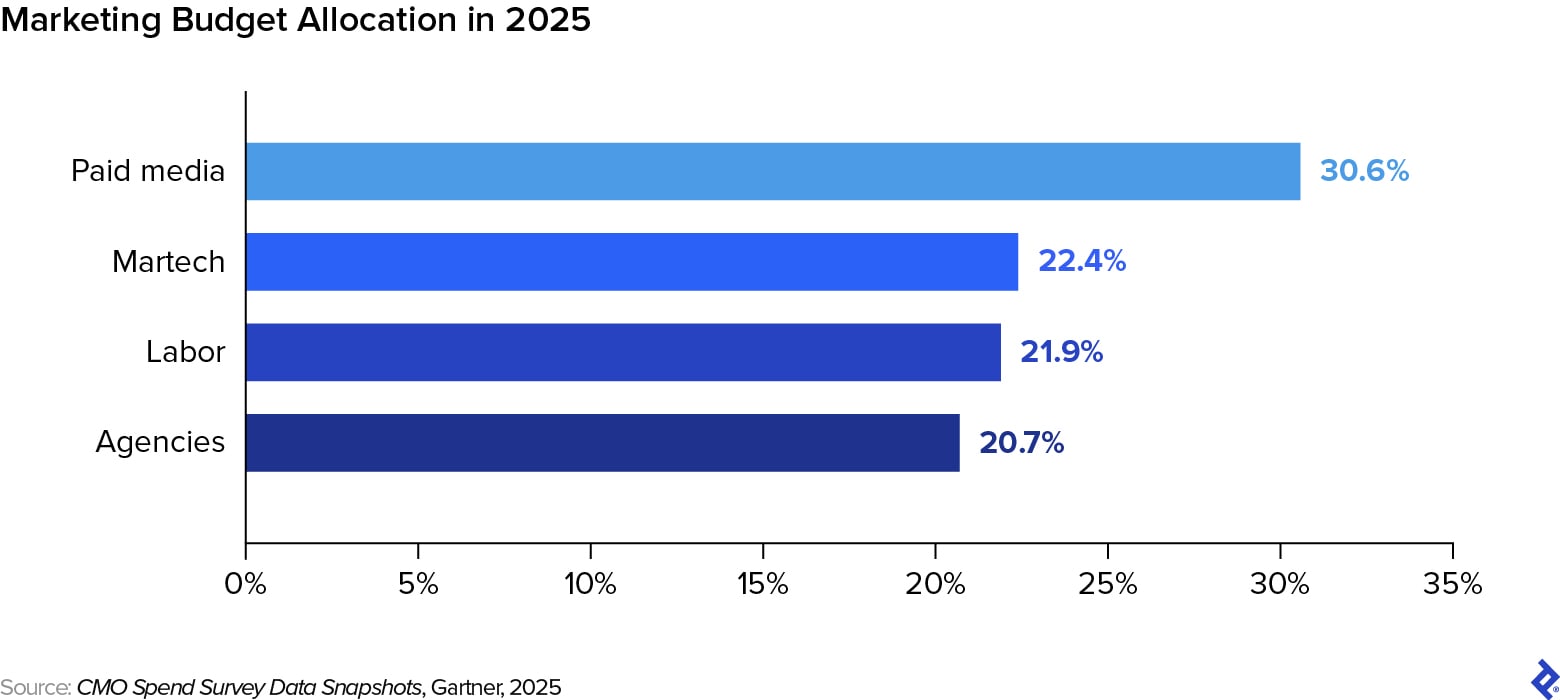
As a marketing data scientist and the founder of a startup that builds AI data analysis tools for small e-commerce companies, I have helped many clients refine their digital marketing strategies and save hundreds of thousands of dollars per year by identifying and cutting off losing marketing campaigns early on. So, when does the cost of testing a new ad become higher than the potential profit you would get if it performed well? Data science points to a helpful rule of thumb: spend no more than a fifth of your ad budget on testing, an insight that supports smarter advertising budget planning. Let me explain.
How to Determine an Advertising Budget
The problem described above is a variation of a notorious problem in mathematics and decision theory called the optimal stopping problem. It is found in many areas of decision-making where the objective is to find the best choice among a pool of candidates. For example, how many job applicants should you interview before picking the best one? How many people should you date before choosing a lifelong partner? How many houses should you see before putting in an offer?
To illustrate this problem in marketing terms, imagine a company has a $50,000 budget for advertising. For the sake of simplicity, we will say the company is only advertising on a single channel (e.g., Facebook). To test whether an ad is effective or not, it would need to invest $500 to get a statistically significant measure of its performance. How many ads should the company test?
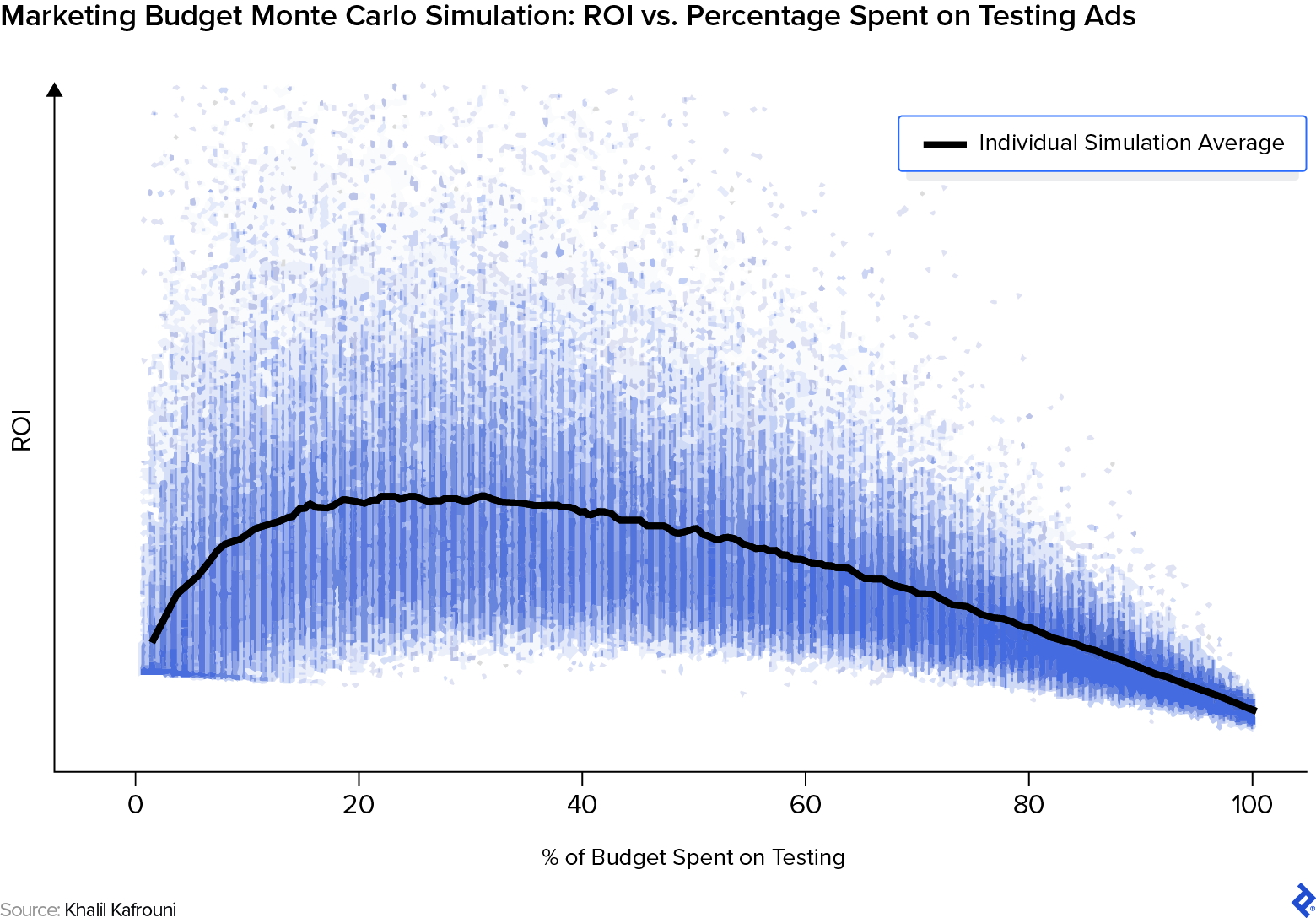
We can run a Monte Carlo simulation, a model used to predict possible outcomes of an uncertain event, to find the answer. To frame the problem more mathematically, we can allocate X% of the ad spend budget to testing new ads and we will be left with (100-X)% to invest in the best-performing ad found. At which threshold (X) do we maximize our ROI?
Methods for Calculating an Advertising Budget
When determining an advertising budget, marketers typically align it with objectives and consider competitive and industry norms. They may use budget calculation methods such as the Percentage of Sales Method or objective-and-task approaches to set and adjust spending.
While the exact percentage may vary, Monte Carlo simulations run across different test cases suggest that returns often peak when testing consumes roughly 20% of the overall budget, but this isn’t a hard rule. The ideal advertising budgeting depends on a range of factors, including total budget size, industry, average customer acquisition cost, and the scale of the target audience.
As the chart below shows, this advertising budget allocation often yields strong returns, but that doesn’t mean it’s right for every campaign. Instead, consider it a directional benchmark. This is an example of the risk-reward ratio. Soon after passing the budget sweet spot, the prospect of finding a stellar-performing ad is outweighed by two factors: The advertising costs of creating and testing a new ad and the reduction in budget that would otherwise be allocated to a high-performing ad that had already been found. Now, the question that remains is this: How can we use this insight to increase profitability?
How to Test and Track Performance
Before diving deeper into specific tips for increasing marketing ROI, it’s vital to lay the groundwork. What are your goals behind a marketing campaign, and how are you going to measure its success? In the simulation above, I used the Return on Ad Spend (RoAS) as an example metric, but this only makes sense when the purpose of the ad is to drive direct sales. That might not be what you are looking for if, for example, you are running ads for a real estate agency, the RoAS becomes entirely irrelevant. In this case, you might decide to craft your own metric based on the ratio of the number of leads who filled out an interest form divided by the spend. On the other hand, if you are a consumer goods brand and your goal is to build brand loyalty where customers keep coming back for repeat purchases, you might use one of the models that predict customer lifetime value (CLV) and track that as the success metric. Whatever your use case is, make sure to think deeply about the metrics that best encapsulate what you want to achieve.
Monitoring and controlling an advertising budget requires tracking key performance indicators such as ROAS or ACOS to evaluate advertising performance and adjust spending as results come in. This ongoing process of advertising budget monitoring helps prevent overspending or underfunding.
This is the first part of the foundation. The second part is tracking those metrics and acting on them. For this, it is paramount to stay on top of the data. This means setting up alerting systems that tell you when a campaign needs attention. Since you might be creating metrics that are not built into the standard ad management platforms, like Facebook and Google Ads, you might have to set up external alerting systems that cater to your specific needs. The alerts, in combination with regular examination, will guide you on which campaigns are underperforming and need to be adjusted or paused, or which campaigns are outperforming and thus need to have a budget increase. Now, with all the foundation in place, everything is set for the bigger battle: optimizing spend.
Top 5 Budget Allocation Strategies
While this simulation serves as a good generic guideline, its main goal is highlighting the need to keep the risk-reward balance of all marketing efforts in check. Generally, the returns of extensive testing will soon diminish, and it might be wiser to stick with a strong formula that has already been established.
Effective budget allocation strategies often start with understanding the core components of an advertising budget (like media purchases, production costs, agency fees, and market research) then applying objective-driven budgeting methods and data analysis to make the most of each dollar.
Many factors come into play when determining advertising budgets for promotional activities. Here are my top tips to optimize your advertising spend:
1. Research Your Competitors
Having consulted with many marketing departments, I know how often ad budgets are wasted on poorly performing ads when a bit of market research before launch could have revealed that the ad was unlikely to be effective or resonate with the target audience. This is particularly vital, of course, for newer and smaller companies with limited budgets.
Research your competitors and pay close attention to the style of advertising and distribution channels they prioritize. Larger brands in your sector will often have the resources to experiment with wide-ranging strategies. Use these campaigns as inspiration, but borrow ideas intentionally. Imitation without purpose can fall flat. Nostalgia marketing, for example, has been used successfully in campaigns like Pepsi’s “Pepsi Generation” relaunch, or Burger King’s revival of its 1970s branding. These worked because they leaned into retro aesthetics with self-awareness and emotional appeal. Similarly, a sports retailer may look at the way Nike leveraged emotional storytelling in its successful “Dream Crazy” campaign and adapt that emotional tone to fit its own brand identity and audience.
2. Be Strategic With Split Testing
Traditional A/B testing dictates that two variations of an ad be shown to people in equal proportion until one proves to be the statistically significant winner. Although this is a foundational mechanism for data-driven marketing teams, it does come at a cost: Statistical significance often takes a lot of time and money to reach. By waiting for the final verdict, there is always an amount of ad spend budget wasted on the worse-performing ad. This problem is called Bayesian regret, and the costs can be high, especially if one variant ends up being substantially better than the other.
Consider an auction: Bidders don’t know the exact value of the item they are bidding on but have some beliefs or probabilistic estimates. Bayesian regret measures how much worse their chosen bids are, on average, compared to the bids they would make if they knew the exact value. It helps in understanding how much uncertainty impacts decision quality.
It is possible to minimize the Bayesian regret of your ad testing using multi-armed bandit (MAB) testing. With MAB, the allocation of traffic for each variant is dynamically set based on its performance. For example, we would begin with two variants, A and B, which have a 50% traffic allocation. If after a day it was observed that variant A was performing better, even when the difference in performance was not statistically significant, the traffic allocation would be shifted slightly in favor of variant A. This would continue, weighting the allocation more heavily in favor of the winner as we gather more data. This reduces the Bayesian regret and allows for more effective decision-making around campaign management.
3. Consider Digital Content Shelf Life
For large budgets and small target audiences, even the most effective advertising campaigns will eventually reach diminishing returns. At the start of an ad’s life, it’s easier for algorithms to optimize the audience and show the ad to the people most likely to react to it. Over a certain time period, however, they will exhaust the list of people likely to click the ad, and the pool of optimal users will decline. This is why marketing teams often see ads that once had a robust return on ad spend later taper off into unimpressive, and sometimes losing, numbers.
To address this within the context of testing budgets, it is important to monitor ad budget over time. Ad budget monitoring helps you catch signs of diminishing returns, such as a decline in click-through rates, a rise in cost-per-click, or a decrease in conversion rates.
4. Test Different Channels Individually
The simulation above only considers one digital marketing channel. In reality, most marketing teams will have ads across multiple digital channels, and each of these will garner a different response to the same ad. For example, an ad that is successful using Meta ads will not necessarily be a hit using Google Ads. This means that when your marketing team is showing the same ad across multiple channels, particularly social media platforms, each version must be analyzed by platform individually, as though they are different ads.
5. Remember: New Ads Are Not Always the Solution
There may be certain cases where testing different ads requires extensive resources or where the advertising budget is very limited, and this interferes with the ability to reach statistically significant results. Consider pursuing a different advertising strategy. For instance, you might opt for incremental testing, where small changes are made to existing high-performing ads rather than creating entirely new ones. Alternatively, focus your internal resources on optimizing other aspects of the marketing funnel, such as improving landing page conversion rates and enhancing email marketing strategies, which may yield better long-term returns than continuous ad testing. Don’t be blindly incentivized to keep creating new material when it isn’t needed.
Why Advertising Budgeting Matters
The result of the advertising budget simulation is a useful guideline for data-driven digital marketing teams: Proceed with caution when spending beyond a fifth of your advertising budget on testing. By striking a balance between innovation and the efficient scaling of existing ads, companies can optimize their advertising efforts, manage their budgets more effectively, and maximize their return on investment. Budgeting is important in advertising because it helps avoid costly missteps and support long-term business planning. Clear plans reduce the risk of overspending or underfunding and strengthen the connection between spend and marketing objectives.
When making decisions about online advertising campaigns, keep in mind that even the best-performing ads may have diminishing returns. Once your target audience has seen your ads multiple times, response rates will naturally decline. At that point, continued spending may yield lower ROI and signal it’s time to reinvest elsewhere. As part of your marketing strategy, conduct thorough competitor and market research before incurring any creative costs. Be sure to evaluate advertising spend across different advertising channels, and use MAB testing to make the most of your testing resources.
Data analytics may not be the flashiest part of marketing, but it’s the engine powering smart, high-performing campaigns. Behind every compelling ad is a series of informed decisions: what to test, when to scale, and where to invest. Without rigorous data interpretation, even the best creative ideas risk falling flat. Marketing analysis doesn’t just guide strategy. It fuels creativity so that insights, not guesses, drive innovation.
As the digital advertising landscape continues to rapidly evolve, so too will strategies for advertising budget allocation and testing. By staying informed about emerging marketing tools, trends, and technologies, businesses can refine their advertising activities, ensuring they remain competitive in an ever-changing market.