

Read the full transcript of the video above
Hi, I’m Zora Ibrahimi, Cyber and Information Security Services Practice Lead at Toptal. Over the past 15 years, I’ve led enterprise risk management, cybersecurity strategy, and digital governance initiatives for Fortune 500 companies and global organizations, including leadership roles at Grant Thornton and McCormick & Company.
I co-authored this article with Toptal Management Consultant Jonathan Thurston and Client Partner Alex Bachman. We wrote this article because digital accessibility is often treated as a compliance checkbox rather than what it truly is, a growth lever for business.
As organizations shift more services online, accessibility directly impacts revenue, customer trust, operational efficiency, and brand strength. Our goal was to reframe accessibility from a reactive obligation into a strategic advantage using real-world examples from companies like Apple, Airbnb, and Barclays. The article is structured around three dimensions: the scale of the opportunity, the cost of inaction, and what distinguishes organizations that lead in accessibility from those that struggle.
Drawing from our experience with enterprises large and small, my co-authors and I lay out a clear roadmap for achieving sustainable accessibility. The takeaway is simple: Accessibility is not a side effort or afterthought. When it’s embedded into products and platforms, it expands market reach, strengthens trust, improves efficiency, and compounds value across the business.
I hope you find the article helpful. Thanks for reading.
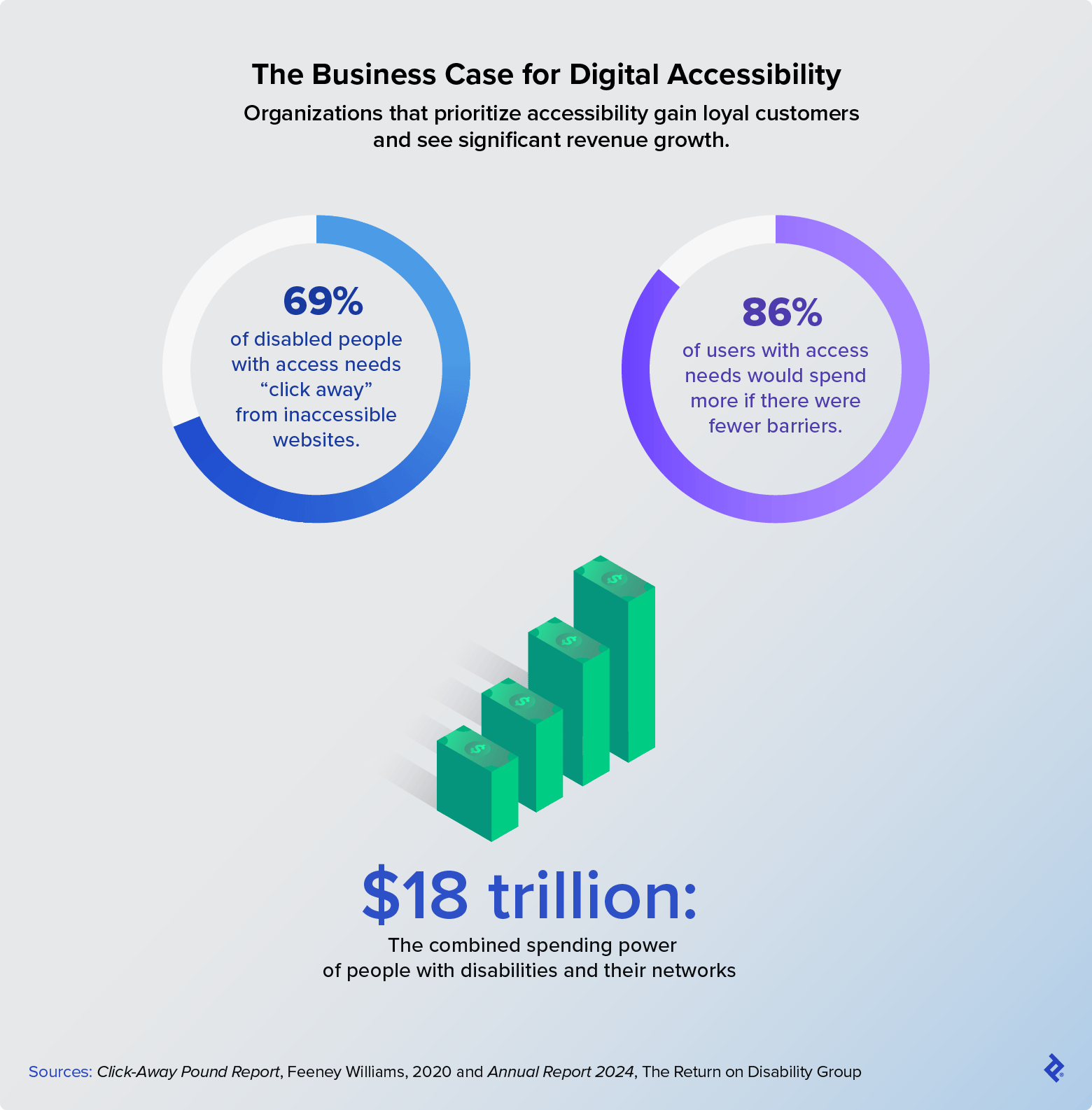
As companies increasingly rely on digital channels to reach customers and deliver services, digital accessibility has become a strategic imperative. Making websites, mobile apps, and platforms usable for people with disabilities reduces risk, expands market reach, and impacts revenue. In North America and Europe alone, people with disabilities have access to $2.6 trillion in disposable income. Globally, the annual spending power of people with disabilities and their friends and families is estimated to be over $18 trillion.
Organizations of all types are facing a complex web of state, country, and international accessibility rules, with a number of deadlines approaching in 2026, 2027, and 2028 across North America, including the ADA Title II Web and Mobile Rule, the Section 504 HHS Digital Accessibility Rule, and Canada’s Digital Technologies Accessibility Regulations, among others.
As accessibility pressure has increased, the number of vendors offering digital accessibility services like automated testing tools, auditing, and remediation has expanded quickly. In 2025, the global digital accessibility market was valued at $1.4 billion and is estimated to reach $3.2 billion by 2034. Unfortunately, this surge in demand has given way to a fragmented landscape of tools and vendors, resulting in inefficiencies, inconsistent work quality, and missed targets for organizations.
In our experience working with large organizations, the companies that struggle most are those that treat accessibility as a one-time fix. In contrast, successful organizations treat accessibility as a product quality issue, and the difference shows up in speed, cost, and trust.
Why Accessibility Matters
Digital accessibility entails designing websites, mobile apps, and other digital content so that people with sensory, cognitive, physical, and communication needs can use them effectively. In the US, nearly 30% of adults have a disability of some type, according to the Centers for Disease Control. Almost 14% have a cognitive disability that impacts concentration, memory, or decision-making, while more than 6% are hard of hearing or deaf, and 5.5% have blindness or a vision disability that can’t be corrected by glasses.
Key factors in digitally accessible design include alt text, captions, keyboard navigation, screen‑reader compatibility, predictable structures, legible typography and colors, and clear visual hierarchies. When interfaces lack these elements, users are forced to work harder, rely on others, or are shut out entirely.
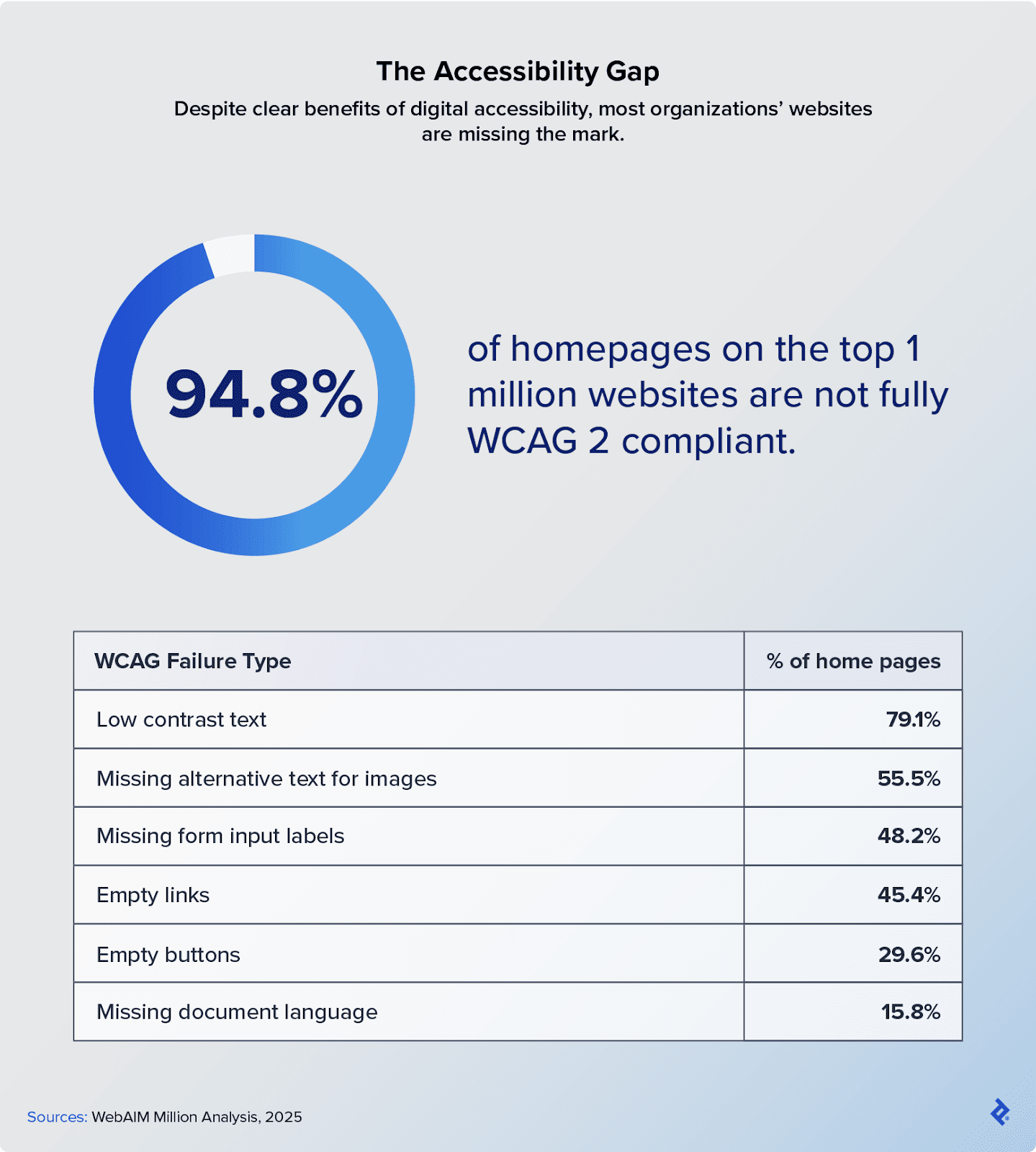
Many organizations are behind schedule in their accessibility efforts and find themselves falling well short of emerging accessibility standards. The 2025 WebAIM Million study, for example, analyzed the top 1 million websites and found that nearly 95% of their home pages contain errors like low-contrast text or missing alt text that make them noncompliant with Web Content Accessibility Guidelines (WCAG).
Every accessibility defect can represent a user who is unable to complete a task independently. At scale, that results in lost customers, higher support costs, and reputational drag. When teams build accessibility into design systems and delivery pipelines, defects also disappear upstream. Accessibility goes further than pure altruism; it represents operational efficiency.
For many companies, accessibility errors can lead to fines, reputational harm, and costly mandatory remediation. But these challenges are solvable. In our work with clients, we’ve found that organizations can minimize these risks with a proactive approach that combines comprehensive audits with regular testing and employee training.
The Benefits of Accessibility
Organizations have a responsibility to make sure people of all abilities can interact with and access their content. But beyond that, achieving accessibility can unlock a larger customer base and increase revenue.
The World Health Organization estimates that there are 1.3 billion customers worldwide who are excluded when digital products are not designed for accessibility. Meanwhile, a UK survey by disability consultancy Freeney Williams found that 69% of disabled people with access needs “click away” from inaccessible websites. And 86% of the users surveyed said they would spend more if there were fewer barriers.
Accessible websites also rank better in online searches. A 2025 study of 10,000 websites found that integrating accessibility features alt text, keyboard navigation, sufficient contrast ratios, and semantic HTML, lead to improved SEO outcomes and can raise organic traffic by 23%.
Digital Accessibility Examples and Case Studies
Accessibility is one of the few investments that simultaneously reduces risk, expands market reach, and improves product quality. Very few initiatives deliver all three. As evidenced by these examples at Barclays, Airbnb, and Apple, meeting minimum standards is only the starting line. Product-led accessibility is what lets you compete.
Building Competitive Advantage at Barclays
Barclays’ accessibility strategy illustrates how inclusive design can become a competitive advantage. Rather than treating ADA/WCAG guidelines as a risk management tool, the bank integrated accessibility into product development, corporate governance, and service design. That shift has helped Barclays reduce customer friction, elevate innovation (such as adapted services and customer support pathways), and strengthen customer trust and loyalty, positioning accessibility as a contributor to long-term brand value.
Accessibility as a Core Product Capability at Airbnb
Airbnb offers a modern example of accessibility as product strategy. After expanding its accessibility features and review system, the platform saw a 450% increase in listings with verified accessibility details. The result was a materially larger and more usable marketplace for travelers with access needs. Airbnb built this by treating accessibility as a core product capability. Dedicated cross-functional teams across design, engineering, and research work directly with people who have lived accessibility needs. This approach frames accessibility as a driver of inventory growth, customer trust, and market reach, not as a one-time exercise.
Growth Through Accessibility at Apple
Apple demonstrates what it looks like when accessibility is treated as a growth lever. By embedding accessibility into its core platforms, from iOS and macOS to the App Store itself, Apple has turned inclusive design into a product differentiator at global scale. Features such as Live Captions, eye-tracking input, system-wide text customization, and the new Accessibility Nutrition Labels are not niche add-ons. They expand who can adopt Apple hardware, build on its ecosystem, and remain loyal to it. Accessibility at Apple is not owned by a compliance team. It is a first-class product capability that widens the addressable market, strengthens platform lock-in, and reinforces brand trust. The business signal is clear: when accessibility is built into the platform, it compounds value across every product line.
Accessible design is good design, and not just because it’s inclusive, but because all users benefit from design choices that align with accessibility best practices. When you follow guidelines for keyboard navigation, color contrast, legible type, clear hierarchy, and other accessibility standards, everyone wins.
The Cost of Inaction: Consequences of Inaccessibility
Despite the far-reaching benefits of accessibility, a vast majority of digital footprints are not fully operable by people with disabilities, and many organizations are falling behind in their efforts. A case in point: Just two months before the European Accessibility Act (EAA) became fully enforceable in 2025, a research group found that of 120 European companies surveyed, only 27% considered themselves fully prepared, and 28% were either somewhat unprepared or not prepared at all.
In our work with large organizations, we’ve noted that accessibility failures are rarely edge cases. They usually sit in the highest-traffic flows, such as checkout, enrollment, and authentication. When those break, an organization isn’t just excluding a niche audience, it is bleeding revenue. Aside from losing business, the fines for noncompliance with applicable accessibility regulations can be significant. There are also legal implications. In a 2006 case, for example, Target settled with the National Federation of the Blind and agreed to pay $6 million, upgrade its website, and cooperate with rigorous oversight. In 2025, Fashion Nova, a US-based online retailer, agreed to a $5.15 million settlement in a class action lawsuit rooted in website accessibility issues.
If the opportunity to reach trillions of dollars in market potential isn’t enough to engage organizations, the looming specter of spending millions of dollars on potential penalties should push accessibility to a top priority for the coming year.
Today’s Digital Accessibility Best Practices
For too many organizations, digital accessibility focuses solely on patching up current assets. But a remediation-only strategy can increase operational costs, technical debt, and risk. In our work with organizations large and small, we’ve learned that adopting a comprehensive, ongoing accessibility strategy built on the pillars of audits, remediation, technology stack upgrades, and strategic partnerships is a much more cost-effective and sustainable solution.
Comprehensive Accessibility Audits
Accessibility audits combine automated scanning with manual evaluation to assess real user experiences and identify gaps. Automated tools can quickly identify common issues such as missing alt text, low contrast, and misuse of accessible rich internet application (ARIA) features, but they can’t do it all. Manual testing of screen readers, keyboard navigation, and cognitive stressors uncovers barriers that automated tools may miss. A thorough audit will then evaluate WCAG 2.2 conformance and prioritize issues by user impact, frequency, and technical effort, creating a roadmap that addresses the most significant barriers first and supports progress toward accessibility.
Strategic Remediation
Phased implementation makes accessibility efforts manageable and sustainable by dividing work into stages that deliver early value and support long-term change. Quick wins, such as improving color contrast, adding alt text, or correcting heading structure, enhance usability immediately and build momentum. Deeper improvements like redesigning templates, refactoring components, and updating content governance require more time and coordination, but they may create problems if ignored. Once these foundational remediations are complete, ongoing monitoring through automated scans, manual checks, user feedback, and periodic audits ensures accessibility remains an ongoing practice and helps prevent regressions.
Technology Stack Considerations
Cloud services such as AWS make it possible to build accessibility into your infrastructure with scalable hosting, managed services, and tools that support semantic markup, responsive design, and assistive‑technology compatibility. Choosing an accessibility‑focused CMS that supports structured content models and keyboard‑navigable templates helps creators and developers avoid introducing barriers as they publish new content. Meanwhile, modern development frameworks featuring strong, baked-in accessibility design, such as Vue.js with vetted component libraries, can further reduce risk. Finally, integrating automated and manual testing tools creates a continuous validation loop so sustainable accessibility is integrated into every update and release.
Strategic Partnerships
Relying on multiple, disparate vendors for different aspects of accessibility can lead to significant coordination challenges, inconsistent quality, and a lack of accountability for the overall accessibility posture. The ideal digital accessibility services partner would be one that offers an end-to-end accessibility solution that spans strategic planning, implementation, remediation, and continuous maintenance. Targeted solutions provided by any accessibility partner you consider should include:
- Accessibility audits conducted by certified specialists.
- Voluntary Product Accessibility Template (VPAT) readiness assessments.
- Remediation support delivered by skilled developers and QA engineers.
- Easy access to major accessibility organizations including TPGi, IAAP, G3ict and Continual Engine.
Truly comprehensive digital accessibility solutions may also include access to on-demand technical talent that your organization may lack in-house.
We’ve found that accessibility challenges rarely occur in isolation, and that organizations often achieve better, more sustainable results when accessibility upgrades are embedded in broader digital transformation efforts. Rather than work with one vendor to address accessibility standards and another to improve their outdated underlying infrastructure, for example, a state legislative branch came to Toptal for a unified solution. We took an integrative approach, and our accessibility experts redesigned the platform to meet WCAG standards, while our DevOps and cloud developers addressed the technical architecture improvements. This unified strategy resulted in a more inclusive platform that significantly improved user experience and created a scalable foundation that drove more reliable performance going forward.
Industry-specific Accessibility Considerations
Organizations of all kinds must meet accessibility standards applicable to the regions and sectors in which they operate. Educational institutions, financial firms, and government agencies face a different order of complexity and urgency. They operate vast, interdependent digital ecosystems that have been shaped over years or decades. Learning platforms layered with legacy content, banking systems stitched together from vendor tools and custom code, and government portals built across administrations rarely have a single owner or clean boundary. Accessibility gaps in these environments are not isolated defects. They cascade across systems, workflows, and user journeys. That reality makes quick fixes illusory and point solutions brittle. In these sectors, accessibility is not a retrofit problem. It is a structural one.
Accessibility in Higher Education
Digital accessibility impacts students’ ability to fully engage in academic life. When these systems fail, students do not just struggle; they can suffer. They may disengage, fall behind, or leave.
Key Higher Education Systems and Content to Consider
- Learning management systems: These systems should provide accessible course navigation so students can move through materials using keyboard controls and screen readers without barriers, among other standards.
- Multimedia content: Lecture videos should include accurate captions and transcripts, while instructional images and diagrams should include alternative text that offers the same educational value to non-visual learners.
- Interactive tools: Discussion boards, quizzes, and virtual labs should be operable without a mouse and compatible with assistive technologies used by students and faculty.
Accessibility for Banking, Financial Services, and Insurance (BFSI) Products
Financial institutions provide access to money, credit, and financial services that are fundamental to modern life. Every inaccessible form could cause an abandoned application and a forced call-center interaction.
Key BFSI Systems and Content to Consider
- Banking dashboards: Digital banking platforms should provide accessible data visualizations with text equivalents, keyboard-accessible transaction filters, and clear navigation that works with assistive technologies.
- Account management: Statements, transaction history, and financial summaries should be perceivable by screen readers and available in formats that support alternative access methods.
- Forms and applications: Account opening processes and applications for loans and credit cards need clear error messaging and compatibility with assistive technologies so all users can understand and complete the tasks.
- Authentication and security: Two-factor verification and login flows should support screen readers and avoid time limits that disadvantage users with cognitive or motor disabilities.
- Customer service: To comply with best practices, chat functions, support requests, and help centers need to be navigable without a mouse and compatible with assistive technologies.
Accessibility in the Government Sector
When agencies prioritize accessibility, they strengthen public trust, serve all constituents equitably, and reduce customer support requests.
Key Government Digital Services to Consider
- Public service portals: Accessible benefits applications, licensing systems, and tax submission platforms should include properly labeled form fields, logical tab order, and clear instructions that work with assistive technologies.
- Official documents: Tax forms, licenses, and policy documents should be available as tagged PDFs or in alternate formats that screen readers can navigate.
- Emergency communications: Alerts, public safety notices, and crisis information should be available in multiple formats, including captioned video, plain language text, and layouts that are easily navigated by screen readers.
- Transit services: Schedules, maps, and service updates should be available in formats that serve travelers with disabilities.
- Communication channels: Accessible constituent contact forms, comment systems, and feedback portals are operable without a mouse and compatible with assistive technologies.
Taking Action on Digital Accessibility
Digital accessibility isn’t a one-time project. Rather, it is an ongoing journey that requires a commitment to regular testing and refinement as technologies and standards continue to evolve. With deadlines quickly approaching, organizations cannot afford to delay this work. The digital accessibility landscape is complex and requires specialized expertise to navigate well. Organizations that lack this knowledge in-house should seek a strategic partner to help them build a sustainable program that meets standards, supports their business goals, and creates truly inclusive experiences for all users.
Have a question for Zohra or her Digital Accessibility team? Get in touch.