

Key Takeaways:
- Vibe coding is fast but fragile
- Production systems require structure and discipline
- The gap between the two is where most failures happen
- AI is a powerful tool, but not a complete solution
The proliferation of artificial intelligence has had a profound impact on software development. Today, an application can be built in a weekend. Sometimes, even in a few hours.
With modern AI coding tools, a single prompt can generate entire features, APIs, and user interfaces. This new way of building software is called vibe coding, a term popularized by AI researcher Andrej Karpathy in early 2025.
Founders use vibe coding to validate ideas. Non-developers use it to build products. Even experienced engineers use it to move faster. But there’s a problem. What works beautifully in a demo often collapses in production.
This article breaks down what vibe coding actually is, why AI development services feel so powerful, and why it fails when real users, real data, and real scale enter the picture.

Most Popular Uses of AI in Software Development, Statista
What Is Vibe Coding?
Vibe coding is the practice of building software primarily through AI prompts, intuition, and rapid iteration, without deeply understanding or designing the underlying system.
In practice, instead of writing every component from scratch, a developer (or a non-developer) describes the required functionality, and an AI tool generates the corresponding code.

This process is iterative in nature: users refine the generated results, adjust their prompts, and gradually assemble the application.
Vibe coding didn’t take off by accident. It had several objectives underlying it:
- Speed: Produce features in hours instead of weeks or months
- Accessibility: Anyone should have a chance to create software without formal training
- Quick experimentation: For early-stage projects (MVPs and idea validation), vibe coding is quite effective. It lowers the barrier to entry and accelerates development.
| Traditional Development | Vibe Coding |
| Code is written manually | Code is largely generated by AI |
| Strong focus on architecture | Minimal upfront system design |
| Deep understanding required | Partial or surface-level understanding |
| Slower but structured | Faster but less controlled |
How Vibe Coding Differs from Traditional Development
The Perception Gap: Why Vibe Coding Feels Effective
Vibe coding often spawns a strong and immediate sense of success. Teams can swiftly build functionality, demonstrate working prototypes, and release visually flawless applications in a mere fraction of the time that would be required using traditional development approaches.
From a business perspective, this early momentum seems highly attractive. Stakeholders see quick progress, a reduced time-to-demo, and lower initial development costs.
Consequently, vibe coding is often perceived not only as a faster approach but also as one that is equally reliable and entirely suitable for use in production environments. And a prototype-like system is treated as a valid, solid application.
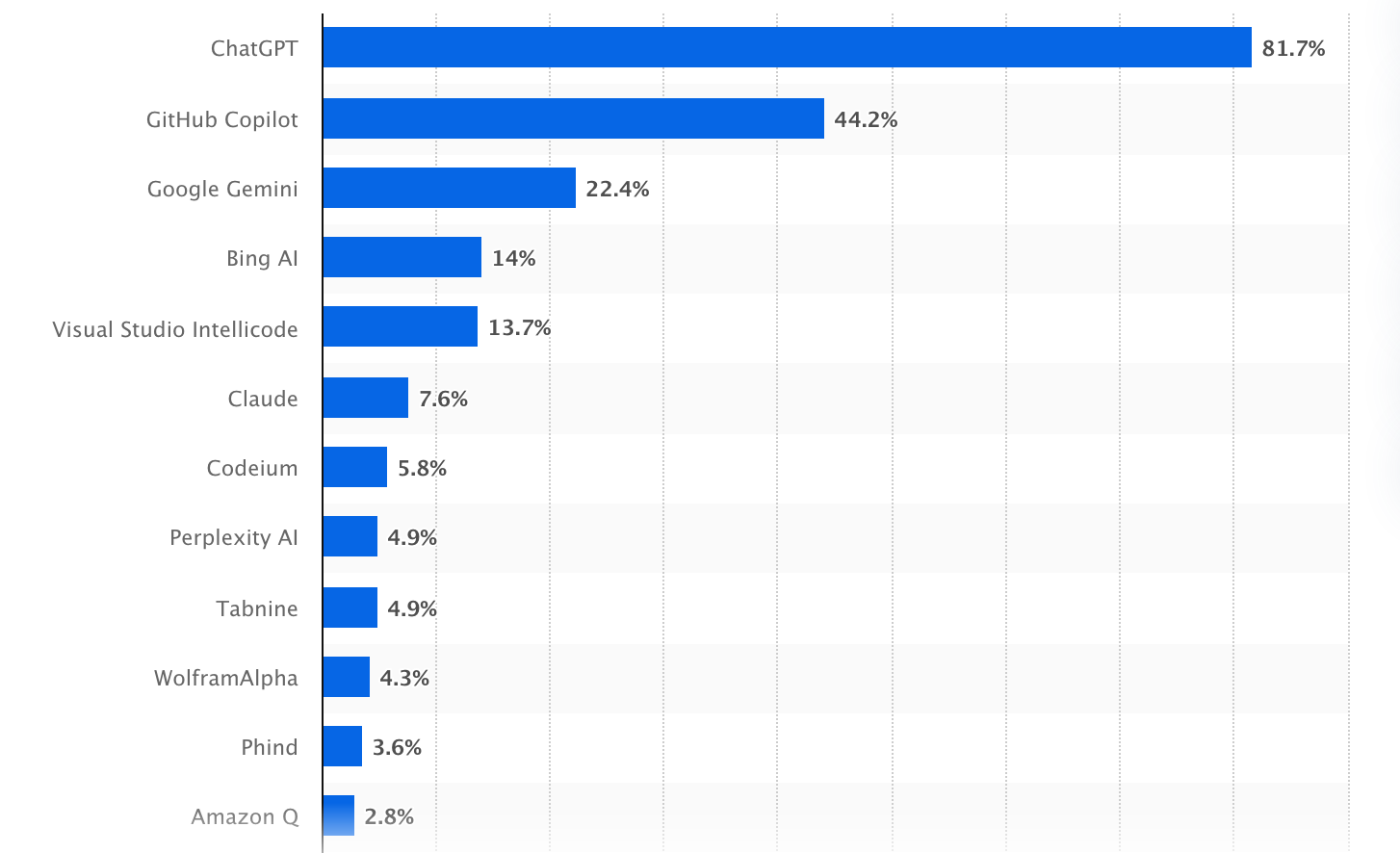
Most Popular AI Developer tools Used in Software Engineering
The “Working” vs. “Production-Ready” Disconnect
The core issue lies in how the success of a software product is measured. In early stages, “working” typically means:
- The application runs
- Center features execute without errors
- The demo scenario succeeds
The main stumbling block is that the software cannot remain at the stage of a functional prototype in case of success and must move to a production-ready system.
In production, the definition significantly changes. Systems must be reliable under continuous usage, scalable as demand grows, secure against real-world threats, maintainable over time. Vibe coding often satisfies the first definition but falls short of the second.
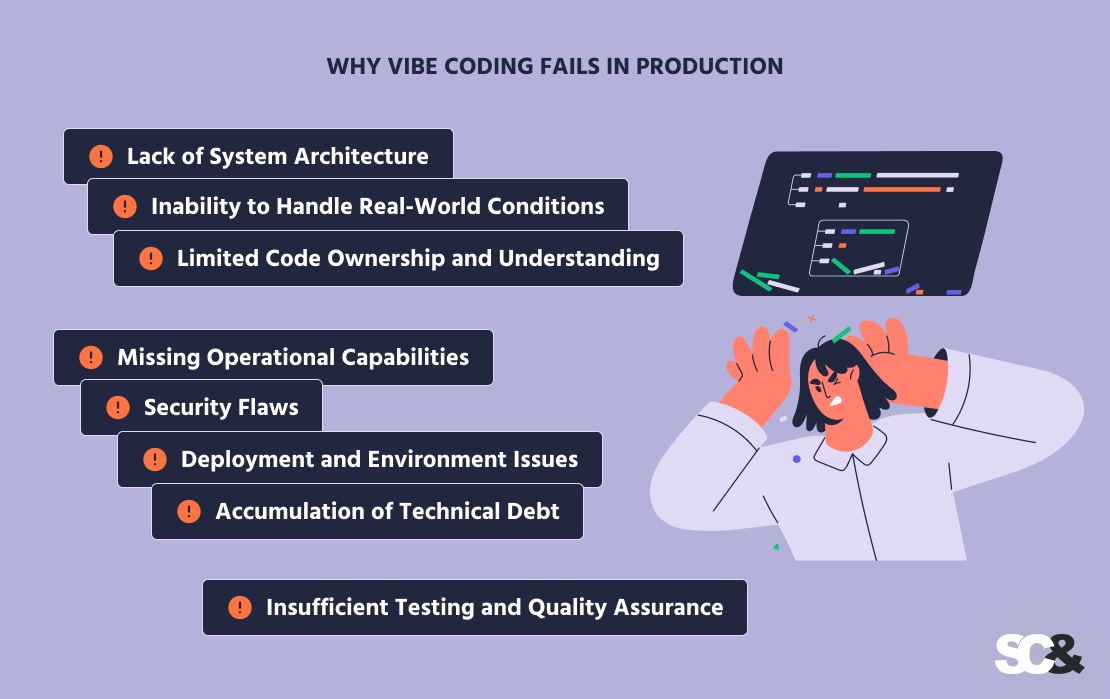
Why Vibe Coding Fails in Production
Early success typically obscures deep-seated structural flaws. Initial testing is typically conducted in controlled environments, where limited conditions fail to reflect real-world usage.
Low user load hides scalability limitations, while simplified data flows allow the system to bypass “edge cases” that, under different circumstances, would expose its fragility. At the same time, short development timelines delay the visible impact of technical debt, creating a false sense of stability.
These issues typically surface only after deployment, when the application begins interacting with real users, real data, and real operational loads. At this stage, resolving them becomes a significantly more complex, labor-intensive, and costly process.
For organizations, misjudging this gap can entail tangible business consequences. Teams may overestimate the product’s readiness and underinvest in the engineering rigor required for production-grade systems.
Moreover, the costs of rectifying errors (whether through refactoring or a complete system rebuild) can far exceed the initial savings achieved through accelerated development.
Lack of System Architecture
Vibe coding prioritizes speed and immediate functionality, often at the expense of thoughtful system design. Applications are made incrementally, driven by text prompts rather than structured planning, which results in loosely coupled components that lack a clear architectural foundation.
Though this approach may be quite adequate for prototyping, it creates substantial challenges during the operational phase, where system performance depends on the presence of a clearly defined architecture aimed at security and scale.
Limited Code Ownership and Understanding
When code is generated predominantly by artificial intelligence, teams often lack a deep understanding of how the system actually works in production environments, where debugging, extending, and maintaining the application require clarity and confidence in the codebase.
Without such understanding, even minor changes can lead to instability, increasing both risks and development timelines.
Security Flaws
In prompt-based programming, safety and security of the code is not given complete precedence. The AI-generated code is likely to meet the desired requirements in terms of functionality but does not adhere to important aspects of coding such as data validation, authentication, and safe handling of data.
The above-discussed loopholes might go undetected until the code is actually put into use, which can lead to reputational or financial losses.
Inability to Handle Real-World Conditions
Applications built using an “intuitive” approach to coding are typically developed and tested under ideal conditions, where input data is predictable, and systems behave exactly as expected.
However, production environments are inherently unpredictable. Users act inconsistently, networks fail, and dependencies break.
Without explicitly addressing such scenarios, applications that show excellent performance in controlled environments often collapse when confronted with the complexities of the real world.
Missing Operational Capabilities
Production systems require more than just functional code; they rely on an operational infrastructure that includes components such as logging, monitoring, alerting, and fault tolerance.
These elements guarantee that systems can be monitored and behave well under defined metrics, can be maintained, and restored in the event of issues. Applications built using a vibe-coding approach often lack these capabilities, making it difficult to identify and resolve problems in real time.
Deployment and Environment Issues
A common problem in applications developed using vibe coding is the disconnect between development and production environments. Code that functions correctly locally may fail after deployment due to configuration errors, missing dependencies, or infrastructure differences.
Without structured processes for deployment and environment management, these issues can delay releases and lead to instability.
Accumulation of Technical Debt
As vibe coding revolves around speed, coding is done quickly and without proper cleaning or standardization.
Therefore, the code developed through this approach might suffer from repetition and poor structuring. The longer this goes on, the less readable the code becomes, making it more difficult to make changes in future updates.
Insufficient Testing and Quality Assurance
In vibe coding workflows, software testing is often skipped or kept minimal to maintain speed. Many applications lack proper automated tests or thorough validation.
While things may seem to work at first, problems start to appear in production. Without solid testing, bugs are more common, systems are less dependable, and fixing problems becomes more time-consuming.
Human Layer in AI Development
Vibe coding does not inherently fail, but it cannot succeed in isolation. To be viable in production, it must be supported by disciplined engineering practices and follow SDLC (software development lifecycle) that bridge the gaps left by AI-generated development.
This means moving beyond intuitive code generation and introducing the fundamentals of software engineering.
Teams need to design system architecture upfront that ideally fits the requirements in terms of performance and costs, review and refine software to improve quality and maintainability, implement proper testing to validate functionality and catch issues, as well as apply security best practices to protect data and systems.
Without these elements, applications may function initially but will struggle to perform reliably under real-world conditions.
The Hybrid Approach (Best Practice)
The most effective way to use vibe coding is through a hybrid approach that combines the strengths of AI with the proficiency of experienced engineers.

In this model, artificial intelligence is used to accelerate development and generate initial implementations, while AI engineers provide the necessary oversight, structure, and judgment.
This balance ensures that code is not only produced quickly but also reviewed, refined, and coordinated with long-term functional and non-functional requirements. Ultimately, sustainable success depends on treating AI as a tool within a disciplined engineering process, rather than relying on it as a standalone solution.
For instance, a product team might use AI to rapidly build a new feature, such as a user onboarding flow, yet entrust engineers with verifying the logic, integrating it into the existing architecture, and implementing proper error handling and analytics prior to product launch.
In another scenario, a startup might create an MVP using vibe coding to validate market demand, and subsequently bring in experienced developers to refactor the codebase, implement testing, and prepare the system for scale.
Similarly, an internal tools team might rely on AI to automate routine work sequences, while engineers prove the solution adheres to security standards and integrates with corporate systems.
How SCAND Helps Turn Vibe-Coded Apps into Production-Ready Systems
Vibe-coded applications don’t have to be rebuilt from scratch to succeed in production, but they do require structured engineering intervention. This is where SCAND can help.
With extensive experience in software modernization and AI-driven development, we help organizations review, stabilize, and turn AI-built applications into production-ready systems.
Our engineers evaluate the existing codebase to uncover architectural gaps, security risks, performance problems, and areas of technical debt. From there, the team refactors AI-generated code, introduces proper system design, and implements best practices for testing, monitoring, and scalability.
A strong example of our expertise can be seen in AI FSM Platform Storm Recovery. In this project, we helped our client recover and stabilize a complex AI-driven platform, ensuring it could tolerate real-world operational demands.
The engagement involved improving system reliability, managing architectural limitations, and enabling the platform to function at its maximum in a production environment.
Conclusion: Vibe Coding Is Not Enough
Vibe coding isn’t going anywhere. Moreover, it is becoming an integral part of modern software development workflows. However, it is crucial to understand its true nature: it is merely a starting point, not the final result.
The future does not lie in AI replacing developers; rather, it belongs to those developers who know how to leverage AI, without sacrificing quality, security, or trustworthiness. This is precisely the difference between a working demo and a product built to last.
Frequently Asked Questions (FAQs)
What is vibe coding?
Vibe coding is basically building software using AI tools by describing what you want instead of writing everything from scratch. You guide the process with prompts and tweak the results until it works, rather than engineering every detail yourself.
Is vibe coding a bad practice?
Not at all. It’s incredibly useful, especially for getting ideas off the ground. The problem isn’t vibe coding itself; it’s relying on it too much in situations where you need long-term stability.
Can AI-generated code be used in production?
Yes, but not without review and refinement. AI-generated code can serve as a starting point, but it must be validated, tested, and integrated within a properly designed architecture to fulfill production standards.
Why do vibe-coded apps fail in production?
They often lack fundamental elements needed for real-world systems, such as structured architecture, proper testing, security controls, and performance optimization. These gaps may not be visible in early stages but become critical at scale.
How can you make vibe coding production-ready?
You have to treat it like a first draft. That means adding proper architecture, reviewing and cleaning up the code, running tests, and embedding security and monitoring. In other words, you still need real engineering.
When should you use vibe coding?
Vibe coding is best used for testing ideas, building MVPs, creating internal tools, and experimenting with new features, i.e., situations where speed is more important than long-term stability.
Does vibe coding replace developers?
No. If anything, developers become more important. AI can generate code, but it can’t take responsibility for how a system behaves in the real world. You still need people who understand, maintain, and improve the system over time.