
Close Menu
geekfence.comgeekfence.com
    What's Hot

    Duck Creek is entering its operating model era

    April 29, 2026

    Sparse AI Hardware Slashes Energy and Latency

    April 29, 2026

    Rogers to offer voluntary buyouts to 10,000 employees

    April 29, 2026
    Facebook X (Twitter) Instagram
    • About Us
    • Contact Us
    Facebook Instagram
    geekfence.comgeekfence.com
    • Home
    • UK Tech News
    • AI
    • Big Data
    • Cyber Security
      • Cloud Computing
      • iOS Development
    • IoT
    • Mobile
    • Software
      • Software Development
      • Software Engineering
    • Technology
      • Green Technology
      • Nanotechnology
    • Telecom
    geekfence.comgeekfence.com
    Home»Nanotechnology»The mathematics of quantum entanglement – Physics World
    Nanotechnology

    The mathematics of quantum entanglement – Physics World

    AdminBy AdminApril 3, 2026No Comments2 Mins Read4 Views
    Facebook Twitter Pinterest LinkedIn Telegram Tumblr Email
    The mathematics of quantum entanglement – Physics World
    Share
    Facebook Twitter LinkedIn Pinterest Email


    A team of researchers from Poland have developed new mathematical methods that could help enable better control of quantum entanglement and teleportation experiments
    Quantum entanglement

    Artistic representation of quantum entanglement (Credit: iStock/Jian-Fan)

    Most headline-grabbing advances in quantum mechanics today are experimental in nature: more qubits, entangled particles, fewer errors.

    Often overlooked are the advances in the mathematics that underpins the behaviour of these quantum systems.

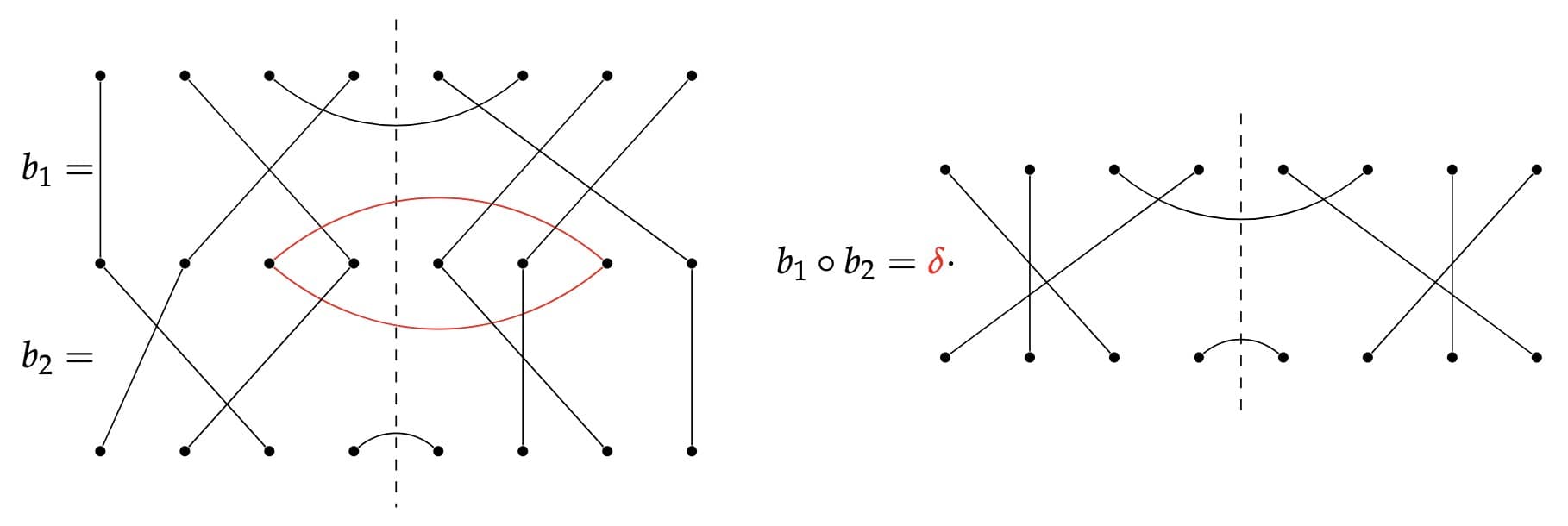
    The walled Brauer algebra is an abstract but increasingly important mathematical structure that appears in quantum information theory whenever physicists study particles, symmetries and transformations involving permutations and partial transposition.

    Work in this area inevitably leads to the question of how a system transforms when particles are permuted or when one part of a composite object is flipped (transposed) while the rest is left untouched. Collect all such operations together and you get the walled Brauer algebra. It plays an important role in the mathematical description of problems ranging from entanglement detection to advanced teleportation schemes.
    Brauer Algebra
    The walled Brauer algebra (Credit: M. Horodecki, M. Studziński and M. Mozrzymas)

    The problem is that this algebra is famously intricate. Until now, physicists have only been able to describe its structure using methods that do not fully align with the natural symmetries of the system, making calculations heavy and sometimes opaque.

    The new work changes that. The authors have developed an iterative construction that builds the algebra piece by piece, revealing its architecture in a symmetry-compatible way. Instead of a tangled hierarchy, the algebra unfolds into independent components, each shaped by the action of two symmetric groups.

    The result is not just a more elegant mathematical picture; it is also a new framework that can make symmetry-based analysis of complex quantum-information problems more systematic and transparent.

    This matters now more than ever. Quantum technologies increasingly involve many-particle configurations where symmetry is both a feature and a challenge. Teleportation schemes that move quantum information without moving particles, algorithms that manipulate unknown quantum operations, and proposals for higher-order quantum processes all rely on understanding how transformations behave under symmetry.

    By clarifying this structure, the new framework could help researchers analyse these settings more effectively and support the development of better-controlled entanglement- and teleportation-based protocols.


    Source link

    Share. Facebook Twitter Pinterest LinkedIn Tumblr Email

    Related Posts

    Tuning Electron Transfer for Advanced Batteries and Sensors

    April 29, 2026

    Scientists just captured a mysterious quantum “dance” inside superconductors

    April 28, 2026

    In vivo self-assembly: A transformative strategy for intelligent cancer nanomedicine

    April 26, 2026

    Interfacial polarity modulation of positive electrode active materials for high-potential lithium metal batteries

    April 25, 2026

    Professional Development and Training Opportunities for Teachers

    April 24, 2026

    Long range attraction between like charged particles – Physics World

    April 23, 2026
    Top Posts

    Understanding U-Net Architecture in Deep Learning

    November 25, 202533 Views

    Hard-braking events as indicators of road segment crash risk

    January 14, 202626 Views

    Redefining AI efficiency with extreme compression

    March 25, 202625 Views
    Don't Miss

    Duck Creek is entering its operating model era

    April 29, 2026

    Many Duck Creek programs are discovering that the hardest part in modernization begins after go-live.…

    Sparse AI Hardware Slashes Energy and Latency

    April 29, 2026

    Rogers to offer voluntary buyouts to 10,000 employees

    April 29, 2026

    Evolving image recognition with Geometric Deep Learning

    April 29, 2026
    Stay In Touch
    • Facebook
    • Instagram
    About Us

    At GeekFence, we are a team of tech-enthusiasts, industry watchers and content creators who believe that technology isn’t just about gadgets—it’s about how innovation transforms our lives, work and society. We’ve come together to build a place where readers, thinkers and industry insiders can converge to explore what’s next in tech.

    Our Picks

    Duck Creek is entering its operating model era

    April 29, 2026

    Sparse AI Hardware Slashes Energy and Latency

    April 29, 2026

    Subscribe to Updates

    Please enable JavaScript in your browser to complete this form.
    Loading
    • About Us
    • Contact Us
    • Disclaimer
    • Privacy Policy
    • Terms and Conditions
    © 2026 Geekfence.All Rigt Reserved.

    Type above and press Enter to search. Press Esc to cancel.