
Close Menu
geekfence.comgeekfence.com
    What's Hot

    Android 17 QPR1 Beta 3 New Features & Changes

    May 24, 2026

    The Download: coding’s future, the ‘Steroid Olympics,’ and AI-driven science

    May 24, 2026

    AION consortium set to build French AI Gigafactory

    May 24, 2026
    Facebook X (Twitter) Instagram
    • About Us
    • Contact Us
    Facebook Instagram
    geekfence.comgeekfence.com
    • Home
    • UK Tech News
    • AI
    • Big Data
    • Cyber Security
      • Cloud Computing
      • iOS Development
    • IoT
    • Mobile
    • Software
      • Software Development
      • Software Engineering
    • Technology
      • Green Technology
      • Nanotechnology
    • Telecom
    geekfence.comgeekfence.com
    Home»Nanotechnology»Flying focus wakefields open a new acceleration regime – Physics World
    Nanotechnology

    Flying focus wakefields open a new acceleration regime – Physics World

    AdminBy AdminMay 24, 2026No Comments2 Mins Read2 Views
    Facebook Twitter Pinterest LinkedIn Telegram Tumblr Email
    Flying focus wakefields open a new acceleration regime – Physics World
    Share
    Facebook Twitter LinkedIn Pinterest Email


    Physicists have directly imaged a novel laser-driven plasma wakefield, taking a large step towards compact, ultra high energy particle accelerators
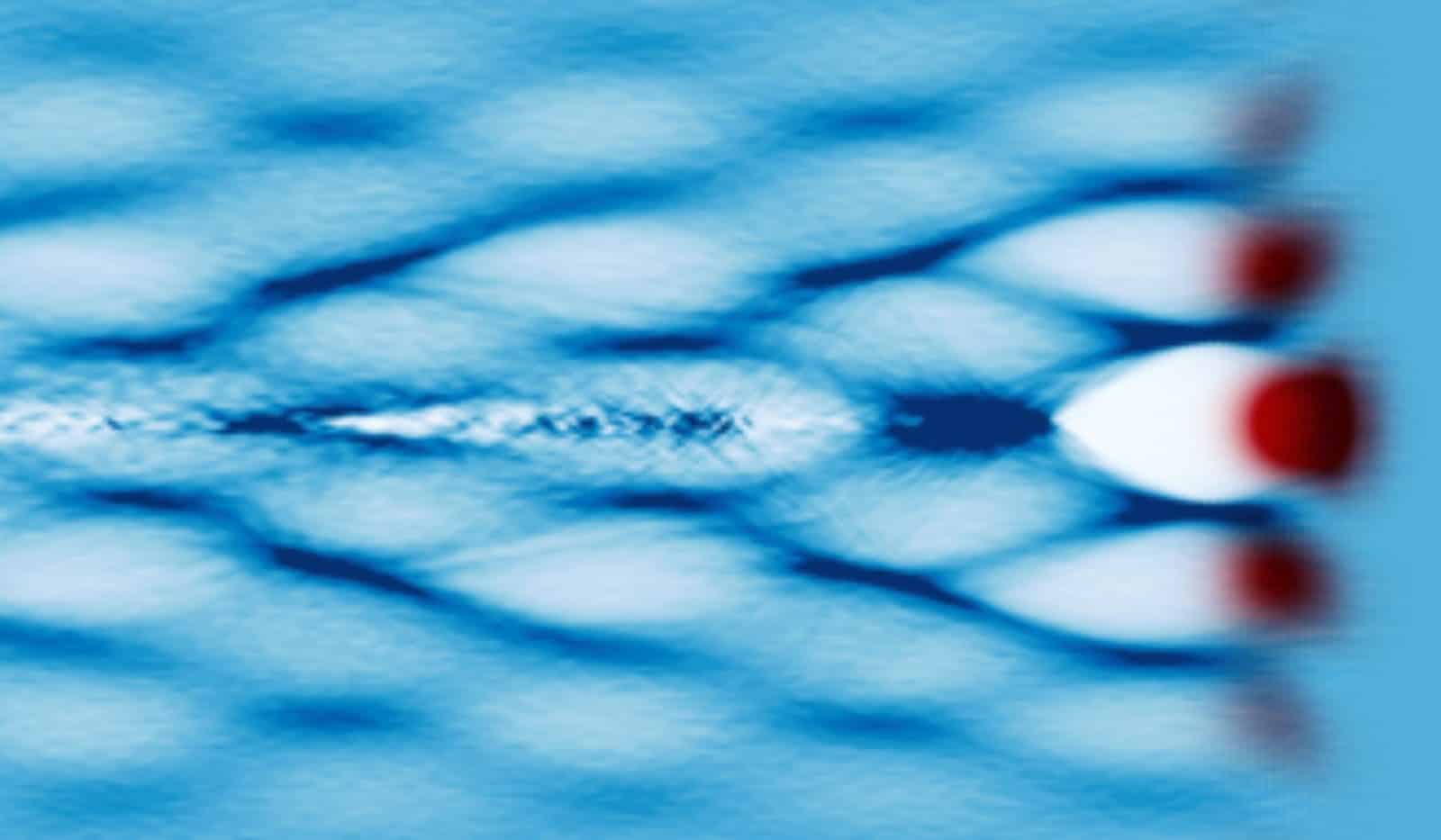
    Flying-Focus Wakefields

    A map of the electron density in the flying focus setup – linked to the acceleration gradient of the plasma wakefield (Credit: A. Liberman).

    Conventional particle accelerators use radio frequency cavities to push particles to high energies, but these machines are vast and expensive. Laser wakefield accelerators (LWFAs) offer a radically different approach. When an intense laser pulse travels through a plasma, it drives a rippling disturbance called a wakefield. Electrons can be trapped in this plasma wave and surf along it, being boosted to very high energies over just centimetres.

    However, these electrons tend to outrun the plasma wave that accelerates them, a limitation known as dephasing. One proposed way around this problem is the flying focus: a laser pulse engineered so that its point of highest intensity moves along the propagation axis at a controllable velocity. By matching this velocity to that of the electrons, the plasma wakefield could, in principle, remain phase locked to the particles, enabling sustained acceleration. While the flying focus concept has been theoretically developed and experimentally demonstrated in principle in recent years, the detailed structure and behaviour of the resulting wakefields has not yet been optimised for applications.

    In a new study, a team of researchers from the Weizmann Institute of Science probed these wakefields directly, combining high resolution experiments with advanced simulations. Using femtosecond relativistic electron microscopy, the team sent a separate electron beam through the flying focus wakefield, allowing them to image its electromagnetic structure with micrometre spatial resolution and femtosecond timing.

    The results reveal that flying focus wakefields are stable but highly structured, blending linear and nonlinear features and extending off axis in ways not seen in conventional laser driven wakefields. The study also shows that factors such as plasma density, composition and ionisation dynamics can significantly reshape the wake. These effects must be carefully modelled and controlled if the scheme is to deliver on its promise.

    By opening a direct experimental window onto flying focus wakefields, the work provides the crucial insight needed to turn a compelling idea into a practical technology.


    Source link

    Share. Facebook Twitter Pinterest LinkedIn Tumblr Email

    Related Posts

    Automation-Driven Software for Reproducible Mechanical Testing Across Nano to Macro Scales

    May 23, 2026

    Ancient chemistry trick unlocks new type of glass that traps CO2 and hydrogen

    May 22, 2026

    Room-temperature hydrogen storage of boron nanoclusters

    May 20, 2026

    Reports & Resources – National Nanotechnology Coordination Office (NNCO)

    May 19, 2026

    what technique may be able to create super-high laser intensities? – Physics World

    May 18, 2026

    How Nanoparticles Could Help Immunotherapy Turn Cold Tumors Hot

    May 17, 2026
    Top Posts

    Understanding U-Net Architecture in Deep Learning

    November 25, 202546 Views

    Hard-braking events as indicators of road segment crash risk

    January 14, 202629 Views

    Redefining AI efficiency with extreme compression

    March 25, 202627 Views
    Don't Miss

    Android 17 QPR1 Beta 3 New Features & Changes

    May 24, 2026

    Summary created by Smart Answers AIIn summary:Tech Advisor reports that Google released Android 17 QPR1…

    The Download: coding’s future, the ‘Steroid Olympics,’ and AI-driven science

    May 24, 2026

    AION consortium set to build French AI Gigafactory

    May 24, 2026

    Building Context-Aware Search in Python with LLM Embeddings + Metadata

    May 24, 2026
    Stay In Touch
    • Facebook
    • Instagram
    About Us

    At GeekFence, we are a team of tech-enthusiasts, industry watchers and content creators who believe that technology isn’t just about gadgets—it’s about how innovation transforms our lives, work and society. We’ve come together to build a place where readers, thinkers and industry insiders can converge to explore what’s next in tech.

    Our Picks

    Android 17 QPR1 Beta 3 New Features & Changes

    May 24, 2026

    The Download: coding’s future, the ‘Steroid Olympics,’ and AI-driven science

    May 24, 2026

    Subscribe to Updates

    Please enable JavaScript in your browser to complete this form.
    Loading
    • About Us
    • Contact Us
    • Disclaimer
    • Privacy Policy
    • Terms and Conditions
    © 2026 Geekfence.All Rigt Reserved.

    Type above and press Enter to search. Press Esc to cancel.