
Close Menu
geekfence.comgeekfence.com
    What's Hot

    Wealth management outlook for 2026: trends and sourcing implications 

    February 9, 2026

    T-Mobile US’ switching strategy lands in court again

    February 9, 2026

    Scientists create smart synthetic skin that can hide images and change shape

    February 9, 2026
    Facebook X (Twitter) Instagram
    • About Us
    • Contact Us
    Facebook Instagram
    geekfence.comgeekfence.com
    • Home
    • UK Tech News
    • AI
    • Big Data
    • Cyber Security
      • Cloud Computing
      • iOS Development
    • IoT
    • Mobile
    • Software
      • Software Development
      • Software Engineering
    • Technology
      • Green Technology
      • Nanotechnology
    • Telecom
    geekfence.comgeekfence.com
    Home»Nanotechnology»Surface-enhanced thermal dissipation in 3D vertical resistive memory arrays with top selector transistors
    Nanotechnology

    Surface-enhanced thermal dissipation in 3D vertical resistive memory arrays with top selector transistors

    AdminBy AdminJanuary 23, 2026No Comments2 Mins Read4 Views
    Facebook Twitter Pinterest LinkedIn Telegram Tumblr Email
    Surface-enhanced thermal dissipation in 3D vertical resistive memory arrays with top selector transistors
    Share
    Facebook Twitter LinkedIn Pinterest Email


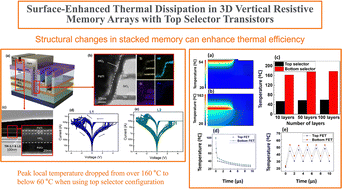
    Recent integration of 3D memory technologies such as high-bandwidth memory [HBM] into AI accelerators has enhanced neural network performance. However, the stacked structures of 3D memories result in notable heat accumulation because lateral interfaces obstruct vertical heat dissipation, thereby hindering effective cooling. An effective approach to mitigating energy consumption involves the utilization of nonvolatile memory technologies, such as resistive random-access memory (RRAM). Integration of selector transistors with RRAM devices mitigates sneak path leakage, increases nonlinearity, and improves the reliability of vertically stacked arrays. Nevertheless, executing core AI tasks—such as vector-matrix multiplication in neuromorphic computing—requires substantial current flow through these transistors, which in turn leads to heat generation, reduced power efficiency, and potential computational errors. Additionally, densely stacked layers create hotspots and restrict access to cooling interfaces. This study presents a comparative analysis of models with various selector transistor configurations, based on power parameters from microfabricated 3D RRAM structures. The results indicate that optimally positioning the selector transistor at the memory interface can reduce nanoscale heat accumulation by up to 11%, as verified through finite-element simulations and numerical calculations. Improved thermal management reduced peak local temperatures from over 160 °C to below 60 °C within 20 nanoseconds in configurations featuring 10 to 100 stacked layers.

    Graphical abstract: Surface-enhanced thermal dissipation in 3D vertical resistive memory arrays with top selector transistors


    This article is Open Access


    Piezotronic-probe modulates piezoelectric-electric-thermal coupling field in GaN power electronics
    Please wait while we load your content…


    Something went wrong. Try again?


    Source link

    Share. Facebook Twitter Pinterest LinkedIn Tumblr Email

    Related Posts

    Molecularly imprinted nanoreactors: Bridging enzyme mimicry and synthetic catalysis

    February 9, 2026

    Tandem architectures for electrochemical CO2 reduction: from coupled atomic sites to tandem electrolysers

    February 8, 2026

    Quantum states that won’t entangle – Physics World

    February 7, 2026

    Nanotoxicology Advances to Integrated Safety Frameworks

    February 6, 2026

    A tiny light trap could unlock million qubit quantum computers

    February 5, 2026

    Piezotronic-probe modulates piezoelectric-electric-thermal coupling field in GaN power electronics

    February 4, 2026
    Top Posts

    Hard-braking events as indicators of road segment crash risk

    January 14, 202617 Views

    Understanding U-Net Architecture in Deep Learning

    November 25, 202512 Views

    Achieving superior intent extraction through decomposition

    January 25, 20268 Views
    Don't Miss

    Wealth management outlook for 2026: trends and sourcing implications 

    February 9, 2026

    Global wealth management is entering a defining phase in 2025-2026 as firms scale their businesses…

    T-Mobile US’ switching strategy lands in court again

    February 9, 2026

    Scientists create smart synthetic skin that can hide images and change shape

    February 9, 2026

    AI Shows How Payment Delays Disrupt Your Business

    February 9, 2026
    Stay In Touch
    • Facebook
    • Instagram
    About Us

    At GeekFence, we are a team of tech-enthusiasts, industry watchers and content creators who believe that technology isn’t just about gadgets—it’s about how innovation transforms our lives, work and society. We’ve come together to build a place where readers, thinkers and industry insiders can converge to explore what’s next in tech.

    Our Picks

    Wealth management outlook for 2026: trends and sourcing implications 

    February 9, 2026

    T-Mobile US’ switching strategy lands in court again

    February 9, 2026

    Subscribe to Updates

    Please enable JavaScript in your browser to complete this form.
    Loading
    • About Us
    • Contact Us
    • Disclaimer
    • Privacy Policy
    • Terms and Conditions
    © 2026 Geekfence.All Rigt Reserved.

    Type above and press Enter to search. Press Esc to cancel.