

Close Menu
geekfence.comgeekfence.com
    What's Hot

    AI Code Review Only Catches Half of Your Bugs – O’Reilly

    April 30, 2026

    Belden to acquire RUCKUS Networks for $1.85bn

    April 30, 2026

    Is Refusing to Adopt AI Tools at Work Damaging Your Career Growth?

    April 30, 2026
    Facebook X (Twitter) Instagram
    • About Us
    • Contact Us
    Facebook Instagram
    geekfence.comgeekfence.com
    • Home
    • UK Tech News
    • AI
    • Big Data
    • Cyber Security
      • Cloud Computing
      • iOS Development
    • IoT
    • Mobile
    • Software
      • Software Development
      • Software Engineering
    • Technology
      • Green Technology
      • Nanotechnology
    • Telecom
    geekfence.comgeekfence.com
    Home»Nanotechnology»Strain engineered single crystal silver films – Physics World
    Nanotechnology

    Strain engineered single crystal silver films – Physics World

    AdminBy AdminApril 30, 2026No Comments3 Mins Read0 Views
    Facebook Twitter Pinterest LinkedIn Telegram Tumblr Email
    Strain engineered single crystal silver films – Physics World
    Share
    Facebook Twitter LinkedIn Pinterest Email


    A new epitaxial mechanism enables ultra-high quality Ag films on Cu substrates

    Shapes

    Shapes (Courtesy: Shutterstock/Olga Korneeva)

    It is straightforward to produce polycrystalline metal films on wafers but producing single‑crystal metal films is far more challenging. Because single crystals have no grain boundaries (the joints between differently oriented crystal regions in polycrystalline materials), they offer much better electrical performance: higher conductivity, lower resistive losses, improved high‑frequency behaviour (important for high‑speed communication and 5G), and reduced noise for quantum technologies. As a result, methods for reliably producing single‑crystal films are highly sought after. 

    Single‑crystal silver and copper films are particularly valuable. Silver is an exceptional conductor of both electricity and light, while copper provides excellent thermal management and reduces resistive heating. However, growing silver on copper is notoriously difficult because the two materials have a large lattice mismatch (13%), which normally introduces strain, defects, dislocations, and rough, low‑quality films. This makes conventional epitaxy essentially impossible. 
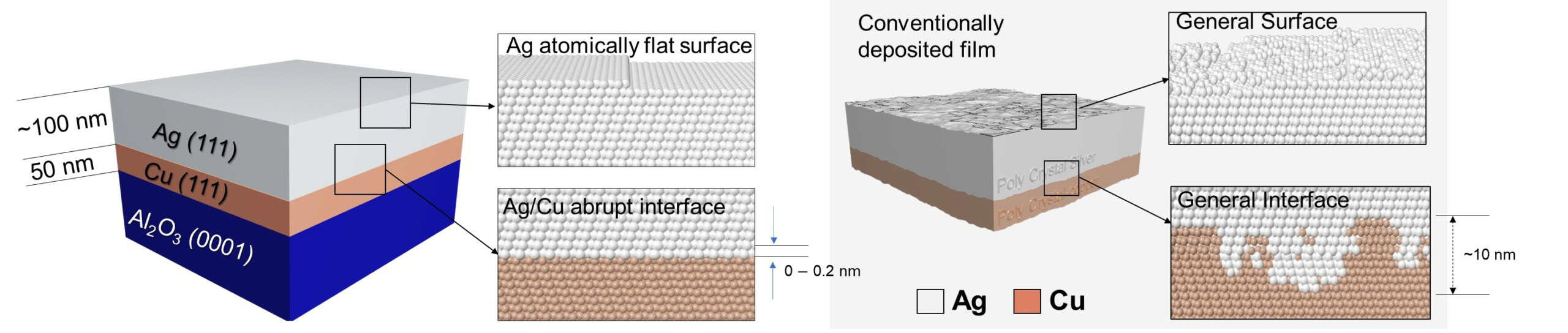
    Schematics of a heteroepitaxial Ag film on a Cu buffer layer/Al2O3 substrate (left) and a rough surface and thick (or mixed) interface of a conventionally deposited Ag thin film (right)
    Schematics of a heteroepitaxial Ag film on a Cu buffer layer/Al2O3 substrate (left) and a rough surface and thick (or mixed) interface of a conventionally deposited Ag thin film (right), from figure 1 in article (Courtesy: Su Jae Kim et al 2026 Rep. Prog. Phys. 89 028002)

    In this work, the researchers overcame this barrier using Atomic Sputtering Epitaxy, which allows precise atomic deposition, combined with post‑annealing to reduce twin boundaries. They discovered that the mismatch strain is absorbed entirely within the first atomic layer of silver. This occurs because the atoms at the interface shift sideways in a periodic, controlled pattern that releases the strain. This represents a new form of heteroepitaxy in which two materials with different lattice periodicities can still grow together seamlessly. 

    They demonstrated wafer‑scale, defect‑free single‑crystal silver films on copper despite the huge lattice mismatch, enabling ultra‑high quality metal films for advanced optical and electronic technologies. This approach opens the door to new heteroepitaxial systems and provides a route to producing silver films with exceptional optical and electronic performance. 

    “What we find most notable is that a 13% lattice mismatch, which would normally prevent clean heteroepitaxy, is absorbed almost entirely within the first monoatomic Ag layer at the Ag/Cu interface, allowing the film above to grow as if on its own native lattice and yielding wafer-scale, grain-boundary-free films with atomically flat surfaces. We hope this concept of a strain-absorbing monolayer interface can be extended to other dissimilar metal pairs.” – Professor Young-Min Kim, Sungkyunkwan University

    Do you want to learn more about this topic?

    Si/Ge nanostructures by Karl Brunner (2001)


    Source link

    Share. Facebook Twitter Pinterest LinkedIn Tumblr Email

    Related Posts

    Tuning Electron Transfer for Advanced Batteries and Sensors

    April 29, 2026

    Scientists just captured a mysterious quantum “dance” inside superconductors

    April 28, 2026

    In vivo self-assembly: A transformative strategy for intelligent cancer nanomedicine

    April 26, 2026

    Interfacial polarity modulation of positive electrode active materials for high-potential lithium metal batteries

    April 25, 2026

    Professional Development and Training Opportunities for Teachers

    April 24, 2026

    Long range attraction between like charged particles – Physics World

    April 23, 2026
    Top Posts

    Understanding U-Net Architecture in Deep Learning

    November 25, 202533 Views

    Hard-braking events as indicators of road segment crash risk

    January 14, 202626 Views

    Redefining AI efficiency with extreme compression

    March 25, 202625 Views
    Don't Miss

    AI Code Review Only Catches Half of Your Bugs – O’Reilly

    April 30, 2026

    This is the fifth article in a series on agentic engineering and AI-driven development. Read part…

    Belden to acquire RUCKUS Networks for $1.85bn

    April 30, 2026

    Is Refusing to Adopt AI Tools at Work Damaging Your Career Growth?

    April 30, 2026

    Unified observability in Amazon OpenSearch Service: metrics, traces, and AI agent debugging in a single interface

    April 30, 2026
    Stay In Touch
    • Facebook
    • Instagram
    About Us

    At GeekFence, we are a team of tech-enthusiasts, industry watchers and content creators who believe that technology isn’t just about gadgets—it’s about how innovation transforms our lives, work and society. We’ve come together to build a place where readers, thinkers and industry insiders can converge to explore what’s next in tech.

    Our Picks

    AI Code Review Only Catches Half of Your Bugs – O’Reilly

    April 30, 2026

    Belden to acquire RUCKUS Networks for $1.85bn

    April 30, 2026

    Subscribe to Updates

    Please enable JavaScript in your browser to complete this form.
    Loading
    • About Us
    • Contact Us
    • Disclaimer
    • Privacy Policy
    • Terms and Conditions
    © 2026 Geekfence.All Rigt Reserved.

    Type above and press Enter to search. Press Esc to cancel.