
Close Menu
geekfence.comgeekfence.com
    What's Hot

    Ana Inês Inácio: TNO Researcher Advancing Wireless Tech

    May 9, 2026

    Telenor launches sovereign cloud venture in Norway

    May 9, 2026

    Posit AI Blog: AO, NAO, ENSO: A wavelet analysis example

    May 9, 2026
    Facebook X (Twitter) Instagram
    • About Us
    • Contact Us
    Facebook Instagram
    geekfence.comgeekfence.com
    • Home
    • UK Tech News
    • AI
    • Big Data
    • Cyber Security
      • Cloud Computing
      • iOS Development
    • IoT
    • Mobile
    • Software
      • Software Development
      • Software Engineering
    • Technology
      • Green Technology
      • Nanotechnology
    • Telecom
    geekfence.comgeekfence.com
    Home»Nanotechnology»Quantum states that won’t entangle – Physics World
    Nanotechnology

    Quantum states that won’t entangle – Physics World

    AdminBy AdminFebruary 7, 2026No Comments3 Mins Read1 Views
    Facebook Twitter Pinterest LinkedIn Telegram Tumblr Email
    Quantum states that won’t entangle – Physics World
    Share
    Facebook Twitter LinkedIn Pinterest Email


    New research has emerged, showing when quantum systems are absolutely separable and fundamentally non-entangled
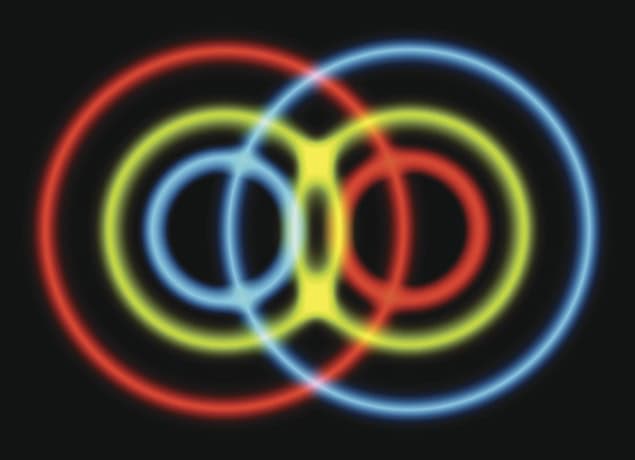
    Quantum entanglement

    An artistic depiction of quantum entanglement (Courtesy: istock/traffic-analyzer)

    Quantum entanglement is a uniquely quantum link between particles that makes their properties inseparable. It underlies the power of many quantum technologies from secure communication to quantum computing, by enabling correlations impossible in classical physics.

    Entanglement nevertheless remains poorly understood and is therefore the subject of a lot of research, both in the fields of quantum technologies as well as fundamental physics.

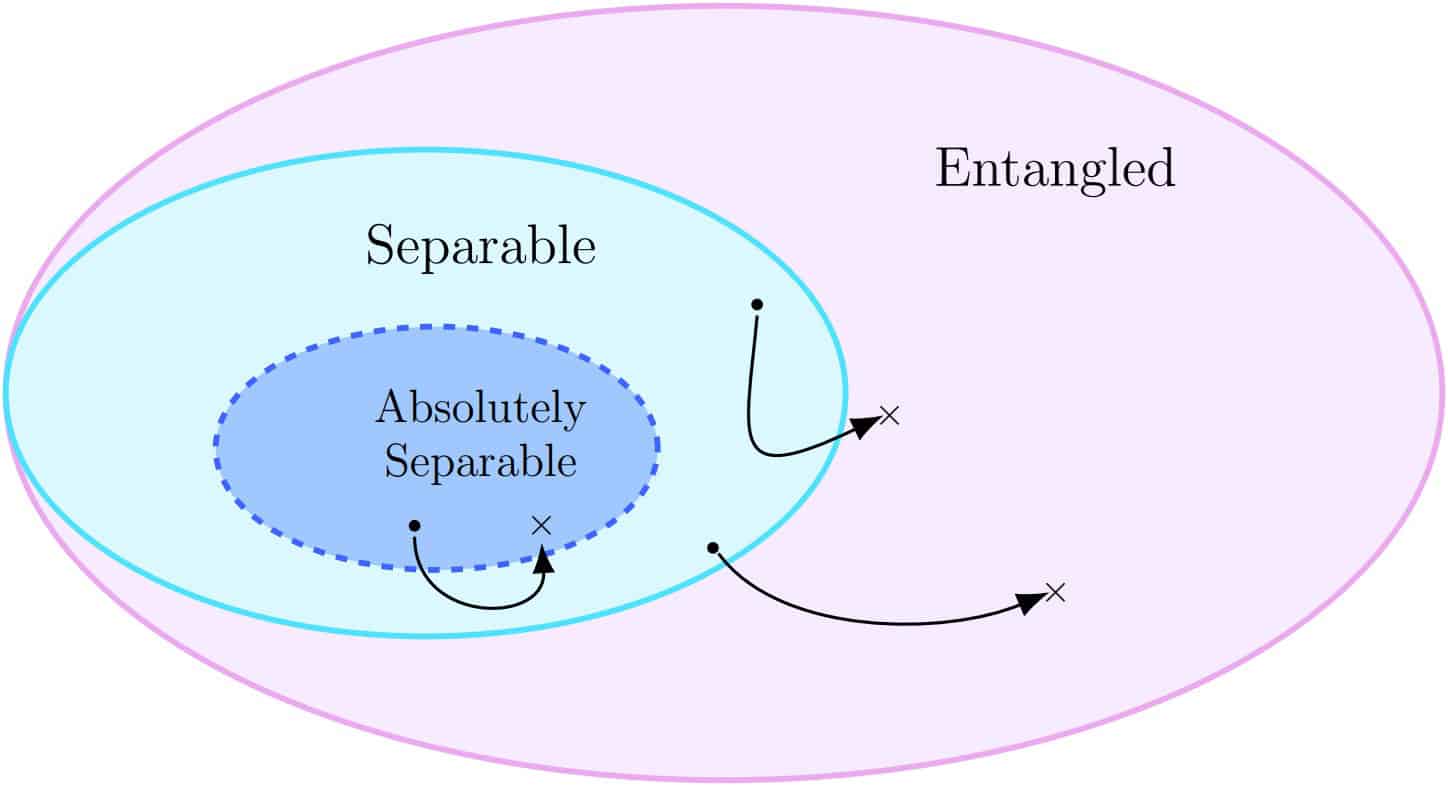
    In this context, the idea of separability refers to a composite system that can be written as a simple product (or mixture of products) of the states of its individual parts. This implies there is no entanglement between them and to create entanglement, a global transformation is needed.

    A system that remains completely free of entanglement, even after any possible global invertible transformation is applied, is called absolutely separable.  In other words, it can never become entangled under the action of quantum gates.
    Absolutely separable
    Separable, Absolutely Separable and Entangled sets: It is impossible to make absolutely separable states entangled with a global transformation (Courtesy J. Abellanet Vidal and A. Sanpera Trigueros)

    Necessary and sufficient conditions to ensure separability exist only in the simplest cases or for highly restricted families of states. In fact, entanglement verification and quantification is known to be generically an NP-hard problem.

    Recent research published by a team of researchers from Spain and Poland has tackled this problem head-on. By introducing new analytical tools such as linear maps and their inverses, they were able to identify when a quantum state is guaranteed to be absolutely separable.

    These tools work in any number of dimensions and allow the authors to pinpoint specific states that are on the border of being absolutely separable or not (mathematically speaking, ones that lie on the boundary of the set). They also show how different criteria for absolute separability, which may not always agree with each other, can be combined and refined using convex geometry optimisation.

    Being able to more easily and accurately determine whether a quantum state is absolutely separable will be invaluable in quantum computation and communication.

    The team’s results for multipartite systems (systems with more than two parts) also reveal how little we currently understand about the entanglement properties of mixed, noisy states. This knowledge gap suggests that much more research is needed in this area.


    Source link

    Share. Facebook Twitter Pinterest LinkedIn Tumblr Email

    Related Posts

    Self-adhesive high-entropy oxide sub-nanowire monolithic electrocatalysts

    May 8, 2026

    National Nanotechnology Day 2025 Activities

    May 7, 2026

    How polarons travel through TiO₂ – Physics World

    May 6, 2026

    Hamamatsu Photonics Expands Intended Use of NanoZoomer® MD Series in Europe to Include Cytology

    May 5, 2026

    MIT scientists finally reveal the hidden structure of a mysterious high-tech material

    May 4, 2026

    Programmable artificial RNA condensates in mammalian cells

    May 2, 2026
    Top Posts

    Understanding U-Net Architecture in Deep Learning

    November 25, 202539 Views

    Hard-braking events as indicators of road segment crash risk

    January 14, 202627 Views

    Redefining AI efficiency with extreme compression

    March 25, 202626 Views
    Don't Miss

    Ana Inês Inácio: TNO Researcher Advancing Wireless Tech

    May 9, 2026

    When Ana Inês Inácio goes to work at the Netherlands Organization for Applied Scientific Research…

    Telenor launches sovereign cloud venture in Norway

    May 9, 2026

    Posit AI Blog: AO, NAO, ENSO: A wavelet analysis example

    May 9, 2026

    Why Moving Your CCM to the Cloud Can’t Wait

    May 9, 2026
    Stay In Touch
    • Facebook
    • Instagram
    About Us

    At GeekFence, we are a team of tech-enthusiasts, industry watchers and content creators who believe that technology isn’t just about gadgets—it’s about how innovation transforms our lives, work and society. We’ve come together to build a place where readers, thinkers and industry insiders can converge to explore what’s next in tech.

    Our Picks

    Ana Inês Inácio: TNO Researcher Advancing Wireless Tech

    May 9, 2026

    Telenor launches sovereign cloud venture in Norway

    May 9, 2026

    Subscribe to Updates

    Please enable JavaScript in your browser to complete this form.
    Loading
    • About Us
    • Contact Us
    • Disclaimer
    • Privacy Policy
    • Terms and Conditions
    © 2026 Geekfence.All Rigt Reserved.

    Type above and press Enter to search. Press Esc to cancel.