
Close Menu
geekfence.comgeekfence.com
    What's Hot

    Oppo Find X9s Gets Global Launch Alongside Ultra

    April 18, 2026

    The Best Smart Home Accessories to Boost Your Curb Appeal (2026)

    April 18, 2026

    How Yeastar Simplifies Self-hosted UCaaS for Service Providers

    April 18, 2026
    Facebook X (Twitter) Instagram
    • About Us
    • Contact Us
    Facebook Instagram
    geekfence.comgeekfence.com
    • Home
    • UK Tech News
    • AI
    • Big Data
    • Cyber Security
      • Cloud Computing
      • iOS Development
    • IoT
    • Mobile
    • Software
      • Software Development
      • Software Engineering
    • Technology
      • Green Technology
      • Nanotechnology
    • Telecom
    geekfence.comgeekfence.com
    Home»Nanotechnology»AI discovers the hidden signal of liquid-like ion flow in solid-state batteries
    Nanotechnology

    AI discovers the hidden signal of liquid-like ion flow in solid-state batteries

    AdminBy AdminMarch 8, 2026No Comments3 Mins Read4 Views
    Facebook Twitter Pinterest LinkedIn Telegram Tumblr Email
    AI discovers the hidden signal of liquid-like ion flow in solid-state batteries
    Share
    Facebook Twitter LinkedIn Pinterest Email


    All-solid-state batteries (ASSB) are widely viewed as a safer and potentially more energy-dense alternative to traditional lithium-ion batteries. Their performance depends strongly on how quickly ions can travel through solid electrolytes. Identifying materials that enable this rapid ion movement has traditionally required time-consuming synthesis and experimental characterization. Researchers also rely on computer simulations, but existing computational approaches often struggle to accurately model the complex and disordered behavior of ions at high temperatures.

    Another major difficulty is detecting and predicting when ions move through crystals in a liquid-like manner. Standard computational techniques that attempt to calculate the properties of such dynamically disordered systems demand extremely high computing power, making large-scale studies impractical.

    Machine Learning Predicts Raman Signals of Liquid-Like Ion Motion

    To address these challenges, researchers developed a machine learning (ML) accelerated workflow that combines ML force fields with tensorial ML models to simulate Raman spectra. Their findings show that strong low-frequency Raman intensity can act as a clear spectroscopic indicator of liquid-like ionic conduction.

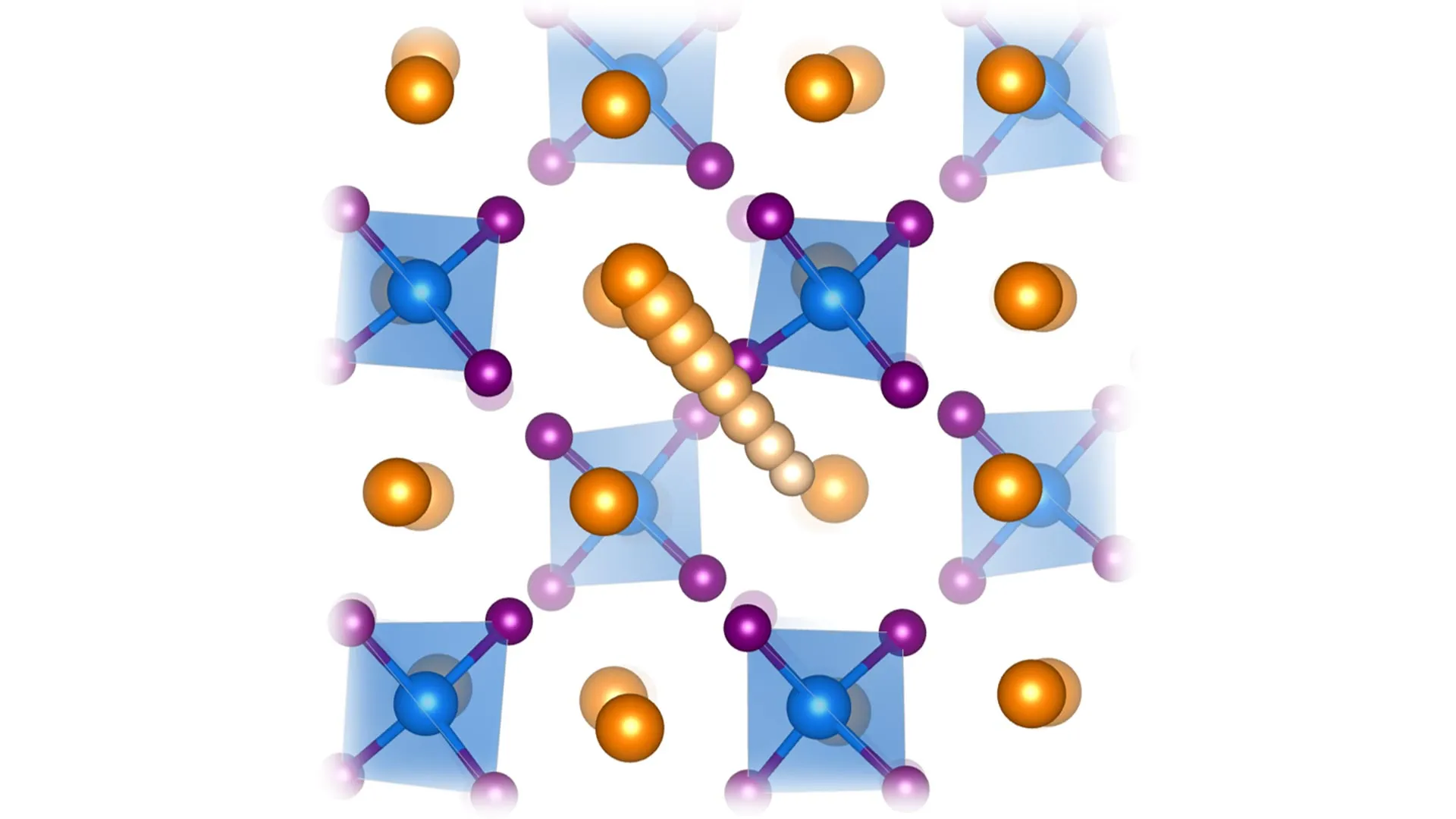
    When ions move through a crystal lattice in a fluid-like way, their motion temporarily disturbs the lattice symmetry. This disturbance relaxes the usual Raman selection rules and produces distinctive low-frequency Raman scattering. These spectral signals can be directly connected to high ionic mobility.

    The new approach allows scientists to simulate the vibrational spectra of complex and disordered materials at realistic temperatures with near-ab initio accuracy while significantly reducing computational cost. When applied to sodium-ion conducting materials such as Na3SbS4, the method revealed pronounced low-frequency Raman features. These signals arise from symmetry breaking caused by rapid ion transport and provide a reliable indicator of fast ionic conduction. The results also help explain earlier experimental observations and open the door to high-throughput screening for new superionic materials.

    Raman Features Reveal Superionic Conductors

    The researchers further tested the method using sodium-ion conducting systems. The workflow successfully identified Raman signatures linked to liquid-like ion motion. Materials that displayed strong low-frequency Raman features also showed high ionic diffusivity and dynamic relaxation of the host lattice.

    By contrast, materials where ion transport occurs mainly through hopping between fixed positions did not produce these Raman signatures. This distinction highlights how Raman signals can reveal the underlying transport mechanism inside a material.

    Accelerating Discovery of Advanced Battery Materials

    By extending the breakdown of Raman selection rules beyond traditional superionic systems, the study provides a broader framework for interpreting diffusive Raman scattering across many classes of materials. The ML-accelerated Raman pipeline connects atomistic simulations with experimental measurements, allowing scientists to evaluate candidate materials more efficiently.

    This strategy introduces a powerful new route for data-driven discovery in energy storage research. By helping researchers quickly identify fast-ion conductors, the method could accelerate the development of high-performance solid-state battery technologies.

    The findings were recently published in the online edition of AI for Science, an international journal focused on interdisciplinary artificial intelligence research.


    Source link

    Share. Facebook Twitter Pinterest LinkedIn Tumblr Email

    Related Posts

    Enhancing antitumour nanovaccine efficacy via integrated cholesterol modulation in situ

    April 18, 2026

    NNI Supplement to the President’s 2026 Budget

    April 17, 2026

    Ferroelectric devices push reservoir computing forward – Physics World

    April 16, 2026

    HgTe Nanocrystal Photodiodes: Improved Voltage and Detection

    April 15, 2026

    “Giant superatoms” could finally solve quantum computing’s biggest problem

    April 14, 2026

    Biomineralization-inspired tuning of hydroxyapatite nanostructures: Decoupling topography and material effects on antimicrobial properties

    April 12, 2026
    Top Posts

    Understanding U-Net Architecture in Deep Learning

    November 25, 202530 Views

    Hard-braking events as indicators of road segment crash risk

    January 14, 202625 Views

    Redefining AI efficiency with extreme compression

    March 25, 202624 Views
    Don't Miss

    Oppo Find X9s Gets Global Launch Alongside Ultra

    April 18, 2026

    Summary created by Smart Answers AIIn summary:Tech Advisor reports that Oppo has confirmed a global…

    The Best Smart Home Accessories to Boost Your Curb Appeal (2026)

    April 18, 2026

    How Yeastar Simplifies Self-hosted UCaaS for Service Providers

    April 18, 2026

    Posit AI Blog: Implementing rotation equivariance: Group-equivariant CNN from scratch

    April 18, 2026
    Stay In Touch
    • Facebook
    • Instagram
    About Us

    At GeekFence, we are a team of tech-enthusiasts, industry watchers and content creators who believe that technology isn’t just about gadgets—it’s about how innovation transforms our lives, work and society. We’ve come together to build a place where readers, thinkers and industry insiders can converge to explore what’s next in tech.

    Our Picks

    Oppo Find X9s Gets Global Launch Alongside Ultra

    April 18, 2026

    The Best Smart Home Accessories to Boost Your Curb Appeal (2026)

    April 18, 2026

    Subscribe to Updates

    Please enable JavaScript in your browser to complete this form.
    Loading
    • About Us
    • Contact Us
    • Disclaimer
    • Privacy Policy
    • Terms and Conditions
    © 2026 Geekfence.All Rigt Reserved.

    Type above and press Enter to search. Press Esc to cancel.