

Following one of the toughest years in its modern history, Ford Motor Co. is recalibrating its sustainability strategy — focusing on hybrids rather than plug-in electric vehicles, building a new “Universal EV Platform” and creating a new line of business for battery energy storage.
Ford is “evolving our electrified vehicle strategy to match changing customer needs and market conditions,” Executive Chairman Bill Ford and CEO Jim Farley wrote in Ford’s 2026 Integrated Sustainability and Financial Report, released on April 30. That evolution features a buffet product strategy that includes hybrids, “extended-range electric vehicles” (which have a small gas motor that recharges the electric engine), fully electric vehicles and internal combustion cars.
The company lost $8.2 billion in fiscal year 2025 on record revenue of $187.3 billion. Those results included special charges of more than $19 billion related to its EV business.
In response, the company has tempered its short-term EV goals while not abandoning its long-term sustainability aims. Ford still aims to be “carbon neutral” by 2050, said Mary Wroten, Ford’s director of global sustainability since 2024, in an interview.
“Our North Star hasn’t changed,” Wroten said. “What’s changed … is the short-term approach we’re taking to achieve our longer-term aspiration.”
Larger forces
Like all major automakers not based in China, Ford has been buffeted by tepid EV sales, whipsawing policies in the U.S. coupled with drastically tightened reporting requirements in the E.U., and growing competition from Chinese EV makers whose low-cost products dominate in many developing markets.
Around 22 percent of light-duty vehicles sold in 2025 in the United States were to some degree electrified — i.e., hybrid, battery electric or plug-in hybrid vehicles — up from 20 percent in 2024, according to the U.S. Energy Information Administration, but well below earlier forecasts for EV sales growth. A total of 1.5 million plug-in EVs were sold in the U.S. in 2025, according to Argonne National Laboratory, a four percent drop from 2024.
Sales of plug-in EVs spiked in the second half of 2025 before falling sharply after federal tax credits expired at the end of September.
The bright spot: hybrids, which now make up close to 13 percent of all vehicle sales in the U.S. Rising sales suggest that hybrids offer a gateway to increased levels of electrification and technological sophistication, said Wroten.

Consumers “will get more comfortable with the level of technology of the products, and then they’ll want to shift from a hybrid to an E-REV, or an E-REV to an EV,” she said.
A universal plant
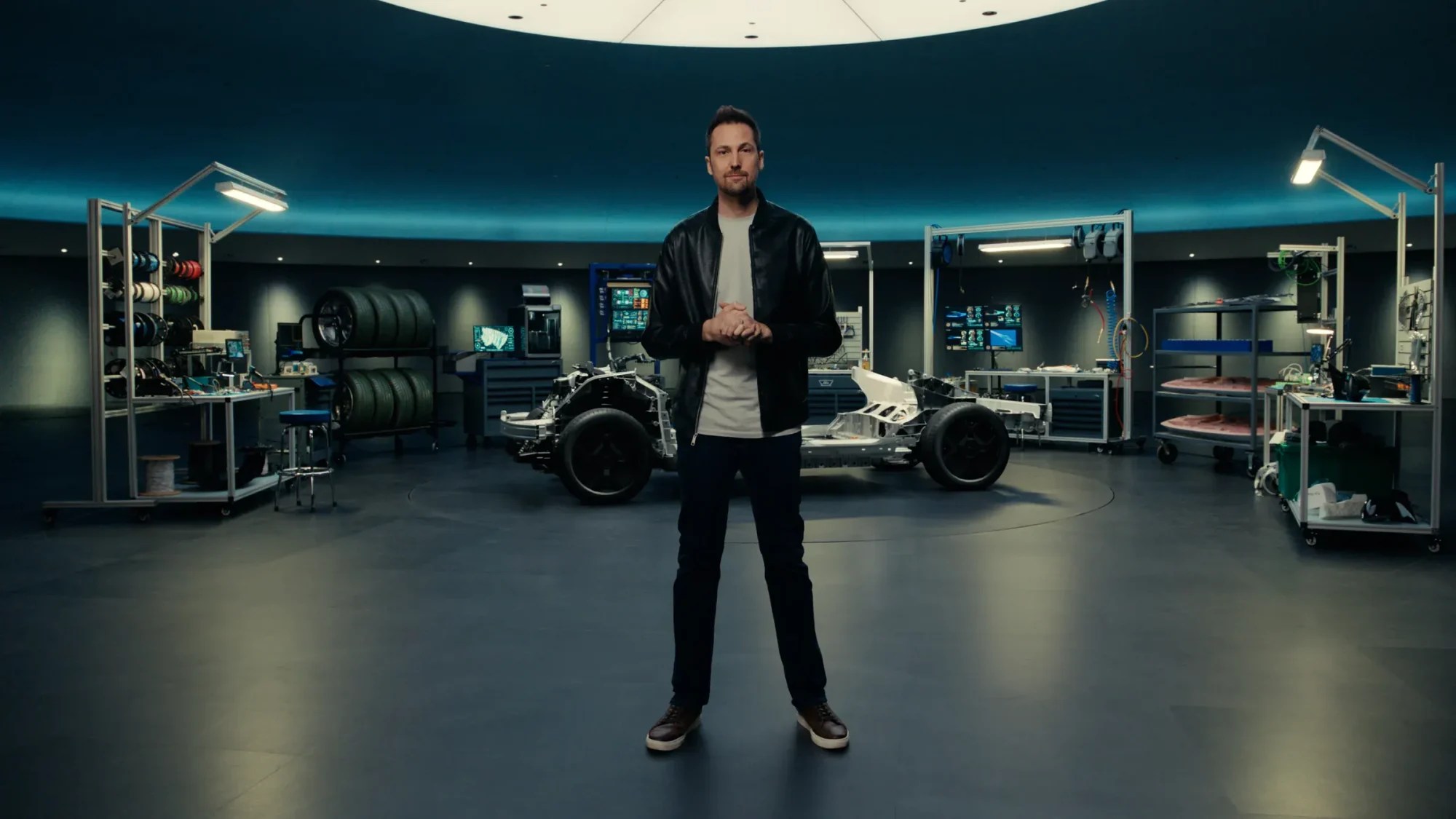
Announced last August, the Universal EV Platform is meant to enable a new, more affordable class of vehicles, beginning with an all-electric pickup truck, priced around $30,000 and estimated to hit the market in 2027. The project team, including designers from the manufacturing, product development and supply chain teams, plus a smattering of former Formula One engineers, optimized aerodynamics, battery technology, body materials and manufacturing processes to squeeze both emissions and dollars out of the end product.
“The skunkworks team out in California, they took the product, they took how we design vehicles, and they just shifted it upside down,” said Wroten.
The project has resulted in the complete overhaul of Ford’s assembly plant in Louisville, Ky., which has been redesigned to be adaptable for the next few waves of EV technology, something U.S. automakers have not proven adept at. (Ford has not disclosed total costs of the project, but says it “is investing approximately $5 billion … across Louisville Assembly Plant and BlueOval Battery Park Michigan to deliver a new pickup.”)
2025 milestones
The 2025 edition is Ford’s 27th annual sustainability report and its second produced under the eyes of auditors from PwC to meet the stringent requirements of the E.U.’s Corporate Sustainability Reporting Directive (CSRD), which has “revolutionized sustainability reporting,” said Wroten.
Achievements pointed to in the report:
- A record 440,000 hybrids sold worldwide, up 25 percent from 2024
- Deployment of a new residential vehicle-to-grid application for the F-150 Lightning truck
- Launch of a plug-in hybrid version of the Ranger pickup, sold in 180 markets globally
Total emissions from Ford’s operations were up slightly year-over-year but have fallen 43 percent since 2017, said Wroten, and the company is on track for a 76 percent reduction by 2035. Ford aims to draw all of its power from carbon-free sources by the same year. All of its manufacturing facilities in Europe, Mexico and Ohio are now carbon-free.
But emissions from operations, of course, are not the issue. To actually reduce its climate footprint, the auto industry must stop selling so many gas-powered cars and trucks. That target has not gotten closer, according to this year’s report.
The 15 months since Donald Trump took office for the second time have been discouraging to Ford’s sustainability goals and detrimental to its bottom line. Like other automakers, it also faces a critical labor shortage that is slowing its transition: Ford has 5,000 open positions for highly skilled technicians, Farley has said. But Wroten remains inspired by working at a company where everyone from leadership to factory workers is determined to turn the company around and build more planet-friendly vehicles.
“I feel very fortunate to work for a company where our executive chairman’s last name is the name on the car that I drive,” she said. “Because you’re looking at the executive chairman of the company, and you’re leading sustainability for the company, and he’s very passionate in this space.”