

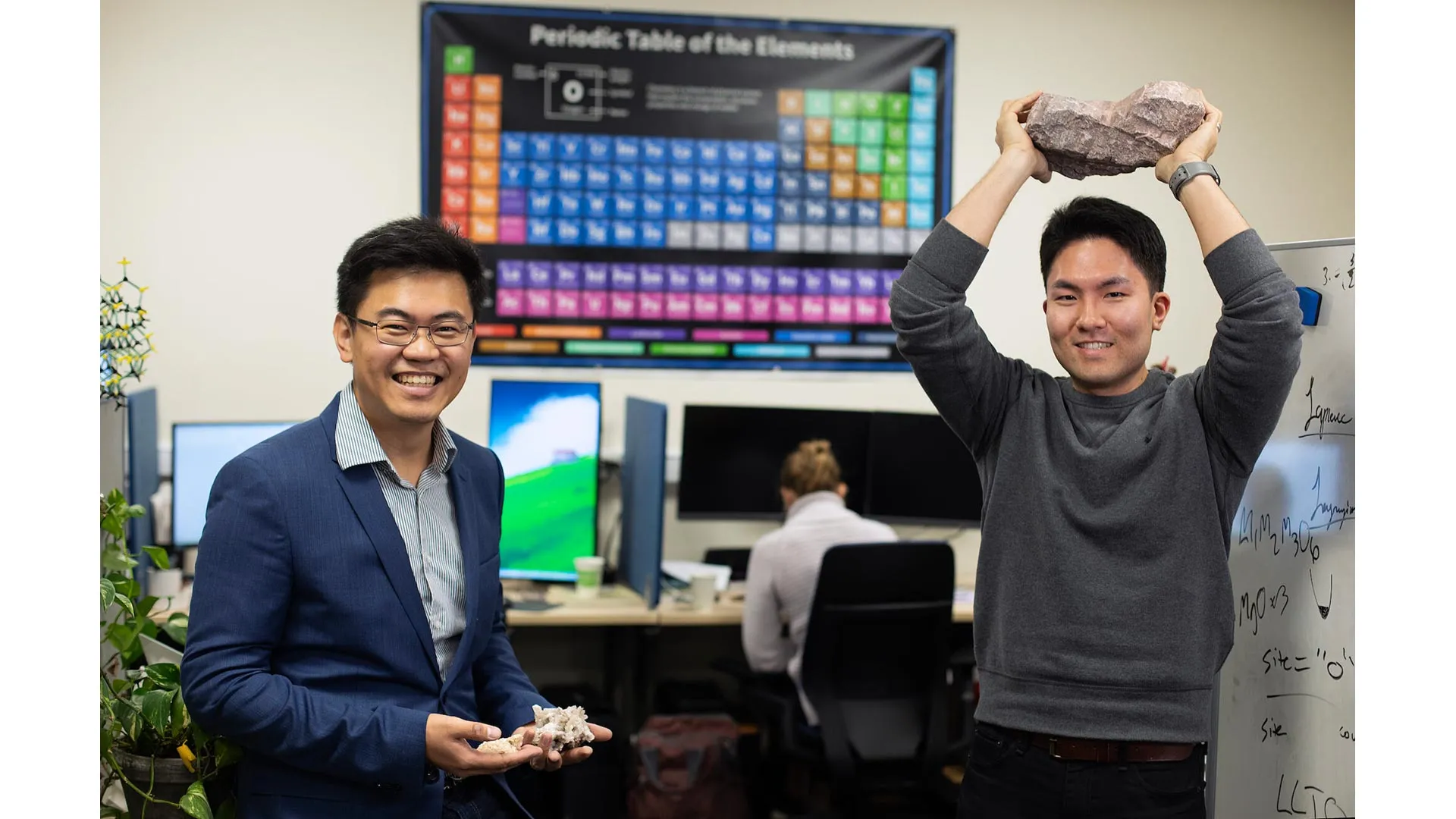
For more than two centuries, scientists tried and failed to grow dolomite in the lab under conditions thought to match how it forms in nature. A recent study has finally changed that. Researchers from the University of Michigan and Hokkaido University in Sapporo, Japan succeeded by developing a new theory based on detailed atomic simulations.
Their work solves a long-standing geological puzzle known as the “Dolomite Problem.” Dolomite is a widespread mineral found in iconic locations such as the Dolomite mountains in Italy, Niagara Falls and Utah’s Hoodoos. It is abundant in rocks older than 100 million years, yet it is rarely seen forming in more recent environments.
“If we understand how dolomite grows in nature, we might learn new strategies to promote the crystal growth of modern technological materials,” said Wenhao Sun, the Dow Early Career Professor of Materials Science and Engineering at U-M and the corresponding author of the paper published in Science.
Why Dolomite Growth Is So Slow
The key breakthrough came from understanding what disrupts dolomite as it forms. In water, minerals typically grow as atoms attach in an orderly way to the surface of a crystal. Dolomite behaves differently because its structure is made of alternating layers of calcium and magnesium.
As the crystal grows, these two elements often attach randomly instead of lining up correctly. This creates structural defects that block further growth. The result is an extremely slow process. At that rate, forming a single well-ordered layer of dolomite could take up to 10 million years.
Nature’s Built-In Reset Mechanism
The researchers realized that these defects are not permanent. Atoms that are out of place are less stable and more likely to dissolve when exposed to water. In natural environments, cycles such as rainfall or tidal changes repeatedly wash away these flawed areas.
Over time, this process clears the surface so new, properly arranged layers can form. Instead of taking millions of years for a single layer, dolomite can gradually build up in far shorter intervals. Over long geological periods, this leads to the large deposits seen in ancient rock formations.
Simulating Crystal Growth at the Atomic Level
To test their idea, the team needed to model how atoms interact as dolomite forms. This requires calculating the energy involved in countless interactions between electrons and atoms, which is usually extremely demanding in terms of computing power.
Researchers at U-M’s Predictive Structure Materials Science (PRISMS) Center developed software that simplifies this challenge. It calculates the energy for certain atomic arrangements and then predicts others based on the symmetry of the crystal structure.
“Our software calculates the energy for some atomic arrangements, then extrapolates to predict the energies for other arrangements based on the symmetry of the crystal structure,” said Brian Puchala, one of the software’s lead developers and an associate research scientist in U-M’s Department of Materials Science and Engineering.
This approach made it possible to simulate dolomite growth over timescales that reflect real geological processes.
“Each atomic step would normally take over 5,000 CPU hours on a supercomputer. Now, we can do the same calculation in 2 milliseconds on a desktop,” said Joonsoo Kim, a doctoral student of materials science and engineering and the study’s first author.
Lab Experiment Confirms the Theory
Natural settings where dolomite still forms today often experience cycles of flooding followed by drying, which supports the team’s theory. However, direct experimental evidence was still needed.
That evidence came from Yuki Kimura, a professor of materials science at Hokkaido University, and Tomoya Yamazaki, a postdoctoral researcher in his lab. They used an unusual property of transmission electron microscopes to recreate the process.
“Electron microscopes usually use electron beams just to image samples,” Kimura said. “However, the beam can also split water, which makes acid that can cause crystals to dissolve. Usually this is bad for imaging, but in this case, dissolution is exactly what we wanted.”
The team placed a small dolomite crystal in a solution containing calcium and magnesium. They then pulsed the electron beam 4,000 times over two hours, repeatedly dissolving the defects as they formed.
After this process, the crystal grew to about 100 nanometers, or roughly 250,000 times smaller than an inch. That growth represented around 300 layers of dolomite. Previous experiments had never produced more than five layers.
Implications for Modern Technology
Solving the Dolomite Problem does more than explain a geological mystery. It also offers insight into how to control crystal growth in advanced materials used in modern technology.
“In the past, crystal growers who wanted to make materials without defects would try to grow them really slowly,” Sun said. “Our theory shows that you can grow defect-free materials quickly, if you periodically dissolve the defects away during growth.”
This concept could help improve the production of semiconductors, solar panels, batteries and other high-performance technologies.
The research was funded by the American Chemical Society PRF New Doctoral Investigator grant, the U.S. Department of Energy and the Japanese Society for the Promotion of Science.