

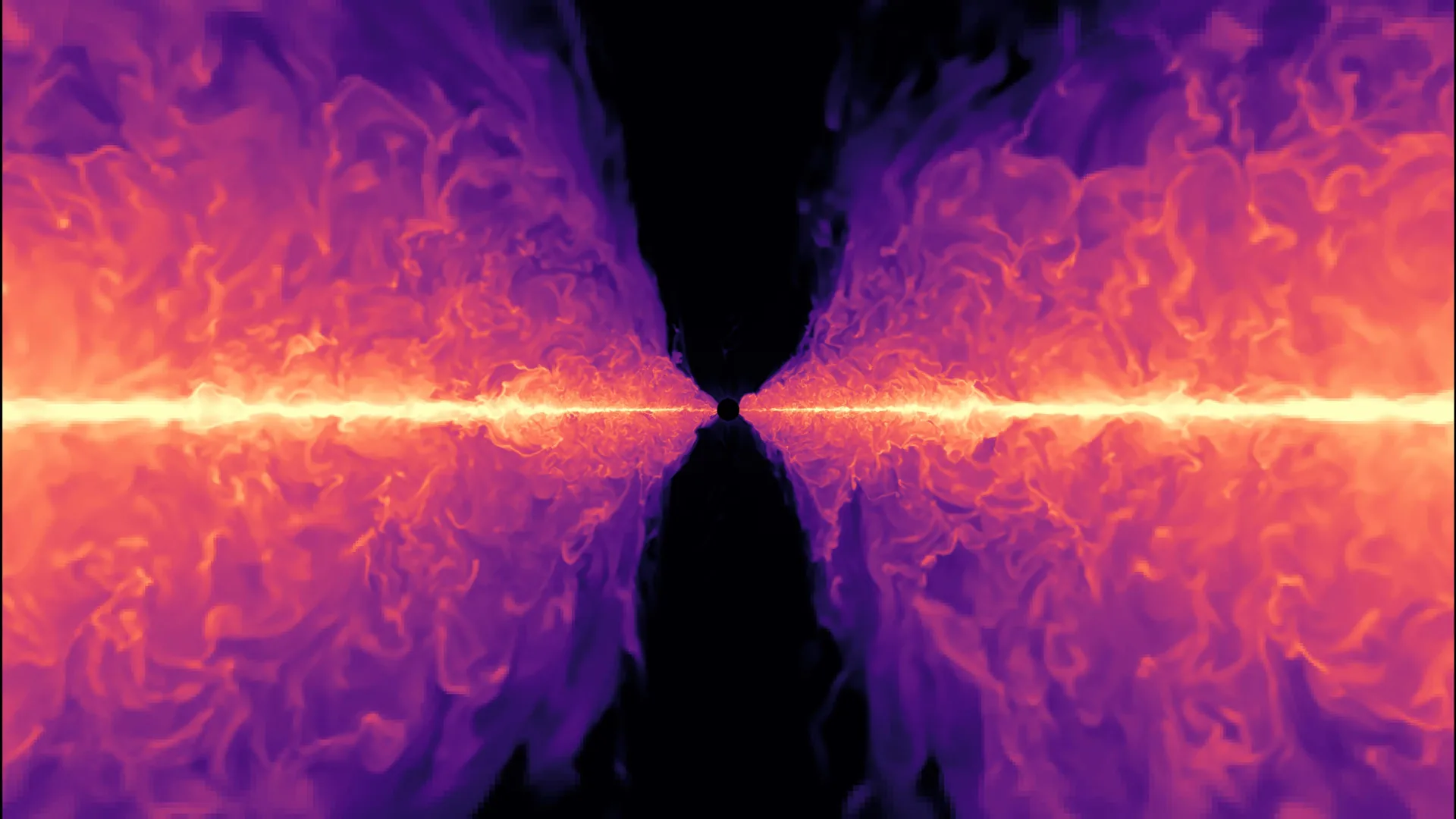
After decades of steady progress, computational astrophysicists have reached a major turning point in black hole research. A new study presents the most detailed and complete model yet of luminous black hole accretion, the process by which black holes pull in surrounding matter and emit intense radiation. Using some of the most powerful supercomputers on Earth, the researchers successfully calculated how matter flows into black holes while fully accounting for both Einstein’s theory of gravity and the dominant role of radiation, without relying on simplifying shortcuts.
This achievement marks the first time such calculations have been carried out in full general relativity under radiation-dominated conditions. The results open a new window into how black holes behave in extreme environments that were previously out of reach for simulations.
Who Led the Research and Where It Was Published
The study was published in The Astrophysical Journal and led by scientists from the Institute for Advanced Study and the Flatiron Institute’s Center for Computational Astrophysics. It represents the first paper in a planned series that will introduce the team’s new computational framework and apply it to different types of black hole systems.
“This is the first time we’ve been able to see what happens when the most important physical processes in black hole accretion are included accurately. These systems are extremely nonlinear — any over-simplifying assumption can completely change the outcome. What’s most exciting is that our simulations now reproduce remarkably consistent behaviors across black hole systems seen in the sky, from ultraluminous X-ray sources to X-ray binaries. In a sense, we’ve managed to ‘observe’ these systems not through a telescope, but through a computer,” said lead author Lizhong Zhang.
Zhang is a joint postdoctoral research fellow at the Institute for Advanced Study’s School of Natural Sciences and the Flatiron Institute’s Center for Computational Astrophysics. He began the project during his first year at IAS (2023-24) and continued the work at Flatiron.
Why Black Hole Models Need Relativity and Radiation
Any realistic model of a black hole must include general relativity, since the intense gravity of these objects bends space and time in extreme ways. But gravity alone is not enough. When large amounts of matter fall toward a black hole, enormous energy is released in the form of radiation. Accurately tracking how that radiation moves through curved spacetime and interacts with nearby gas is essential for understanding what astronomers actually observe.
Until now, simulations could not fully handle this combination of effects. Like simplified classroom models that capture only part of a real system, earlier approaches relied on assumptions that made the calculations manageable but incomplete.
“Previous methods used approximations that treat radiation as a sort of fluid, which does not reflect its actual behavior,” Zhang explained.
Solving the Full Equations Without Shortcuts
Those approximations were once unavoidable because the underlying equations are extraordinarily complex and demand massive computational resources. By combining insights developed over many years, the team created new algorithms capable of solving these equations directly, without approximations.
“Ours is the only algorithm that exists at the moment that provides a solution by treating radiation as it really is in general relativity,” Zhang said.
This breakthrough allows researchers to simulate black hole environments with a level of realism that was previously impossible.
Focusing on Stellar Mass Black Holes
The study focuses on stellar mass black holes, which typically have about 10 times the mass of the Sun. These objects are much smaller than Sgr A*, the supermassive black hole at the center of the Milky Way, but they offer unique advantages for study.
While astronomers have produced detailed images of supermassive black holes, stellar mass black holes appear only as tiny points of light. Scientists must analyze their emitted light by breaking it into a spectrum, which reveals how energy is distributed around the black hole. Because stellar mass black holes evolve over minutes to hours rather than years or centuries, they allow researchers to observe rapid changes in real time.
Simulations That Match Real Observations
Using their new model, the researchers followed how matter spirals inward, forming turbulent, radiation-dominated disks around stellar mass black holes. The simulations also showed strong winds flowing outward and, in some cases, the formation of powerful jets.
Crucially, the simulated light spectra closely matched what astronomers observe from real systems. This strong agreement makes it possible to draw more confident conclusions from limited observational data and deepens scientists’ understanding of how these distant objects operate.
Supercomputers Powering the Breakthrough
The Institute for Advanced Study has a long history of advancing science through computational modeling. One early milestone was the Electronic Computer Project led by founding Professor (1933-55) John von Neumann, which influenced fields ranging from fluid dynamics to climate science and nuclear physics.
Continuing that tradition, Zhang and his colleagues were granted access to two of the world’s most powerful supercomputers, Frontier at Oak Ridge National Laboratory and Aurora at Argonne National Laboratory. These exascale machines can perform a quintillion calculations per second and occupy thousands of square feet — recalling the massive size of the earliest computers.
Harnessing this computing power required sophisticated mathematics and software designed specifically for the task. Christopher White of the Flatiron Institute and Princeton University led the development of the radiation transport algorithm. Patrick Mullen, Member (2021-22) in the School of Natural Sciences and now at Los Alamos National Laboratory, led the integration of this algorithm into the AthenaK code, which is optimized for exascale systems.
What Comes Next for Black Hole Research
The team plans to test whether their approach can be applied to all types of black holes. Beyond stellar mass systems, the simulations may also shed new light on supermassive black holes, which play a central role in shaping galaxies. Future work will further refine how radiation interacts with matter across a wide range of temperatures and densities.
“What makes this project unique is, on the one hand, the time and effort it has taken to develop the applied mathematics and software capable of modeling these complex systems, and, on the other hand, having a very large allocation on the world’s largest supercomputers to perform these calculations,” said co-author James Stone, Professor in the Institute for Advanced Study’s School of Natural Sciences. “Now the task is to understand all the science that is coming out of it.