
Close Menu
geekfence.comgeekfence.com
    What's Hot

    Why Discipline Beats Vision

    July 8, 2026

    Why AI Coding Agents Still Need Clear Specs – O’Reilly

    July 8, 2026

    How the FCC can protect IoT innovation in the 900 MHz band (Reader Forum)

    July 8, 2026
    Facebook X (Twitter) Instagram
    • About Us
    • Contact Us
    Facebook Instagram
    geekfence.comgeekfence.com
    • Home
    • UK Tech News
    • AI
    • Big Data
    • Cyber Security
      • Cloud Computing
      • iOS Development
    • IoT
    • Mobile
    • Software
      • Software Development
      • Software Engineering
    • Technology
      • Green Technology
      • Nanotechnology
    • Telecom
    geekfence.comgeekfence.com
    Home»Nanotechnology»Shear strain reshapes magic angle graphene – Physics World
    Nanotechnology

    Shear strain reshapes magic angle graphene – Physics World

    AdminBy AdminJune 15, 2026No Comments2 Mins Read5 Views
    Facebook Twitter Pinterest LinkedIn Telegram Tumblr Email
    Shear strain reshapes magic angle graphene – Physics World
    Share
    Facebook Twitter LinkedIn Pinterest Email


    New STM measurements show that shear strain decisively shapes flat-band structure across multiple magic angle regimes
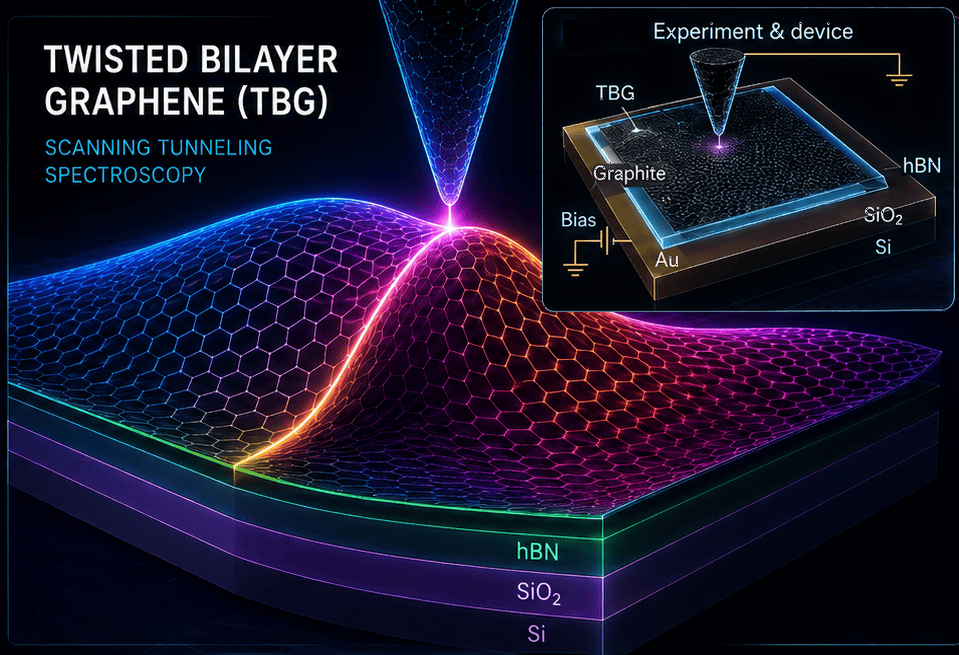
    Shear strain reshapes the flat bands of TBG

    Shear strain reshapes the flat bands of TBG – Scanning tunneling microscopy reveals that shear strain, not just the twist angle, is the decisive factor engineering flat bands in twisted bilayer graphene. (Courtesy: Wei Li/Tsinghua University)

    Twisted bilayer graphene has become a key area of research in 2‑dimensional materials. Two graphene sheets are stacked and rotated slightly so their carbon atoms no longer align, creating an interference pattern called a moiré lattice. At specific magic angles (1.1°, 0.55°, 0.37°), the geometry and interlayer coupling slow the electrons dramatically, nearly reducing their velocity to zero. These slowed electrons form flat bands, where interactions become extremely strong and can give rise to exotic phases such as superconductivity and strange‑metal behaviour.

    In this work, the researchers examined what happens as the twist angle varies from 0.35° to 1.30°, using scanning tunnelling microscopy (STM) to image individual atoms and local electronic states. STM measures the tunnelling current between a sharp metal tip and the sample, allowing the researchers to map the electronic structure across regions for the first, second, and third magic angles.

    They found that shear strain, a sideways distortion where one graphene layer shifts relative to the other, has a far greater impact on the electronic structure than biaxial stretching or compression. Shear strain strongly controls how far apart the flat bands are, how wide they become, and how electrons distribute between them. It enhances the upper flat band while suppressing the lower one, making it a decisive structural factor rather than a minor defect. They also showed that remote bands depend only on twist angle, not strain, making them reliable markers of the local twist. Strain reshapes flat‑band energies within each moiré unit cell, and only a theoretical model combining strain and electron-electron interactions reproduces the full experimental behaviour.

    This research demonstrates that shear strain, not just the twist angle, is a critical factor shaping the flat‑band structure in twisted bilayer graphene, redefining how correlated and superconducting states must be engineered.

    Do you want to learn more about this topic?

    Emergent phases in graphene flat bands by Saisab Bhowmik, Arindam Ghosh and U Chandni (2024)


    Source link

    Share. Facebook Twitter Pinterest LinkedIn Tumblr Email

    Related Posts

    Electrostatic regulation of solvation chemistry enables ampere-hour-scale high-energy lithium metal batteries

    July 8, 2026

    How can you fast-forward a quantum simulation? – Physics World

    July 7, 2026

    Gold Nanowires Help Contact Lens Monitor Oxygen Levels

    July 6, 2026

    Scientists reveal what really happens when water is trapped in tiny spaces

    July 5, 2026

    Monolithic manufacturing of an electrically addressable quasi-suspended nanophotonic aperture

    July 3, 2026

    Can surplus renewable power make green hydrogen cheaper? – Physics World

    July 2, 2026
    Top Posts

    Understanding U-Net Architecture in Deep Learning

    November 25, 202560 Views

    Hard-braking events as indicators of road segment crash risk

    January 14, 202631 Views

    Redefining AI efficiency with extreme compression

    March 25, 202628 Views
    Don't Miss

    Why Discipline Beats Vision

    July 8, 2026

    Guest post by Dane Hudson, who is a former 25-year global CEO. Discipline Beats Vision:…

    Why AI Coding Agents Still Need Clear Specs – O’Reilly

    July 8, 2026

    How the FCC can protect IoT innovation in the 900 MHz band (Reader Forum)

    July 8, 2026

    The Download: worms fight pollution, and geoengineering faces reality

    July 8, 2026
    Stay In Touch
    • Facebook
    • Instagram
    About Us

    At GeekFence, we are a team of tech-enthusiasts, industry watchers and content creators who believe that technology isn’t just about gadgets—it’s about how innovation transforms our lives, work and society. We’ve come together to build a place where readers, thinkers and industry insiders can converge to explore what’s next in tech.

    Our Picks

    Why Discipline Beats Vision

    July 8, 2026

    Why AI Coding Agents Still Need Clear Specs – O’Reilly

    July 8, 2026

    Subscribe to Updates

    Please enable JavaScript in your browser to complete this form.
    Loading
    • About Us
    • Contact Us
    • Disclaimer
    • Privacy Policy
    • Terms and Conditions
    © 2026 Geekfence.All Rigt Reserved.

    Type above and press Enter to search. Press Esc to cancel.