


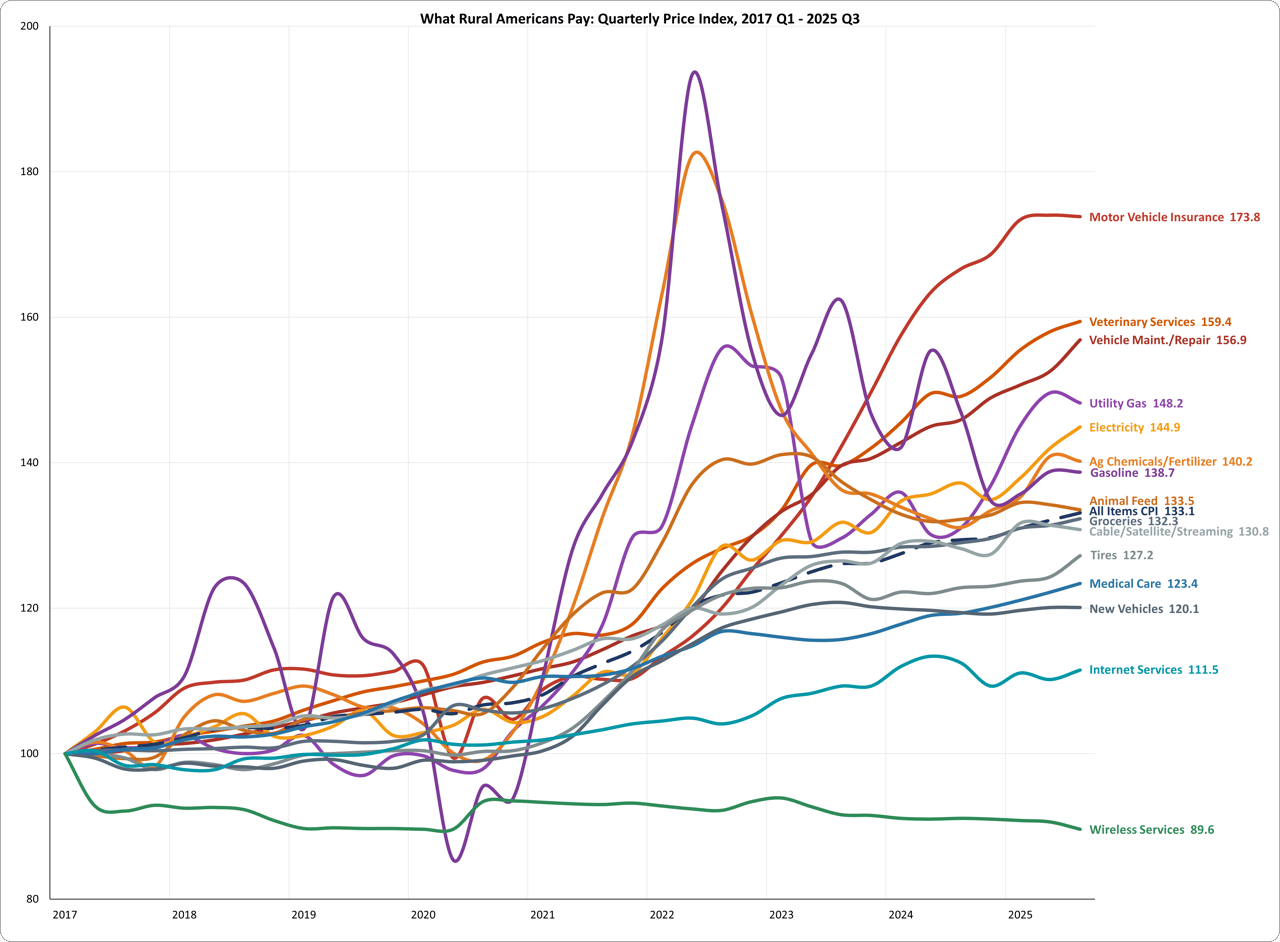
Since 2017, the cost of nearly everything American households depend on has risen. Groceries are up 32%. Electricity costs 45% more. Car insurance has nearly doubled. Gasoline swings wildly but trends up. Veterinary bills, vehicle repairs, tires, natural gas: all higher, most by double digits. The Bureau of Labor Statistics Consumer Price Index confirms what every family already knows at the checkout counter and the gas pump.
However, there is one category that costs less today than it did eight years ago: wireless service.
The BLS wireless telephone services index has fallen from 51.7 in the first quarter of 2017 to 46.3 in the third quarter of 2025. That is a 10.4% decline in a period when overall consumer prices rose 33.1%. A household paying for wireless today gets more data, faster speeds, better coverage and increasingly bundled entertainment for a lower quality-adjusted price than it paid eight years ago.
Home broadband tells a similar story, if slightly less dramatic. Internet services prices rose 11.5% over the same period, roughly one-third the pace of general inflation. That 11.5% buys speeds that have roughly doubled. The value proposition of a broadband connection in 2025 is better by nearly every measure than what consumers had in 2017.
The device side of the equation is even more striking. The BLS telephone hardware index has fallen 64.6% since early 2017. Carriers deserve credit here. Trade-in programs, installment plans and promotional pricing have kept the effective cost of a new smartphone contained even as the devices evolved into pocket supercomputers. BLS cannot fully capture the value of a $1,000 phone that replaces a camera, GPS, calculator, flashlight, notebook and music player, but its quality-adjustment methodology shows the direction clearly: consumers pay less for dramatically more capable hardware.
Put these three together and telecommunications is the single largest source of consumer price relief in the American household budget.
(Source: Bureau of Labor Statistics, CPI and PPI, 2017 to Q3 2025)
What rural Americans face
The contrast sharpens when you look at costs that hit rural households and agricultural operations hardest.
Fertilizer prices spiked 82% above their 2017 baseline in mid-2022, driven by the war in Ukraine and supply chain disruptions. They have come down since but remain 40% above where they started. Animal feed costs rose 41% and have plateaued there. These are not consumer luxuries. They are the cost of putting food on the table for the rest of the country.
Motor vehicle insurance is up 74% since early 2017, with most of the acceleration coming in 2023 and 2024. For a rural household where two trucks on the road is a minimum, not a choice, that increase lands hard. Vehicle maintenance and repair costs rose 57%. Tires are up 27%. Utility gas, essential for heating in northern agricultural states, peaked at 56% above baseline in late 2022 and remains elevated near 48%. Electricity is up 45%, and rural households and farms consume more per capita than urban ones.
Against this backdrop, the wireless bill went down. The broadband bill barely moved relative to inflation. The smartphone in a farmer’s pocket costs less, adjusted for quality, than it did when that farmer was using a phone with half the capability.
The practical value goes beyond the price tag. Precision agriculture platforms that optimize planting and irrigation depend on reliable wireless connectivity. Commodity trading happens in real time on smartphone apps. Weather monitoring, equipment diagnostics, veterinary telemedicine for livestock: they all run on the same wireless and broadband infrastructure whose cost has stayed flat or declined. In a household budget where every other line item is climbing, that is not a minor detail.
The ACP test
The Affordable Connectivity Program (ACP), which provided $30 monthly broadband subsidies to roughly 23 million low-income households, expired in June 2024. Critics predicted a wave of disconnections and price increases. The data tells a different story.
Internet services CPI peaked at 113.4 (indexed to 2017 Q1 = 100) in the second quarter of 2024, right as the ACP wound down. By the fourth quarter, it had fallen to 109.3. Prices actually declined after the subsidy ended.
The impact on individual low-income households was real. Losing $30 a month matters when your household income is $25,000. Nobody should minimize that. But the market-level response was competition, not exploitation. Carriers and ISPs did not pile on with price increases when the government backstop disappeared. They competed for customers who were suddenly making purchase decisions based on price again. Several carriers extended their own low-income programs to fill part of the gap. The broadband market absorbed the loss of the ACP without the systemic disruption that critics feared.
The competitive dynamics that held broadband prices in check after the ACP expiration are the same dynamics that have driven wireless prices down for a decade. They are not fragile. They are the product of sustained capital investment, spectrum deployment and aggressive competition among carriers who know that price is the single most powerful lever for customer acquisition.
Protect what is working
Of 16 major cost categories tracked by BLS, spanning consumer staples, transportation, housing, healthcare and agricultural inputs, 15 rose faster than telecom services. One, wireless, actually declined.
The question facing policymakers is not whether American broadband is affordable. The data answers that. The question is whether Washington will protect the competitive framework that produced these results or risk disrupting it.
For Chairman Carr and the FCC: The light-touch approach to broadband pricing has delivered measurable consumer benefits for over a decade. Codifying that approach, making clear that broadband pricing will remain market-driven, would give carriers the investment certainty they need to keep building out rural networks and competing on price. Regulatory ambiguity is the enemy of capital deployment. Every dollar a carrier spends preparing for potential price regulation is a dollar not spent extending fiber to an unserved county.
For Congress: The ACP expiration showed that the broadband market is resilient, but it also showed that low-income households feel the loss of targeted subsidies. A narrowly designed, means-tested broadband affordability program that works with the market rather than against it would address the access gap without undermining the competitive dynamics that keep prices low for everyone else. Fund demand-side support. Do not impose supply-side price controls.
For the White House: Telecommunications is the success story in the American consumer economy. Every other major household cost is a source of voter frustration. Wireless and broadband are the exception. A clear policy statement affirming market-driven broadband pricing would reinforce carrier investment confidence, accelerate rural buildout and give this administration ownership of the one sector where American consumers are genuinely better off than they were eight years ago.
The American household needs a lot of things to go right. Groceries, insurance, energy, healthcare: None of those are getting cheaper. The one sector delivering more for less deserves a policy environment that lets it keep doing so.
About Recon Analytics
Recon Analytics, a Light Reading contributor, delivers near-real-time market intelligence for the telecom and artificial intelligence sectors through its Recon Analytics Pulse platform. Each year, Recon reaches more than half a million consumers, empowering clients to understand and respond to major industry developments faster than ever before.