


This April, some of the biggest names in sustainability gathered at the neoclassical Gotham Hall in midtown Manhattan to toast the quarter-century anniversary of environmental disclosure platform CDP, one of the profession’s most notable organizations.
More than 22,000 respondents shared emissions data with CDP last year, including businesses that together are responsible for nearly two-thirds of global market capitalization.
Today, though, that relationship is fraying. Companies have long grumbled about CDP’s bureaucracy and fees. More recently, as mandatory disclosure laws proliferate, some have started asking whether voluntary reporting is even needed. The data suggests that at least a few think it isn’t: For the first time, the number of reporting companies fell in 2025.
CDP asserts that its role remains critical because it ensures that data is not just reported but used — by investors, supply-chain partners and others. Nonetheless, recent developments raise an uncomfortable question: Are companies ready to break up with CDP?
‘Wildly successful’
CDP launched in 2001 and received 235 responses from companies, cities and states to its initial emissions data request. Some recipients had no idea where to start: In a 2022 podcast, CDP co-founder Paul Dickinson recalled a large logistics company that claimed it had no emissions to report. Dickinson asked if it was sure. Well, none except from the trucks and airplanes, the company replied.
Things are very different now. In addition to emissions, CDP asks about water use, forests, plastics, oceans and biodiversity. The organization has also expanded beyond its original mission of helping investors understand and engage with corporate environmental strategies. Companies that pay to join CDP’s Supply Chain program, for example, can use the platform to send disclosure requests to suppliers. More than 45,000 businesses were asked to share data in this way in 2025. For suppliers, the process allows them to complete a single disclosure that multiple customers can use.
Today, though, some form of the emissions disclosure that CDP has pushed on a voluntary basis is, or will soon be, mandatory in more than 40 jurisdictions worldwide, from California to Qatar.
“It’s much easier to legislate for something if people are already doing it voluntarily,” said Owen Hewlett, chief technical officer at Gold Standard, a leading standards-setter for carbon credits and related projects. “So you’d have to say that it’s been wildly successful.”
Failing grade
Moments of tension between standards bodies and companies are inevitable. The GHG Protocol’s proposal to change how emissions from electricity generation are accounted for sparked an ongoing, sometimes heated, dispute. Frustration has also arisen over a recent rules change at the Science Based Targets initiative.
In CDP’s case, opaque bureaucracy has often been the focus. The 2024 disclosure cycle, for example, was marred by technical glitches. The following year, an unrelated issue caused what CDP describes as “isolated” problems.
One sustainability team member at a well-known U.S. company, who asked to remain anonymous because she was not authorized to discuss the incident, described receiving a D grade for the firm’s 2024 disclosure. The result was a “complete and utter shock” to a company that had previously scored much higher.
CDP reluctantly agreed not to publish the score and eventually acknowledged that a technical error had wrongly penalized the company. It was regraded with an A-.
“A small number of scores were affected by a technology error in 2025, where ‘not applicable’ responses were incorrectly marked as ‘unanswered,’ ” said Shannon Joly, CDP’s chief marketing and communications officer. “This was identified and resolved post release, and corrected scores were issued to affected organizations.”
Occasional issues are inevitable when processing submissions from 22,000 companies. Yet the 2025 problems came in the same year that CDP laid off one-fifth of its staff, in part to channel more money into improving its technology.
Many other sustainability professionals have related tales of frustration in off-the-record conversations. A transport-industry professional said his company submits but asks not be scored, pointing out that some oil and gas companies have been awarded relatively high scores. “Who wants to score lower than them?” he asked. Others are no longer submitting at all: One tech-company employee said that after years of disclosing she can no longer justify the time, and investors are not asking her to do so.
Companies disclosing to CDP
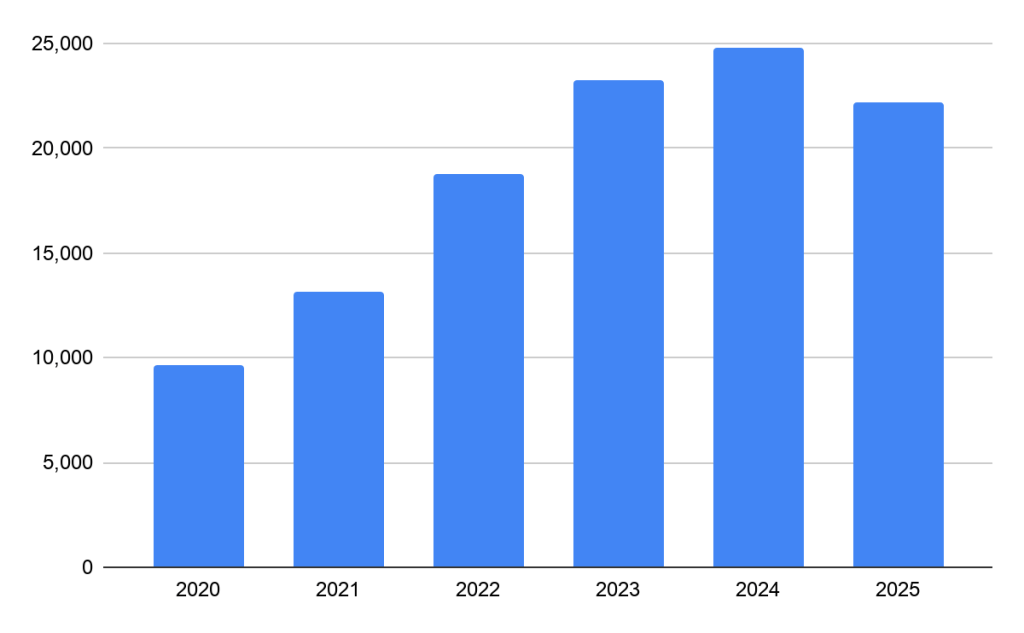
Joly declined to offer reasons behind the recent fall in submissions, but one potential cause is the global growth in mandatory disclosure requirements. After years of fragmented approaches, international standards have coalesced around rulebooks created by the International Sustainability Standards Board (ISSB). The board is overseen by the same organization — the IFRS Foundation — that sets global rules for financial reporting.
Some companies are starting to point investors and other stakeholders with sustainability questions to these mandatory disclosures, said Pamela Gill-Alabaster, a former sustainability leader at Mattel and healthcare company Kenvue who now teaches at Columbia University. A study released last year by the University of Zurich examined disclosures from more than 3,400 companies in 36 countries and found that the likelihood of a company disclosing to CDP dropped by 5.5 percent since the introduction of a mandatory disclosure requirement.
“CDP played a really essential role in building the market, but regulation has redefined the architecture for reporting,” Gill-Alabaster said.
Alternative futures
This suggests that disclosures to CDP — and the organization’s relevance — may continue to slowly decline. But that’s far from a foregone conclusion, in part because mandatory systems have shortcomings that CDP is well placed to address.
The organization supports the alignment of reporting standards, said Joly, but a voluntary option remains critical. “CDP is ensuring the data is not simply reported, but being used by a multitude of actors spanning businesses, financial markets, investors and policy makers. This provides more comprehensive insights into risks, dependencies and opportunities, and helps to fill key information gaps across markets and value chains.”
There’s also the issue of data quality. Disclosures to the EU’s Corporate Sustainability Reporting Directive and other systems are published on company websites rather than in a central system, making it challenging to compare sectors and companies. There are startups using AI to extract data from company reports and assemble it in a single platform, but the results often contain errors. CDP’s data, which comes directly from its questionnaires, remains superior for now, said Maximilian Müller, a financial accounting expert at the University of Cologne.
As a nonprofit with a stated agenda — to enable “Earth-positive decisions to protect future generations” — CDP can also pursue broader goals than those enshrined in disclosure regulations, which tend to focus on the risks and opportunities associated with climate change rather than on company impact. (The EU is a notable exception — its rules also address impact.)
To put it another way: Having had great success with the disclosure challenge, CDP might now set itself new and more ambitious goals. “There is room for an organization to bring together a more holistic reporting across climate and nature and in a more efficient way, and then continue to drive best practice,” said Hewlett.
Perhaps CDP continues in its traditional role — part facilitator, part motivator, part castigator — but with a broader focus. It might not be loved by all the companies that work with it, but that’s not the point. What matters is that there’s still enough common ground — a desire to make progress on sustainability — to keep the relationship together.