

Support CleanTechnica’s work through a Substack subscription, on Patreon, or on Stripe. Help us produce all of the high-quality, original content we publish week after week despite the challenges of content-scraping AI, antisocial media, inflation, and other hurdles.
The US Army has spent years tip-toeing cautiously around the edges of the vehicle electrification field, with battery safety in active war zones among other structural concerns. Now that EVs are on a collision course with driverless, and autonomous robotics, the battery safety factor has faded to the background and the Army is dipping another toe in the water, at least as far as hybrid-electric vehicles go.
US Army Finally Gets Real On EVs
This will be familiar ground to those of you following Ukraine’s life-or-death transition into uncrewed vehicles and weaponry, enabling sparse contingents of frontline fighters to hold off a force that is far greater in number, but ill-quipped to fight a 21st century war.
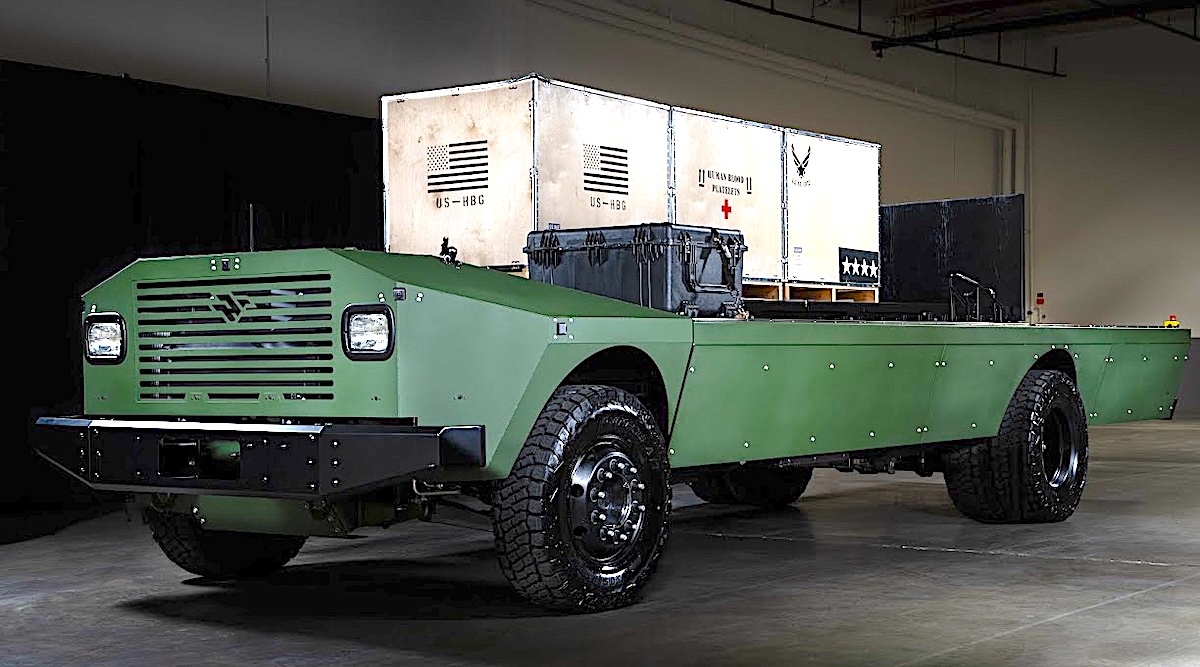
Last week, the California-based EV startup Harbinger Motors announced that the US Army has issued an 18-month contract for the delivery of uncrewed, hybrid-electric resupply vehicles under a partnership with the US branch of the global defense supplier Rheinmetall.
American Rheinmetall is the lead contractor on the team, which also includes the autonomous vehicle specialist Forterra and Primordial Labs, which brings its signature human-machine interface to the project.
“These vehicles will autonomously transport supplies to and from the forward line of troops, reducing risk to Soldiers and increasing operational efficiency in contested environments,” Harbinger explains.
“The program emphasizes advancements in autonomy, commerciality, and hybrid power integration, and incorporates innovative features such as voice control to enhance Soldier system interaction,” the company adds.
Harbinger EVs: Follow The Money
Keep an eye out for test runs of the new vehicle at facilities here in the US. In a video (for which I’ve lost the link — sorry!), the new flatbed EV can be seen picking its way down a remote road, dropping off a series of containers en route.
In the meantime, this is a good time to catch up with Harbinger. The startup seemingly sprang up out of nowhere in 2021 with a business model centered on a stripped, modification-ready electric chassis. The company was in hot pursuit of the medium-duty electric truck market by the time CleanTechnica caught up in April of 2025. Harbinger already had key partnerships already under its wing including the legacy RV maker THOR Industries and the EV distributor ETHERO Truck + Energy.
Harbinger also revved up initial operations at its factory in April of 2025 with a $500 million order book totaling 4,690 EVs to its credit, alongside a new Series B funding round of $100 million co-led by the Technology Impact Fund of Capricorn and the venture capital fund Leitmotif, and returning investor Tiger Global. Harbinger’s list of returning investors also included he Coca-Cola System Sustainability Fund, ArcTern Ventures, THOR Industries (and its investment partner TechNexus), Ridgeline, Maniv Mobility, Ironspring Ventures, Schematic Ventures, and Overture Climate.
Autonomous Hybrid EVs For The US Army
Things have moved along quickly since then. With volume production underway, earlier this year Harbinger introduced its new HC series as a mobile power station as well as a truck. In a foreshadowing of things to come, Harbinger also offers the HC in a range-extended version, deploying an onboard gas tank to recharge the batteries when needed. With the range extender, Harbinger cites a range of up to 500 miles.
The power system is available for both the all-electric and hybrid electric HCs, consisting of an optional onboard AC inverter that can deliver up to 15 kilowatts, thereby eliminating the need to haul a diesel generator — and extra fuel, and extra tools — around.
Partly due to its newcomer status on the EV market, last year Harbinger saw its sales increase in Q4 2025 compared to Q3, a rare breathe of good news while most US automakers saw their EV sales tank after the premature demise of the federal EV tax credit on September 30 last year.
The company’s bet on midsized (class 4-6) electric trucks also paid off, considering that Tesla left that field wide open to concentrate on the Cybertruck (a certified flop hovering somewhere around the Class 2-3 mark) and the long delayed Semi Class 8 truck (not a flop, going by early reports).
The range extender angle is also paying off. The US Army has been adding battery-powered anti-idling kits to its vehicles, with power takeoff capability being the next step and range-extended EVs not far behind.
So, it was no surprise to see Harbinger join up with American Rheinmetall in May of this year, to chase down the defense market with Harbinger’s electric drive adding the key elements of silent running with a sharp reduction in heat signature and noise giveaways.
“Initial areas of collaboration include autonomous tactical wheeled vehicles, contested-logistics resupply, and next-generation robotic platforms aligned with U.S. Army autonomy and manned-unmanned teaming priorities,” Rheinmetall explained in a press statement.
Did The Army Miss The EV Memo?
It took just a few months for Rheinmetall to get from there to an Army contract, which raises the question of whether or not the Army knows that a war on EVs is going on.
White House policy aside, though, the US Army’s procurement policy answers to the “Other Transactions Guide” of 2023, issued by the Office of the Under Secretary of Defense for Acquisition and Sustainment. The Other Transactions pathway is designed to accelerate the adoption of civilian technologies. The 2023 iteration of OT is which is based on a 2022 assessment that underscored the idiocy of using precious diesel fuel to keep a stationary vehicle in idle mode, which is where the average Defense Department vehicle spends about 75% of its time.
Circling back around to Russia’s ill-fated invasion of Ukraine back in February of 2022, the spectacle of a 40-mile military convoy stuck in the road for lack of fuel has become a notorious symbol of the failure of 20th century energy systems to fight the war of the future.
Rheinmetall has an answer for that, too. The parent company envisions hundreds of modular, transportable green hydrogen microgrids stationed throughout Europe, enabling troops in remote locations to resupply hydrogen fuel cell drones and ground robots without risking life, limb, and time on ground transportation or airborne fuel drops.
Zooming out to the big picture, Harbinger is not the only US automaker to anticipate that EV-curious buyers value the security blanket of a range extender. Currently, of course, a gas tank is the extender of choice, but keep an eye on Daimler Truck, which pitching the Mercedes-Benz eCitaro fuel cell/battery extended range electric bus.
Photo: The US startup Harbinger has joined America Rheinmetall and other partners to crack the Defense Department’s EV code with an autonomous, flat bed hybrid designed for crew-free resupply in danger zones (courtesy of Harbinger; photo enhanced for visibility).
Sign up for CleanTechnica’s Weekly Substack for Zach and Scott’s in-depth analyses and high level summaries, sign up for our daily newsletter, and follow us on Google News!
Have a tip for CleanTechnica? Want to advertise? Want to suggest a guest for our CleanTech Talk podcast? Contact us here.
Sign up for our daily newsletter for 15 new cleantech stories a day. Or sign up for our weekly one on top stories of the week if daily is too frequent.


CleanTechnica uses affiliate links. See our policy here.
CleanTechnica’s Comment Policy