

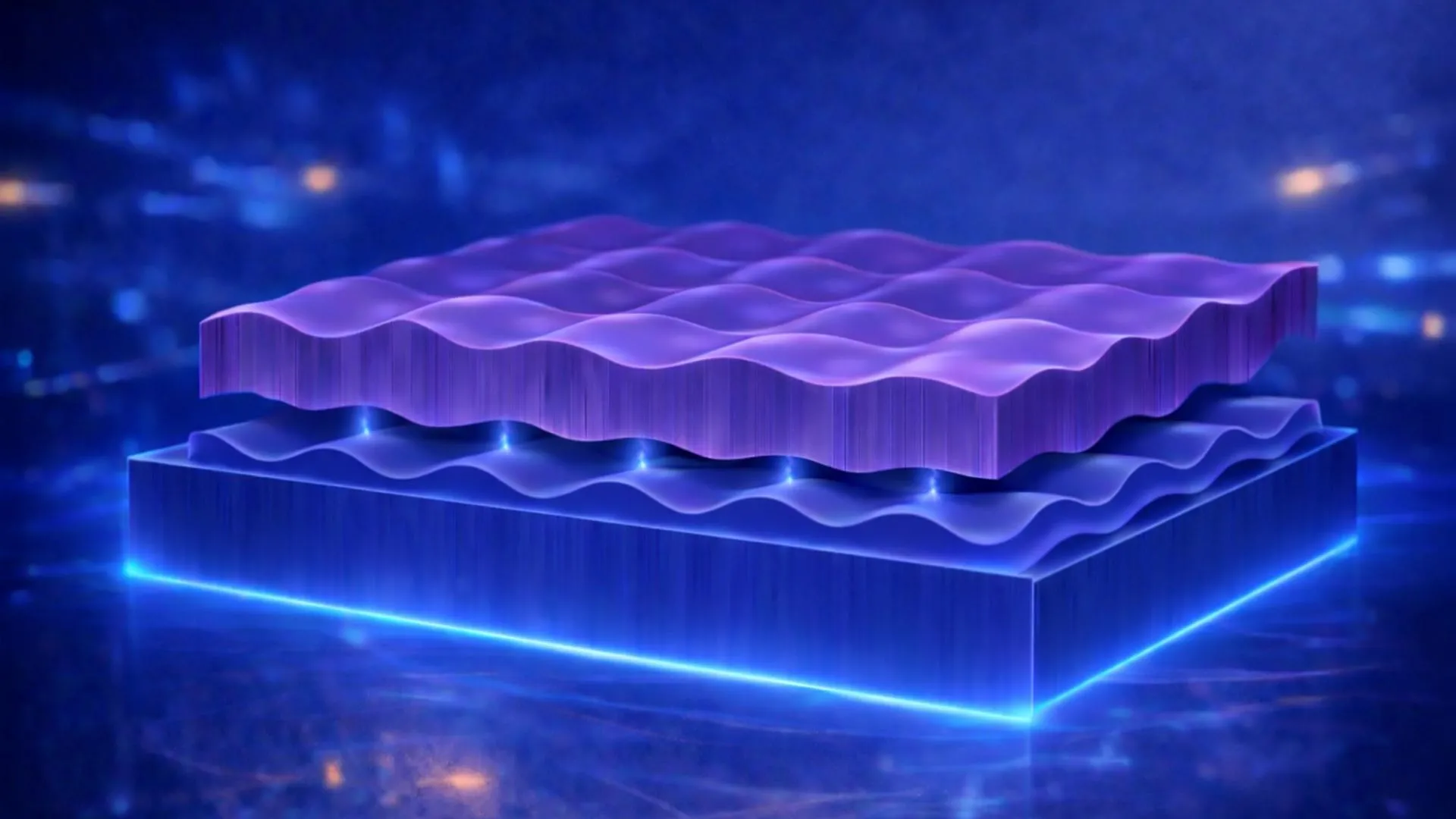
Superconductors could one day help power a new generation of ultra-efficient electronics, but major technical hurdles have kept the technology largely confined to research labs. Now, scientists at Chalmers University of Technology in Sweden have developed a new approach that tackles one of the field’s biggest challenges: maintaining superconductivity at higher temperatures while also resisting strong magnetic fields.
The advance could help move superconducting technologies closer to practical use in electronics, energy systems, and quantum devices.
Modern digital devices, data centers, and information and communications technology (ICT) networks are responsible for an estimated 6 to 12 percent of global electricity consumption. As energy demand continues to rise, researchers are searching for ways to make electronics far more efficient.
Superconductors are particularly attractive because they can carry electrical current with no energy loss. Unlike conventional electronic systems, which waste energy as heat, superconductors can transmit electricity without resistance. In theory, this could make power grids, electronics, and quantum technologies hundreds of times more efficient.
Why Superconductors Are Difficult To Use
Despite their promise, superconductors face several obstacles that limit their real-world applications.
One challenge is temperature. Many superconductors only work at extremely low temperatures, often around minus 200 degrees Celsius. Reaching and maintaining such temperatures requires complex and energy-intensive cooling systems.
Magnetic fields present another major problem. Strong magnetic fields can weaken or even eliminate superconductivity. This is particularly important because many advanced electronic systems and quantum technologies either generate or rely on magnetic fields.
To become practical for widespread use, superconducting materials must be able to operate at higher temperatures (ideally close to room temperature) while remaining stable in strong magnetic environments.
A Different Strategy for Stronger Superconductivity
Researchers have spent years trying to improve superconductors by altering their chemical composition, but progress has been limited. The Chalmers team decided to take a different approach.
“By sculpting the surface that the superconductor rests on, we were able to induce superconductivity at significantly higher temperatures than previously possible. We also found that the material remained superconducting even when exposed to strong magnetic fields,” explains Floriana Lombardi, Professor of Quantum Device Physics at Chalmers and lead author of a study published in Nature Communications.
How a Tiny Surface Change Made a Big Difference
The researchers worked with a copper-oxide material from the cuprate family. Cuprates are already known for exhibiting superconductivity at relatively high temperatures, but their chemical structure is difficult to modify once they have been manufactured.
The superconducting layer used in the study was only a few nanometers thick, less than one millionth the thickness of a human hair. Such ultrathin materials must be grown on a supporting foundation called a substrate, which acts as a template during fabrication.
The breakthrough came from making nanoscale modifications to the substrate itself.
“Because the atoms in the substrate are arranged in a specific pattern, they can ‘guide’ how the atoms in the superconducting layer settle. By changing the surface design of the substrate, we were able to influence the superconducting properties and ensure they were preserved, even at higher temperatures and when high magnetic fields were applied,” explains Eric Walhberg, a researcher at RISE Research Institutes of Sweden.
Before adding the superconducting film, the team treated the substrate in a vacuum at high temperature. This process created an orderly pattern of tiny ridges and valleys across the surface.
Those microscopic features altered the electronic environment where the substrate and superconducting layer meet, creating conditions that favored stronger superconductivity.
“We could see how the electrons’ properties began to have a preferential direction in this interfacial region and behave in a way that stabilized and strengthened the superconducting state,” says Lombardi.
A New Design Principle for Future Superconductors
The findings introduce a new way of thinking about superconducting materials. Instead of focusing solely on discovering new materials or changing their chemistry, researchers may be able to improve performance by carefully engineering the surfaces on which those materials are grown.
“Instead of searching for entirely new materials or manipulating the chemical properties of existing ones, we are now showing how superconductivity can be enhanced by sculpting the substrate,” says Lombardi.
The researchers believe this strategy could eventually help superconductors function at much higher temperatures, potentially even approaching room temperature.
The work also points toward future applications in energy-efficient electronics, advanced quantum components, and technologies that must operate in strong magnetic fields.
“This shows that very small changes at the nanoscale can have decisive effects and may even unlock the full potential of superconductivity in future electronics,” says Lombardi.
Study Details
The study, “Boosting superconductivity in ultrathin YBa2Cu3O7−δ films via nanofaceted substrates,” was published in the journal Nature Communications.
The authors are Eric Wahlberg, Riccardo Arpaia, Debmalya Chakraborty, Alexei Kalaboukhov, David Vignolles, Cyril Proust, Annica M. Black-Schaffer, Thilo Bauch, Götz Seibold, and Floriana Lombardi.
Researchers involved in the project are affiliated with Chalmers University of Technology, RISE Research Institutes of Sweden, Ca’ Foscari University of Venice, Italy, Birla Institute of Technology and Science — Pilani, K. K. Birla Goa Campus, India, Indian Institute of Science Education and Research (IISER), India, Uppsala University, Sweden, Université Grenoble Alpes, Université de Toulouse, INSA-T, France, and Institut für Physik, BTU Cottbus-Senftenberg, Germany.
Part of the research was carried out at Myfab Chalmers, a cleanroom facility.
Funding was provided by the Swedish Research Council (VR), the Knut and Alice Wallenberg Foundation, the European Union through an EIC Pathfinder grant, and the Deutsche Forschungsgemeinschaft.