

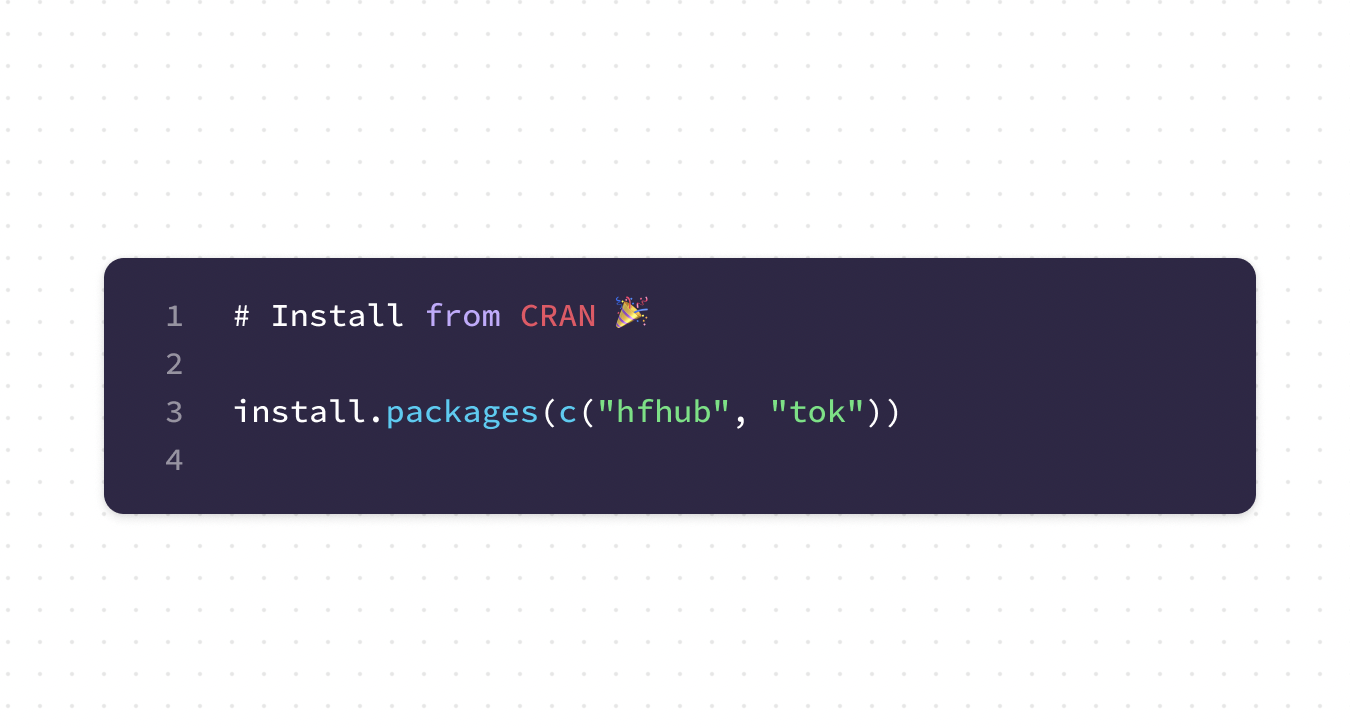

We are happy to announce the first releases of hfhub and tok are now on CRAN.
hfhub is an R interface to Hugging Face Hub, allowing users to download and cache files
from Hugging Face Hub while tok implements R bindings for the Hugging Face tokenizers
library.
Hugging Face rapidly became the platform to build, share and collaborate on
deep learning applications and we hope these integrations will help R users to
get started using Hugging Face tools as well as building novel applications.
We also have previously announced the safetensors
package allowing to read and write files in the safetensors format.
hfhub
hfhub is an R interface to the Hugging Face Hub. hfhub currently implements a single
functionality: downloading files from Hub repositories. Model Hub repositories are
mainly used to store pre-trained model weights together with any other metadata
necessary to load the model, such as the hyperparameters configurations and the
tokenizer vocabulary.
Downloaded files are ached using the same layout as the Python library, thus cached
files can be shared between the R and Python implementation, for easier and quicker
switching between languages.
We already use hfhub in the minhub package and
in the ‘GPT-2 from scratch with torch’ blog post to
download pre-trained weights from Hugging Face Hub.
You can use hub_download() to download any file from a Hugging Face Hub repository
by specifying the repository id and the path to file that you want to download.
If the file is already in the cache, then the function returns the file path imediately,
otherwise the file is downloaded, cached and then the access path is returned.
path <- hfhub::hub_download("gpt2", "model.safetensors")
path
#> /Users/dfalbel/.cache/huggingface/hub/models--gpt2/snapshots/11c5a3d5811f50298f278a704980280950aedb10/model.safetensors
tok
Tokenizers are responsible for converting raw text into the sequence of integers that
is often used as the input for NLP models, making them an critical component of the
NLP pipelines. If you want a higher level overview of NLP pipelines, you might want to read
our previous blog post ‘What are Large Language Models? What are they not?’.
When using a pre-trained model (both for inference or for fine tuning) it’s very
important that you use the exact same tokenization process that has been used during
training, and the Hugging Face team has done an amazing job making sure that its algorithms
match the tokenization strategies used most LLM’s.
tok provides R bindings to the 🤗 tokenizers library. The tokenizers library is itself
implemented in Rust for performance and our bindings use the extendr project
to help interfacing with R. Using tok we can tokenize text the exact same way most
NLP models do, making it easier to load pre-trained models in R as well as sharing
our models with the broader NLP community.
tok can be installed from CRAN, and currently it’s usage is restricted to loading
tokenizers vocabularies from files. For example, you can load the tokenizer for the GPT2
model with:
tokenizer <- tok::tokenizer$from_pretrained("gpt2")
ids <- tokenizer$encode("Hello world! You can use tokenizers from R")$ids
ids
#> [1] 15496   995     0   921   460   779 11241 11341   422   371
tokenizer$decode(ids)
#> [1] "Hello world! You can use tokenizers from R"
Spaces
Remember that you can already host
Shiny (for R and Python) on Hugging Face Spaces. As an example, we have built a Shiny
app that uses:
- torch to implement GPT-NeoX (the neural network architecture of StableLM – the model used for chatting)
- hfhub to download and cache pre-trained weights from the StableLM repository
- tok to tokenize and pre-process text as input for the torch model. tok also uses hfhub to download the tokenizer’s vocabulary.
The app is hosted at in this Space.
It currently runs on CPU, but you can easily switch the the Docker image if you want
to run it on a GPU for faster inference.
The app source code is also open-source and can be found in the Spaces file tab.
Looking forward
It’s the very early days of hfhub and tok and there’s still a lot of work to do
and functionality to implement. We hope to get community help to prioritize work,
thus, if there’s a feature that you are missing, please open an issue in the
GitHub repositories.
Reuse
Text and figures are licensed under Creative Commons Attribution CC BY 4.0. The figures that have been reused from other sources don’t fall under this license and can be recognized by a note in their caption: “Figure from …”.
Citation
For attribution, please cite this work as
Falbel (2023, July 12). Posit AI Blog: Hugging Face Integrations. Retrieved from
BibTeX citation
@misc{hugging-face-integrations,
  author = {Falbel, Daniel},
  title = {Posit AI Blog: Hugging Face Integrations},
  url = {},
  year = {2023}
}