
Close Menu
geekfence.comgeekfence.com
    What's Hot

    Health and wellness influencers dominate social media. A new report shines a light on who they actually are.

    May 7, 2026

    The Best Risk Mitigation Strategy in Data? A Single Source of Truth – O’Reilly

    May 7, 2026

    Build streaming applications on Amazon Managed Service for Apache Flink with AI-assisted guidance

    May 7, 2026
    Facebook X (Twitter) Instagram
    • About Us
    • Contact Us
    Facebook Instagram
    geekfence.comgeekfence.com
    • Home
    • UK Tech News
    • AI
    • Big Data
    • Cyber Security
      • Cloud Computing
      • iOS Development
    • IoT
    • Mobile
    • Software
      • Software Development
      • Software Engineering
    • Technology
      • Green Technology
      • Nanotechnology
    • Telecom
    geekfence.comgeekfence.com
    Home»Software Development»New in Claude Managed Agents: dreaming, outcomes, and multiagent orchestration
    Software Development

    New in Claude Managed Agents: dreaming, outcomes, and multiagent orchestration

    AdminBy AdminMay 7, 2026No Comments3 Mins Read1 Views
    Facebook Twitter Pinterest LinkedIn Telegram Tumblr Email
    New in Claude Managed Agents: dreaming, outcomes, and multiagent orchestration
    Share
    Facebook Twitter LinkedIn Pinterest Email


    Anthropic today launched Claude Managed Agents as a research preview. Dreaming extends memory by reviewing past sessions to find patterns and help agents self-improve. We’re also making outcomes, multiagent orchestration, and webhooks available to developers building with Managed Agents. Together, these updates make agents more capable at handling complex tasks with minimal steering.

    Build self-improving agents with dreaming

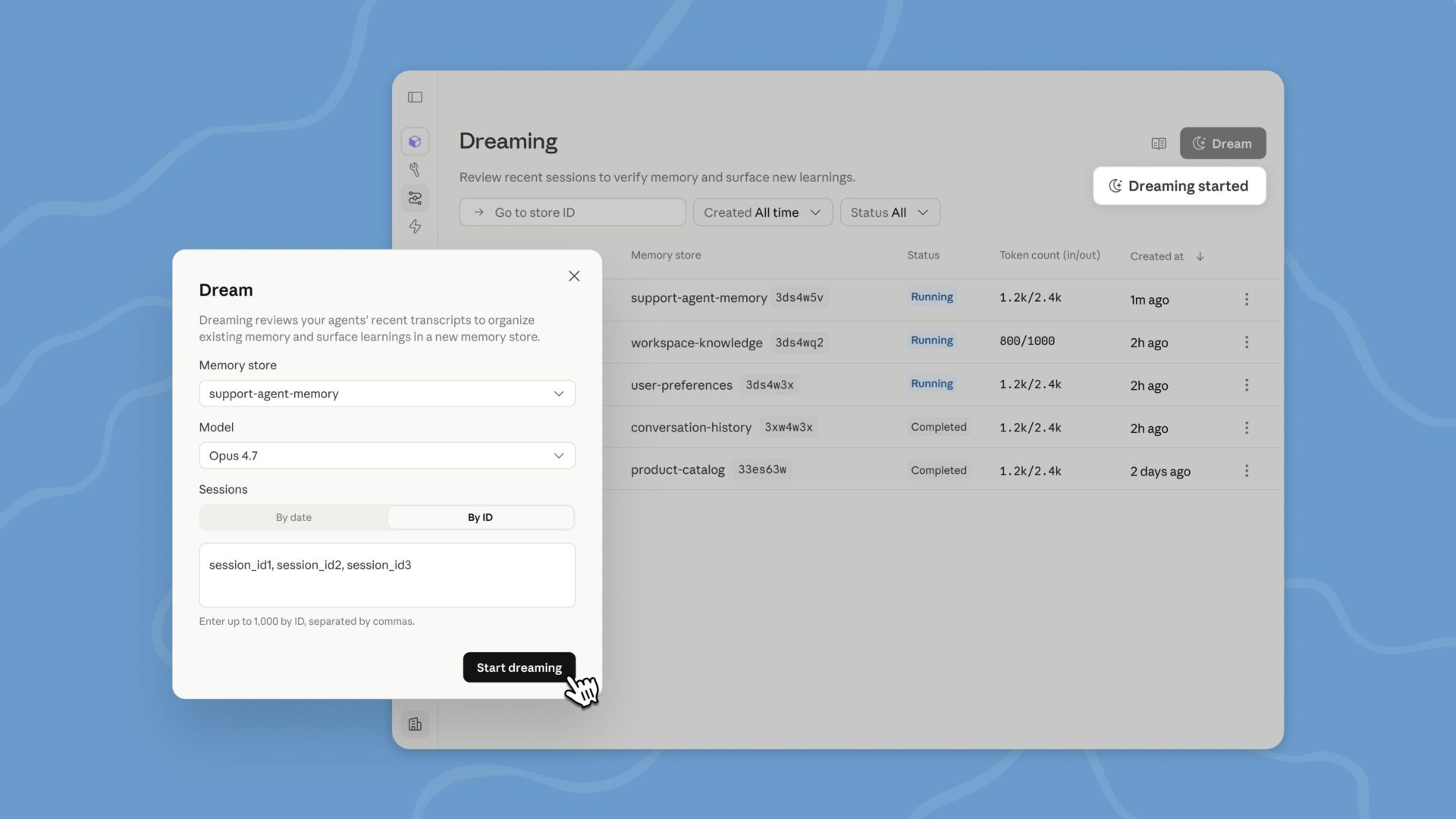
    Dreaming is a scheduled process that reviews your agent sessions and memory stores, extracts patterns, and curates memories so your agents improve over time. You decide how much control you want: dreaming can update memory automatically, or you can review changes before they land.

    Dreaming surfaces patterns that a single agent can’t see on its own, including recurring mistakes, workflows that agents converge on, and preferences shared across a team. It also restructures memory so it stays high-signal as it evolves. This is especially useful for long-running work and multiagent orchestration.

    Together, memory and dreaming form a robust memory system for self-improving agents. Memory lets each agent capture what it learns as it works. Dreaming refines that memory between sessions, pulling shared learnings across agents and keeping it up-to-date.

    Dreaming is available in Managed Agents on the Claude Platform; developers can request access here.

    Deliver better outcomes

    With outcomes, you write a rubric describing what success looks like and the agent works toward it. A separate grader evaluates the output against your criteria in its own context window, so it isn’t influenced by the agent’s reasoning. When something isn’t right, the grader pinpoints what needs to change and the agent takes another pass.

    Agents do their best work when they know what “good” looks like. For example, a structural framework, a presentation standard, or a set of requirements that need to be met. With outcomes, agents can check their work against that bar and self-correct until the output is good enough, without a human needing to review each attempt.

    Outcomes is particularly useful for tasks that require attention to detail and exhaustive coverage. It also works for subjective quality, like whether copy matches a brand voice or a design follows visual guidelines. In testing, outcomes improved task success by up to 10 points over a standard prompting loop, with the largest gains on the hardest problems. Outcomes also improved file generation quality, with +8.4% task success on docx and +10.1% on pptx in our internal benchmarks.

    You can also now define an outcome, let the agent run, and get notified by a webhook when it’s done.

    Handle complex tasks with multiple agents

    When there is too much work for a single agent to do well, multiagent orchestration lets a lead agent break the job into pieces and delegate each one to a specialist with its own model, prompt, and tools. For example, a lead agent can run an investigation while subagents fan out through deploy history, error logs, metrics, and support tickets.

    These specialists work in parallel on a shared filesystem and contribute to the lead agent’s overall context. The lead agent can check back in with other agents mid-workflow because events are persistent and every agent remembers what it’s done. You can also trace every step in the Claude Console: which agent did what, in what order, and why, giving you full visibility into how your task was delegated and executed.


    Source link

    Share. Facebook Twitter Pinterest LinkedIn Tumblr Email

    Related Posts

    A comprehensive Guide to Build SaaS Applications

    May 3, 2026

    Runpod Launches Flash: The Fastest Way to Deploy AI Inference

    May 2, 2026

    Structured-Prompt-Driven Development (SPDD)

    April 30, 2026

    What’s the Difference & Which One Do You Need?

    April 27, 2026

    When Production Logs Become Your Best QA Asset

    April 26, 2026

    Enhancing Web Design: Recognizing Accessibility Issues Now

    April 25, 2026
    Top Posts

    Understanding U-Net Architecture in Deep Learning

    November 25, 202536 Views

    Hard-braking events as indicators of road segment crash risk

    January 14, 202626 Views

    Redefining AI efficiency with extreme compression

    March 25, 202625 Views
    Don't Miss

    Health and wellness influencers dominate social media. A new report shines a light on who they actually are.

    May 7, 2026

    A generation or two ago, when you had a medical question, the solution was obvious:…

    The Best Risk Mitigation Strategy in Data? A Single Source of Truth – O’Reilly

    May 7, 2026

    Build streaming applications on Amazon Managed Service for Apache Flink with AI-assisted guidance

    May 7, 2026

    Microsoft’s clean energy target under pressure from AI data centres

    May 7, 2026
    Stay In Touch
    • Facebook
    • Instagram
    About Us

    At GeekFence, we are a team of tech-enthusiasts, industry watchers and content creators who believe that technology isn’t just about gadgets—it’s about how innovation transforms our lives, work and society. We’ve come together to build a place where readers, thinkers and industry insiders can converge to explore what’s next in tech.

    Our Picks

    Health and wellness influencers dominate social media. A new report shines a light on who they actually are.

    May 7, 2026

    The Best Risk Mitigation Strategy in Data? A Single Source of Truth – O’Reilly

    May 7, 2026

    Subscribe to Updates

    Please enable JavaScript in your browser to complete this form.
    Loading
    • About Us
    • Contact Us
    • Disclaimer
    • Privacy Policy
    • Terms and Conditions
    © 2026 Geekfence.All Rigt Reserved.

    Type above and press Enter to search. Press Esc to cancel.