

An air-dominant, 3D-nanoprinted waveguide combines rapid molecular access with low-loss optical confinement, creating new possibilities for compact sensors and quantum photonic interfaces.
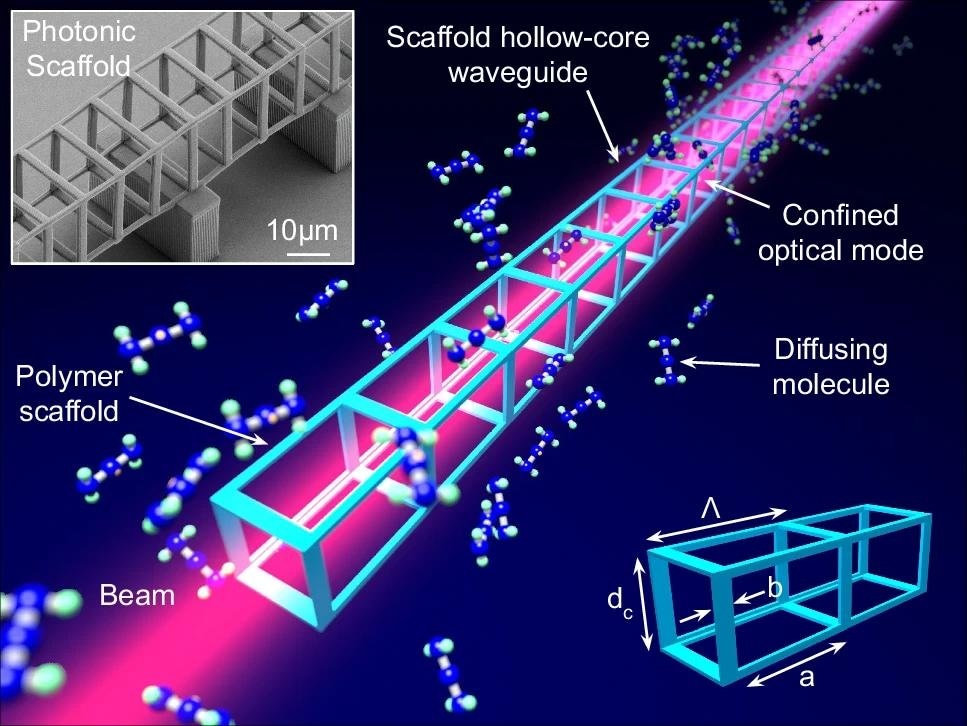
Artistic illustration of the segmented on-chip hollow-core waveguide – the Photonic Scaffold – that includes ultrahigh cladding-openness fraction, allowing light guidance in an air-dominated geometry. Paper: Photonic scaffolds as ultrahigh-openness on-chip hollow-core waveguides for quantum photonics and optofluidics
A recent study published in the journal Nature Communications introduced ‘Photonic Scaffolds’, a new class of open-membrane hollow-core optical waveguide featuring a cladding openness of up to 80%.
Models predicted attenuation at or below 1 dB/mm at this openness, while experiments measured sub-1 dB/mm losses at 68% openness. Utilizing high-precision three-dimensional (3D) two-photon nanoprinting, researchers created a structure that allows rapid lateral diffusion into the light-guiding air core while retaining low-loss guidance.
This platform enabled molecular diffusion in less than one minute and transmitted quantum-dot emission near 894 nm while preserving single-photon characteristics. Reducing the slow mass-transport limitations of conventional hollow-core waveguides could support applications in quantum memories, chemical sensing, and biological sensing.
Challenges in Conventional Hollow-Core Waveguides
Miniaturized photonic circuits rely heavily on strong light-matter interactions for applications such as optical processing, quantum information systems, and chemical sensing. However, guiding light through low-refractive-index media, such as gases and liquids, poses significant challenges because conventional waveguides rely on total internal reflection, which requires the waveguiding core to have a higher refractive index than the surrounding cladding.
To address this limitation, scientists developed anti-resonant hollow-core optical fibers and planar anti-resonant reflecting optical waveguides, which confine light within low-index media. Although these designs provide efficient light guidance, their hollow channels limit lateral access, forcing gases and liquids to diffuse only along the waveguide. In vapor-based quantum technologies, this slow transport can take months to reach adequate concentrations within the core.
Design and Fabrication of Photonic Scaffolds
To overcome the limitations of lateral access and optical confinement, researchers developed the Photonic Scaffold, a dielectric polymer structure surrounding a square hollow core measuring 20–30 μm across. They investigated two designs: Type I, featuring a symmetric arrangement of periodic membrane openings around the core, and Type II, which introduces a half-period shift between vertical and horizontal openings along the waveguide.
The scaffolds were fabricated using two-photon polymerization direct laser writing on a Nanoscribe GT2 system with IP-Dip2 photoresist. The structures were printed horizontally on silicon substrates, supported by vertical micro-pillars to avoid substrate-induced optical effects, and produced with approximately 1.3 μm membrane thicknesses over lengths of up to 30 mm. Light confinement was achieved through anti-resonant reflection and Bloch modes within the membrane structure.
To analyze optical behavior, the study developed a segmented leaky-mode slab-waveguide resonator model that simulated modal decay and power loss. This model demonstrated that the periodic design produced extremely narrow stop bands with longitudinal periodicity-induced reflectivity below 4%, even for 2,000 unit cells. Separate loss simulations indicated that removing approximately 80% of the cladding could maintain attenuation at or below 1 dB/mm.
Experimental Validation of Optical Performance
Optical characterization using a broadband supercontinuum light source across the visible and near-infrared spectrum confirmed that the Photonic Scaffold supports anti-resonant light guidance. The measured transmission spectra showed alternating high-transmission bands and resonance dips that closely matched theoretical predictions. Scaffolds with cladding openness of up to 80% continued to guide light, while experimental propagation losses remained below 1 dB/mm at 68% openness.
Cut-length measurements showed propagation losses of about 0.42–0.93 dB/mm in air for Type I scaffolds with 22 μm and 26 μm core widths. When immersed in water, optical losses were 0.15–0.39 dB/mm at selected visible wavelengths, but reached 0.95 dB/mm at 990 nm due to near-infrared water absorption, demonstrating efficient light guidance in liquid media.
Experimental coupling efficiencies ranged from approximately 23% to 25%. The experimental results supported the theoretical model, showing that removing much of the solid cladding reduced surface-scattering losses, offsetting the small increase in diffractive leakage caused by the open side gaps. The large hollow core maintained strong optical confinement within a nanoliter-scale effective light-liquid interaction volume despite the highly open structure.
Applications in Quantum Photonics and Sensing
The high cladding openness of the Photonic Scaffold enables several important applications in sensing and quantum photonics. In optofluidic spectroscopy, a 9.8 mm-long scaffold immersed in Rhodamine 6G solutions accurately reproduced the dye’s characteristic absorption peak at 527 nm across concentrations up to 25 μM. The measured molar attenuation coefficient of 7.681 μM−1 m−1 and a detection limit of 0.0731 μM closely matched bulk-reference measurements. Separately, the 5 mm diffusion configuration had an estimated effective light-liquid interaction volume of 1.4 nL, although the total liquid reservoir was much larger.
The open structure facilitated rapid molecular transport. During dye diffusion, the scaffold reached a predefined transmission threshold in about 34 seconds, compared with more than 132 minutes for a reference silica capillary used as a proxy for an end-access hollow channel. This represents approximately a 232-fold improvement while maintaining an effective light-liquid interaction volume approximately 60 times smaller than the capillary.
The platform also demonstrated compatibility with quantum photonic applications. Single photons emitted from a quantum dot in a cryogenic micropillar cavity were successfully guided through a Type II scaffold, preserving photon statistics consistent with single-photon emission.
Future Prospects for Integrated Photonics
In summary, the development of Photonic Scaffolds expands the design possibilities for integrated hollow-core waveguides. By demonstrating light guidance in structures with approximately 80% cladding openness and experimentally measuring losses below 1 dB/mm at 68% openness, researchers showed that highly open waveguides can achieve performance comparable to conventional enclosed designs while providing rapid lateral access to the hollow core.
Future work could integrate these waveguides with fiber-interfaced silicon chips and microfluidic systems to enable compact, low-volume analytical devices. The open architecture is promising for warm-vapor quantum technologies because it may enable faster filling with alkali vapors like rubidium and cesium, while potentially reducing surface-induced decoherence and atomic adhesion. Beyond quantum applications, the platform could support real-time biological and environmental sensing, nanoparticle tracking, and on-chip gas sensing, although these applications were not tested in this study.
Source:
- Huang, W., Pereira, D., Zeisberger, M., Said, H., Gómez-López, E., Sun, J., Benson, O., & Schmidt, M. A. (2026). Photonic scaffolds as ultrahigh-openness on-chip hollow-core waveguides for quantum photonics and optofluidics. Nature Communications, 17(1), 7563. DOI: 10.1038/s41467-026-75873-1, https://www.nature.com/articles/s41467-026-75873-1