

Close Menu
geekfence.comgeekfence.com
    What's Hot

    AI infrastructure startup TensorX raises €8m

    June 23, 2026

    The Download: the future of chipmaking and Anthropic’s government clash

    June 23, 2026

    Comarch User Group 2026: Navigating the 2% Growth Trap with Agentic AI and Composable Architecture

    June 23, 2026
    Facebook X (Twitter) Instagram
    • About Us
    • Contact Us
    Facebook Instagram
    geekfence.comgeekfence.com
    • Home
    • UK Tech News
    • AI
    • Big Data
    • Cyber Security
      • Cloud Computing
      • iOS Development
    • IoT
    • Mobile
    • Software
      • Software Development
      • Software Engineering
    • Technology
      • Green Technology
      • Nanotechnology
    • Telecom
    geekfence.comgeekfence.com
    Home»Nanotechnology»Material limits of Spain’s energy transition – Physics World
    Nanotechnology

    Material limits of Spain’s energy transition – Physics World

    AdminBy AdminJune 21, 2026No Comments2 Mins Read2 Views
    Facebook Twitter Pinterest LinkedIn Telegram Tumblr Email
    Material limits of Spain’s energy transition – Physics World
    Share
    Facebook Twitter LinkedIn Pinterest Email


    Spain can rapidly expand renewable energy, but the study shows this is only sustainable if overall material and energy demand is reduced

    Green energy and the economy illustration

    Green energy and the economy illustration (Courtesy: iStock/Galeanu Mihai)

    Spain’s transition to a low‑carbon economy requires expanding renewable technologies such as wind, solar, and electric vehicles. These technologies depend on specific materials, and demand for materials, such as cobalt, lithium, and nickel, already represents a significant share of Spain’s total use.

    The researchers analysed how much materials Spain would need up to 2050 under different decarbonisation pathways. They enhanced the MEDEAS‑Spain model by adding sector‑specific material intensities, improving the tracking of material stocks and flows, and expanding coverage to more than forty materials, a comprehensive assessment of the material requirements of decarbonisation.

    They evaluated three scenarios: Spain’s official energy and climate plan (PNIEC‑LTDS), a scenario where economic demand stops growing after 2025 (CappedEcon), and a Sufficiency scenario where consumption is reduced in a sectorally explicit manner  to levels consistent with decent living standards.

    While low-carbon technologies require large quantities of materials, most material demand comes from wider (unrelated to decarbonisation) economic activities. As a result, and as shown in the figure below, the PNIEC-LTDS, which features a high level of economic growth, increases the material footprint by 51% between 2025 and 2050. In contrast, the Sufficiency scenario reduces the material footprint by over 50% while reducing greenhouse gas emissions by 93%.
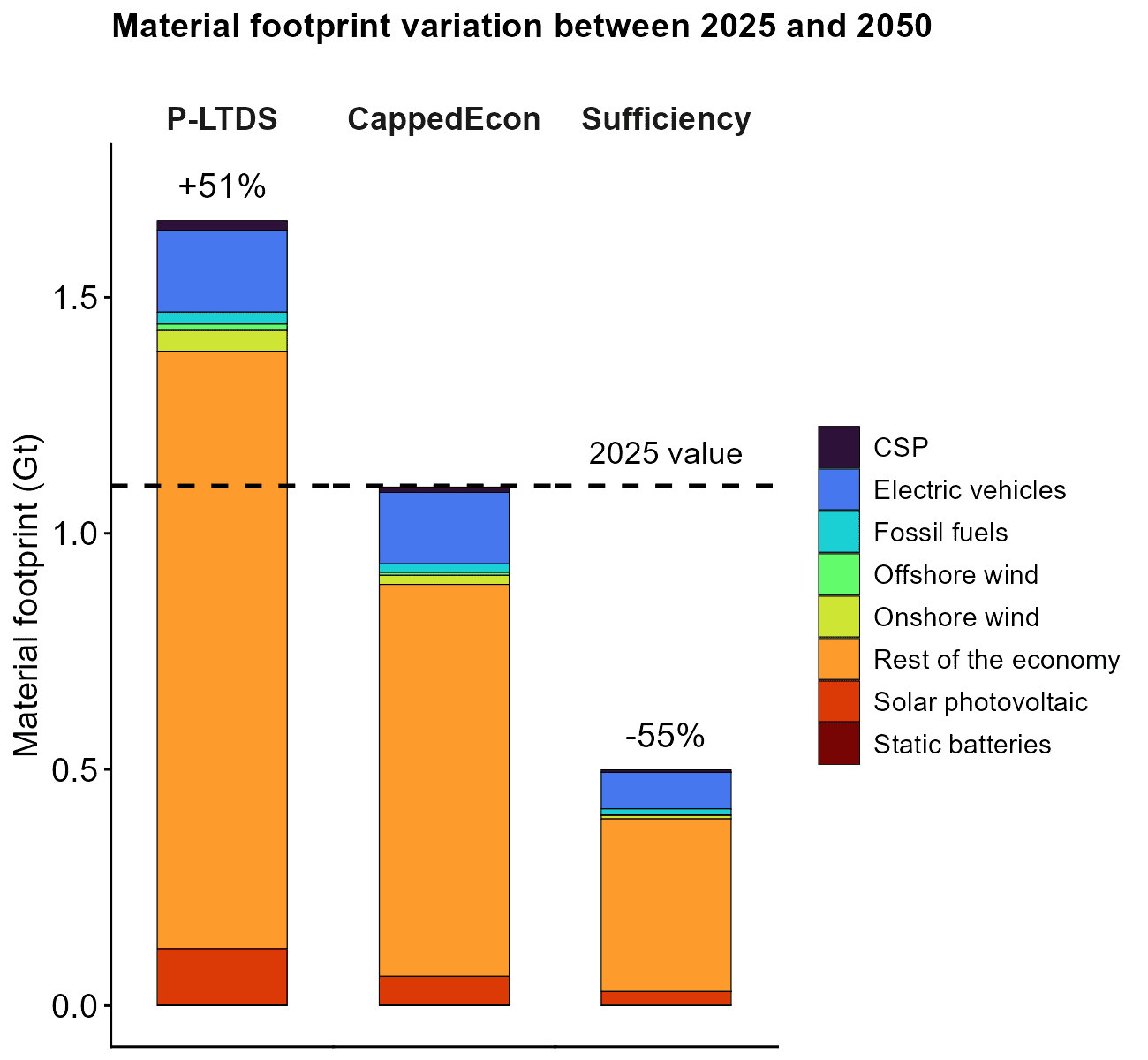
    Material footprint variation adapted from Aramendia et al. 2026

    The study concludes that a rapid expansion of renewable energy is only environmentally sustainable if overall material and energy demand is reduced. Green‑growth pathways sharply increase material use, whereas sufficiency‑based post‑growth approaches enable deep decarbonisation with far lower resource pressure. Ultimately, consumption levels determine the sustainability of the transition.

    Do you want to learn more about this topic?

    Africa’s critical minerals can power the global low-carbon transition N S Ouedraogo and J M M Kilolo (2024)


    Source link

    Share. Facebook Twitter Pinterest LinkedIn Tumblr Email

    Related Posts

    Ultrafast, reconfigurable all-optical beam steering and spatial light modulation

    June 22, 2026

    Vistec Showcases Momentum in E-Beam Lithography for Photonics and Advanced Semiconductor Applications at EMLC 2026

    June 20, 2026

    Superconductivity breakthrough could unlock ultra-efficient electronics

    June 19, 2026

    Precision-engineered STING agonist nanoparticles enable coordinated mucosal-systemic immunity for durable pan-β-coronavirus protection

    June 17, 2026

    Issue 87

    June 16, 2026

    Shear strain reshapes magic angle graphene – Physics World

    June 15, 2026
    Top Posts

    Understanding U-Net Architecture in Deep Learning

    November 25, 202555 Views

    Hard-braking events as indicators of road segment crash risk

    January 14, 202630 Views

    Redefining AI efficiency with extreme compression

    March 25, 202627 Views
    Don't Miss

    AI infrastructure startup TensorX raises €8m

    June 23, 2026

    A team of Irish founders has committed €8 million to Nvidia Blackwell GPUs, including the…

    The Download: the future of chipmaking and Anthropic’s government clash

    June 23, 2026

    Comarch User Group 2026: Navigating the 2% Growth Trap with Agentic AI and Composable Architecture

    June 23, 2026

    Clustering Unstructured Text with LLM Embeddings and HDBSCAN

    June 23, 2026
    Stay In Touch
    • Facebook
    • Instagram
    About Us

    At GeekFence, we are a team of tech-enthusiasts, industry watchers and content creators who believe that technology isn’t just about gadgets—it’s about how innovation transforms our lives, work and society. We’ve come together to build a place where readers, thinkers and industry insiders can converge to explore what’s next in tech.

    Our Picks

    AI infrastructure startup TensorX raises €8m

    June 23, 2026

    The Download: the future of chipmaking and Anthropic’s government clash

    June 23, 2026

    Subscribe to Updates

    Please enable JavaScript in your browser to complete this form.
    Loading
    • About Us
    • Contact Us
    • Disclaimer
    • Privacy Policy
    • Terms and Conditions
    © 2026 Geekfence.All Rigt Reserved.

    Type above and press Enter to search. Press Esc to cancel.