
Close Menu
geekfence.comgeekfence.com
    What's Hot

    AI turns Elisa’s idle batteries into energy grid support

    May 28, 2026

    Samsung and Massachusetts General Hospital Launch Joint Study To Investigate GLP-1 Treatment Monitoring With Galaxy Watch – Samsung Global Newsroom

    May 28, 2026

    SecureFlag launches AI-Assisted Development Labs to  tackle security risks in AI-generated code

    May 28, 2026
    Facebook X (Twitter) Instagram
    • About Us
    • Contact Us
    Facebook Instagram
    geekfence.comgeekfence.com
    • Home
    • UK Tech News
    • AI
    • Big Data
    • Cyber Security
      • Cloud Computing
      • iOS Development
    • IoT
    • Mobile
    • Software
      • Software Development
      • Software Engineering
    • Technology
      • Green Technology
      • Nanotechnology
    • Telecom
    geekfence.comgeekfence.com
    Home»Nanotechnology»Long range attraction between like charged particles – Physics World
    Nanotechnology

    Long range attraction between like charged particles – Physics World

    AdminBy AdminApril 23, 2026No Comments2 Mins Read3 Views
    Facebook Twitter Pinterest LinkedIn Telegram Tumblr Email
    Long range attraction between like charged particles – Physics World
    Share
    Facebook Twitter LinkedIn Pinterest Email


    Direct measurements show that electrosolvation forces can bring particles together and holds them in long-lived bound states
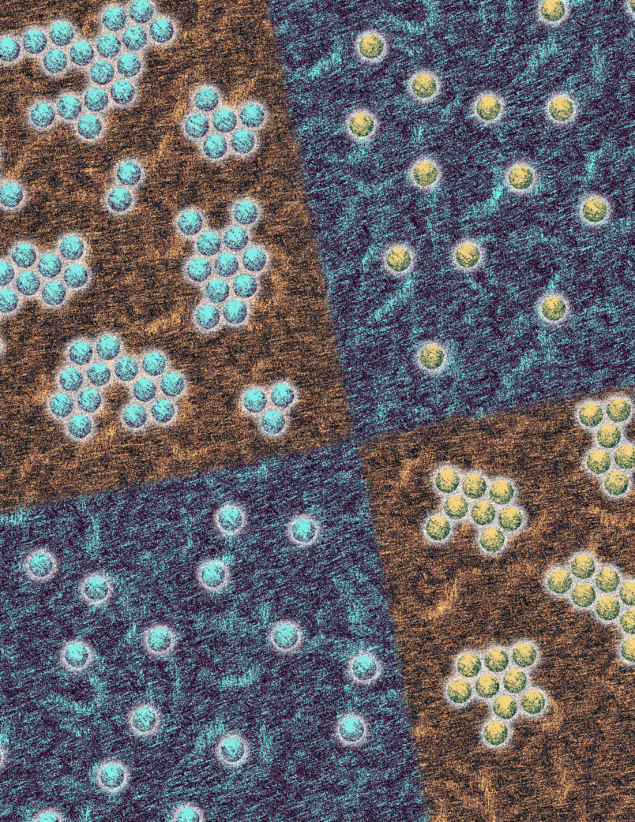
    Artistic image of solvent dependent cluster formation

    Artistic image of solvent dependent cluster formation (Courtesy: Krishnan/University of Oxford)

    A fundamental theory in electrostatics is that two particles with the same charge will repel and two particles with opposite charge will attract. This idea is built into most models that describe how particles behave in liquids. Yet over the past several decades, experiments have revealed that like charged particles can attract each other in solution, forming clusters that standard theories cannot explain. 

    In this work, researchers explore this unusual phenomenon and find that the attraction between like‑charged particles is strong, long‑ranged, and sensitive to the particles’ surface chemistry and size. Using optical imaging, they directly observed how pairs of charged microscopic spheres interact in different liquids with high precision. They tested particles with various surface coatings, including DNA and lipid bilayers, the same material that forms cell membranes. 

    Conventional electrostatic models treat the solvent as a uniform medium with a single dielectric constant, but real solvents (such as water) have structure, form hydrogen bond networks, orient themselves around charged surfaces, and can exhibit long‑range correlations. This research suggests that the way water molecules organise around charged surfaces creates an additional attractive force, known as the electrosolvation force. DNA coated and lipid coated particles show especially long‑range attraction, indicating that the interaction depends not only on the solvent but also on the chemical and structural properties of the particle surface. 

    Overall, this work shows that like charged particles can attract each other over unexpectedly long distances, something current theories say should not happen, revealing a missing piece in our understanding of electrostatic forces in liquids. These insights could reshape models of biological self-organisation and help explain how molecules such as DNA, RNA, and membranes naturally cluster and form structures inside cells. 

    “We are really excited about this emerging discovery and the possibility that what has been uncovered so far on interactions in fluids may be just the tip of the iceberg…” – Professor Madhavi Krishnan, University of Oxford

    Do you want to learn more about this topic?

    Assembly of colloidal particles in solution by Kun Zhao and Thomas G Mason (2018)


    Source link

    Share. Facebook Twitter Pinterest LinkedIn Tumblr Email

    Related Posts

    Large Hadron Collider detects strange particle behavior that could rewrite physics

    May 28, 2026

    Moving past size in nanoplastics research

    May 26, 2026

    Global funding, government initiatives and the company landscape

    May 25, 2026

    Flying focus wakefields open a new acceleration regime – Physics World

    May 24, 2026

    Automation-Driven Software for Reproducible Mechanical Testing Across Nano to Macro Scales

    May 23, 2026

    Ancient chemistry trick unlocks new type of glass that traps CO2 and hydrogen

    May 22, 2026
    Top Posts

    Understanding U-Net Architecture in Deep Learning

    November 25, 202546 Views

    Hard-braking events as indicators of road segment crash risk

    January 14, 202629 Views

    Redefining AI efficiency with extreme compression

    March 25, 202627 Views
    Don't Miss

    AI turns Elisa’s idle batteries into energy grid support

    May 28, 2026

    Elisa Estonia has deployed an AI optimisation solution across its mobile network to convert backup…

    Samsung and Massachusetts General Hospital Launch Joint Study To Investigate GLP-1 Treatment Monitoring With Galaxy Watch – Samsung Global Newsroom

    May 28, 2026

    SecureFlag launches AI-Assisted Development Labs to  tackle security risks in AI-generated code

    May 28, 2026

    Autonomous Drone Delivery at Scale

    May 28, 2026
    Stay In Touch
    • Facebook
    • Instagram
    About Us

    At GeekFence, we are a team of tech-enthusiasts, industry watchers and content creators who believe that technology isn’t just about gadgets—it’s about how innovation transforms our lives, work and society. We’ve come together to build a place where readers, thinkers and industry insiders can converge to explore what’s next in tech.

    Our Picks

    AI turns Elisa’s idle batteries into energy grid support

    May 28, 2026

    Samsung and Massachusetts General Hospital Launch Joint Study To Investigate GLP-1 Treatment Monitoring With Galaxy Watch – Samsung Global Newsroom

    May 28, 2026

    Subscribe to Updates

    Please enable JavaScript in your browser to complete this form.
    Loading
    • About Us
    • Contact Us
    • Disclaimer
    • Privacy Policy
    • Terms and Conditions
    © 2026 Geekfence.All Rigt Reserved.

    Type above and press Enter to search. Press Esc to cancel.