
Close Menu
geekfence.comgeekfence.com
    What's Hot

    Make the guest delighted before they checkout Stephen O’Sullivan, founder I left you a note

    August 1, 2026

    Uber is building an autonomous vehicle empire, and here’s every company it’s using to do it

    August 1, 2026

    Building the AI backbone, waiting on the AI billions

    August 1, 2026
    Facebook X (Twitter) Instagram
    • About Us
    • Contact Us
    Facebook Instagram
    geekfence.comgeekfence.com
    • Home
    • UK Tech News
    • AI
    • Big Data
    • Cyber Security
      • Cloud Computing
      • iOS Development
    • IoT
    • Mobile
    • Software
      • Software Development
      • Software Engineering
    • Technology
      • Green Technology
      • Nanotechnology
    • Telecom
    geekfence.comgeekfence.com
    Home»Nanotechnology»“Great Unified Microscope” reveals micro and nano worlds in a single view
    Nanotechnology

    “Great Unified Microscope” reveals micro and nano worlds in a single view

    AdminBy AdminNovember 18, 2025No Comments3 Mins Read3 Views
    Facebook Twitter Pinterest LinkedIn Telegram Tumblr Email
    “Great Unified Microscope” reveals micro and nano worlds in a single view
    Share
    Facebook Twitter LinkedIn Pinterest Email


    Researchers Kohki Horie, Keiichiro Toda, Takuma Nakamura, and Takuro Ideguchi at the University of Tokyo have created a microscope capable of detecting signals across an intensity range fourteen times broader than that of standard instruments. The system also works label-free, meaning it does not rely on added dyes. This gentle approach allows cells to remain unharmed during long-term imaging, which could benefit testing and quality control in pharmaceutical and biotechnology settings. The study appears in Nature Communications.

    Microscopes have driven scientific progress since the 16th century, but major improvements have often required increasingly specialized tools. As techniques became more advanced, they also faced tradeoffs in what they could measure. Quantitative phase microscopy (QPM) uses forward-scattered light to visualize structures at the microscale (in this study, over 100 nanometers), which makes it useful for capturing still images of complex cell features. However, QPM cannot detect very small particles. Interferometric scattering (iSCAT) microscopy works differently by capturing back-scattered light and can detect structures as tiny as single proteins. While iSCAT enables researchers to “track” individual particles and observe rapid changes inside cells, it lacks the wider view offered by QPM.

    Capturing Two Directions of Light at Once

    “I would like to understand dynamic processes inside living cells using non-invasive methods,” says Horie, one of the first authors.

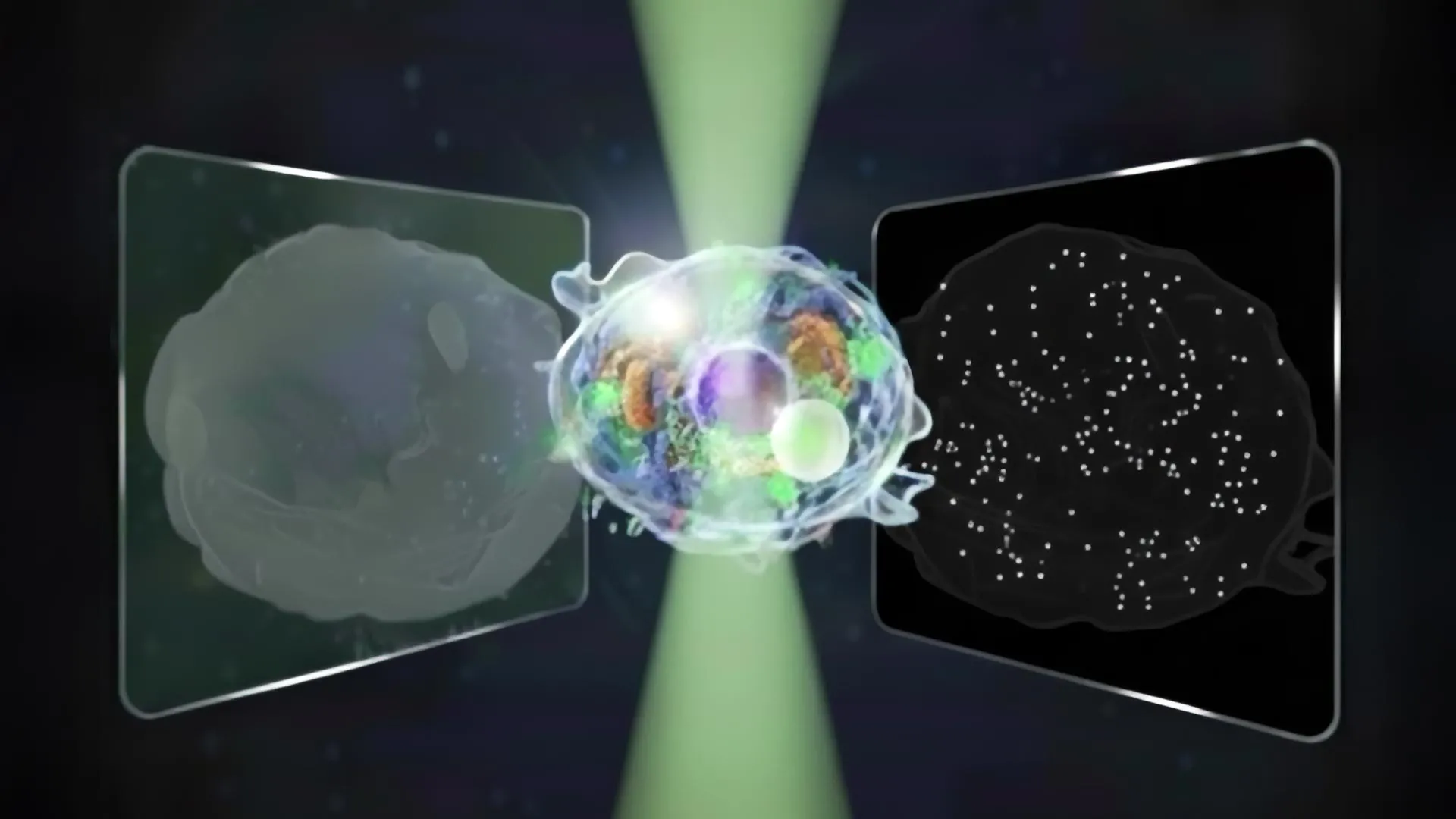
    Motivated by this goal, the team examined whether collecting light from both directions at the same time could bridge the gap and reveal activity across a broad range of sizes and motions in a single image. To explore the idea and confirm that their microscope performed as expected, they observed how cells behaved during cell death. In one experiment, they captured an image that contained information from both forward- and backward-traveling light.

    Separating Overlapping Signals

    “Our biggest challenge,” Toda, another first author, explains, “was cleanly separating two kinds of signals from a single image while keeping noise low and avoiding mixing between them.”

    The researchers succeeded in identifying the movement of larger cell structures (micro) as well as much smaller particles (nano). By comparing the patterns in forward- and back-scattered light, they could estimate each particle’s size and its refractive index, which describes how strongly light bends or scatters when it passes through a material.

    Future Applications for Smaller Particles

    “We plan to study even smaller particles,” Toda says, already thinking about future research, “such as exosomes and viruses, and to estimate their size and refractive index in different samples. We also want to reveal how living cells move toward death by controlling their state and double-checking our results with other techniques.”


    Source link

    Share. Facebook Twitter Pinterest LinkedIn Tumblr Email

    Related Posts

    Understanding core-shell nanoparticle growth – Physics World

    August 1, 2026

    Nano-Printed Scaffolds Bring Direct Molecular Access to Quantum Photonics

    July 31, 2026

    Ultrafast X-rays capture chemistry unfolding atom by atom

    July 30, 2026

    Hidden spin-valley locking stabilizes nanosecond spin polarization in 2D perovskites

    July 28, 2026

    Tescan Unveils the New CLARA to Help Researchers See More at the Nanoscale

    July 26, 2026

    New programmable photonic chip can control how fast light moves

    July 25, 2026
    Top Posts

    Understanding U-Net Architecture in Deep Learning

    November 25, 202567 Views

    The Next Paradigm in Efficient Inference Scaling – The Berkeley Artificial Intelligence Research Blog

    May 16, 202636 Views

    Hard-braking events as indicators of road segment crash risk

    January 14, 202634 Views
    Don't Miss

    Make the guest delighted before they checkout Stephen O’Sullivan, founder I left you a note

    August 1, 2026

    The Local Enterprise Awards for 2026 taok place recently in the Mansion House in Dublin.…

    Uber is building an autonomous vehicle empire, and here’s every company it’s using to do it

    August 1, 2026

    Building the AI backbone, waiting on the AI billions

    August 1, 2026

    The End-to-End Agentic AI Pipeline

    August 1, 2026
    Stay In Touch
    • Facebook
    • Instagram
    About Us

    At GeekFence, we are a team of tech-enthusiasts, industry watchers and content creators who believe that technology isn’t just about gadgets—it’s about how innovation transforms our lives, work and society. We’ve come together to build a place where readers, thinkers and industry insiders can converge to explore what’s next in tech.

    Our Picks

    Make the guest delighted before they checkout Stephen O’Sullivan, founder I left you a note

    August 1, 2026

    Uber is building an autonomous vehicle empire, and here’s every company it’s using to do it

    August 1, 2026

    Subscribe to Updates

    Please enable JavaScript in your browser to complete this form.
    Loading
    • About Us
    • Contact Us
    • Disclaimer
    • Privacy Policy
    • Terms and Conditions
    © 2026 Geekfence.All Rigt Reserved.

    Type above and press Enter to search. Press Esc to cancel.