

Close Menu
geekfence.comgeekfence.com
    What's Hot

    APple’s future success with smart glasses depends on privacy – Computerworld

    July 27, 2026

    2022 IEEE President K.J. Ray Liu Honored for Leadership

    July 27, 2026

    How lasers could help provide fuel for nuclear reactors

    July 27, 2026
    Facebook X (Twitter) Instagram
    • About Us
    • Contact Us
    Facebook Instagram
    geekfence.comgeekfence.com
    • Home
    • UK Tech News
    • AI
    • Big Data
    • Cyber Security
      • Cloud Computing
      • iOS Development
    • IoT
    • Mobile
    • Software
      • Software Development
      • Software Engineering
    • Technology
      • Green Technology
      • Nanotechnology
    • Telecom
    geekfence.comgeekfence.com
    Home»Cyber Security»Grafana says stolen GitHub token let hackers steal codebase
    Cyber Security

    Grafana says stolen GitHub token let hackers steal codebase

    AdminBy AdminMay 18, 2026No Comments3 Mins Read7 Views
    Facebook Twitter Pinterest LinkedIn Telegram Tumblr Email
    Grafana says stolen GitHub token let hackers steal codebase
    Share
    Facebook Twitter LinkedIn Pinterest Email


    Grafana says stolen GitHub token let hackers steal codebase

    Grafana Labs disclosed that hackers have downloaded its source code after breaching its GitHub environment using a stolen access token.

    A relatively new extortion gang known as CoinbaseCartel has claimed the attack by adding Grafana to their data leak site (DLS), although no data has been leaked yet.

    Grafana Labs is the company behind Grafana, the popular open-source platform for analytics, monitoring, and real-time data visualization.

    Paying customers are primarily large enterprises, cloud providers, telecos, banks, governments, e-commerce platforms, and infrastructure operators. According to Grafana, more than 7,000 organizations use the product, including 70% of the Fortune 50 companies.

    No payment for hackers

    In an announcement over the weekend, Grafana Labs said that its investigation found no evidence that customer data or personal information was exposed during the incident. Furthermore, the company notes that customer systems remained unaffected.

    The forensic analysis revealed the source of the leaked credentials. The company “invalidated the compromised credentials and implemented additional security measures” to prevent future unauthorized access.

    The attacker attempted to extort the company, demanding payment in exchange for not publishing the stolen source code. However, Grafana said it chose to follow public guidance from the Federal Bureau of Investigation (FBI) and not pay the ransom, noting that doing so would only encourage other threat actors to pursue similar attacks.

    “Based on our operational experience and the published stance of the FBI, which notes that paying a ransom doesn’t guarantee you or your organization will get any data back and only offers an incentive for others to get involved in this type of illegal activity, we’ve determined the appropriate path forward is not to pay the ransom,” Grafana stated.

    The company said it would release more details about the attack after completing its post-incident investigation.

    BleepingComputer has contacted Grafana with a request for additional details about the breach, but we have not received a response by publishing time.

    CoinbaseCartel escalates activity

    The CoinbaseCartel launched last September and has been quite active this year, announcing more than 100 victims on its data leak portal. The gang focuses on data theft and uses the DLS to pressure victims into paying a ransom.
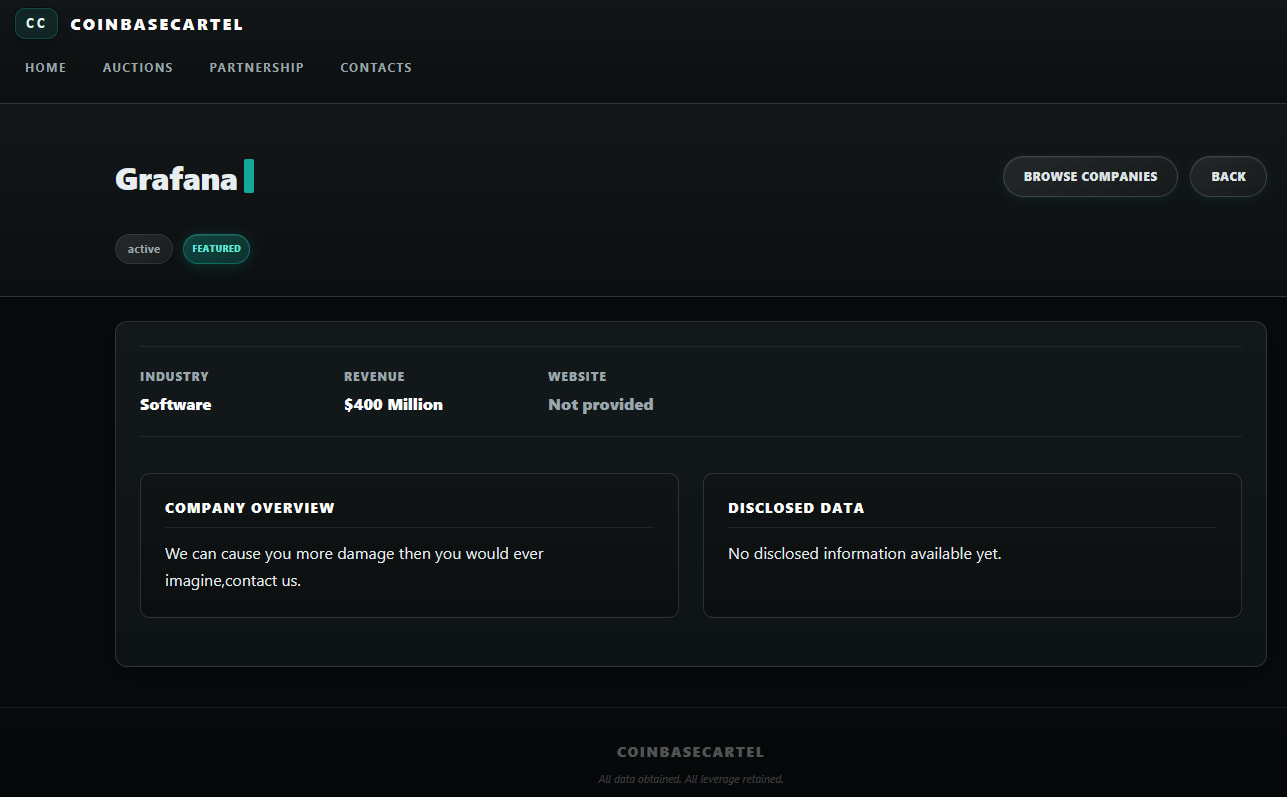
    CoinbaseCartel listing Grafana as on its extortion portal
    CoinbaseCartel listing Grafana on its extortion portal
    Source: BleepingComputer

    The gang announced on its site that they “are behind on many leaks,” indicating increased breaches that may have yet to reach the public space.

    According to multiple researchers, CoinbaseCartel consists of ShinyHunters and Lapsus$ affiliates that gain access to target networks via social engineering, various forms of phishing, and compromised credentials.

    Threat intelligence specialist Joe Shenouda claims that the gang also deploys an in-memory tool called “shinysp1d3r” to encrypt VMware ESXi targets and disable snapshots.

    Last year, BleepingComputer analyzed a ShinySp1d3r Windows encryptor developed by the ShinyHunters extortion group. At the time, the threat actor said that they were working on finishing encryptor versions for Linux and ESXi.


    article image

    Automated pentesting tools deliver real value, but they were built to answer one question: can an attacker move through the network? They were not built to test whether your controls block threats, your detection rules fire, or your cloud configs hold.

    This guide covers the 6 surfaces you actually need to validate.

    Download Now


    Source link

    Share. Facebook Twitter Pinterest LinkedIn Tumblr Email

    Related Posts

    Malvertising Sends Malware in Pieces, Then Makes the Browser Build the Executable

    July 26, 2026

    LG to Ban Residential Proxies from Smart TV Apps – Krebs on Security

    July 25, 2026

    Cyber readiness for SMBs: Getting the basics right

    July 24, 2026

    US Mobile Speeds Jump 74% as Verizon and T-Mobile Split RootMetrics Honors

    July 23, 2026

    How Cisco architected AI-driven support and validated against industry benchmarks

    July 22, 2026

    Ukraine warns fake CAPTCHAs are being used to make you hack yourself

    July 21, 2026
    Top Posts

    Understanding U-Net Architecture in Deep Learning

    November 25, 202566 Views

    Hard-braking events as indicators of road segment crash risk

    January 14, 202634 Views

    Redefining AI efficiency with extreme compression

    March 25, 202632 Views
    Don't Miss

    APple’s future success with smart glasses depends on privacy – Computerworld

    July 27, 2026

    We’ve seen this story After all, since then we’ve seen the likes of Cambridge Analytica…

    2022 IEEE President K.J. Ray Liu Honored for Leadership

    July 27, 2026

    How lasers could help provide fuel for nuclear reactors

    July 27, 2026

    How to Store Petabytes of Data Without Renting It From the Cloud |

    July 27, 2026
    Stay In Touch
    • Facebook
    • Instagram
    About Us

    At GeekFence, we are a team of tech-enthusiasts, industry watchers and content creators who believe that technology isn’t just about gadgets—it’s about how innovation transforms our lives, work and society. We’ve come together to build a place where readers, thinkers and industry insiders can converge to explore what’s next in tech.

    Our Picks

    APple’s future success with smart glasses depends on privacy – Computerworld

    July 27, 2026

    2022 IEEE President K.J. Ray Liu Honored for Leadership

    July 27, 2026

    Subscribe to Updates

    Please enable JavaScript in your browser to complete this form.
    Loading
    • About Us
    • Contact Us
    • Disclaimer
    • Privacy Policy
    • Terms and Conditions
    © 2026 Geekfence.All Rigt Reserved.

    Type above and press Enter to search. Press Esc to cancel.