


In that world, the Chief Information Officer (CIO) is not a buyer of platforms or a keeper of uptime, instead the CIO – the Chief Intelligence Orchestrator, designs how human expertise and autonomous agents learn from each other, supervise each other, and compound value together.
Yes, business units are more involved than ever in technology buying, especially in AI. That’s healthy, demand is closest to the problem. But the center of gravity still sits with the CIO, because only the CIO holds the full picture: architecture, data, risk, interoperability, and the enterprise’s appetite for autonomy. The “new” CIO role is to translate ambition into a governed, scalable operating model where humans and agents co-create outcomes without breaking trust.
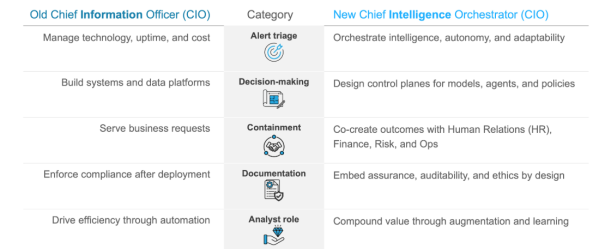 What does that look like in practice? It starts with reframing collaboration. With Human Resources , the CIO co-designs roles, skills, and performance for mixed human–agent teams, including new capabilities such as agent operations, red-teaming, and model stewardship.
With the Chief Finance Officer (CFO), the CIO makes digital labor legible, the total cost of ownership for models and orchestration, capitalization policies, Return on Investment (ROI) for autonomous workflows, and pricing for agent-created products or services. With the Chief Marketing Officer (CMO), the CIO ensures personalization, creative generation, and conversational touchpoints are brand-safe, consent-aware, and measurable end to end.
With the Chief Risk Officer (CRO), the CIO operationalizes assurance, the taxonomy of AI risks, policy-as-code, evaluation gates, audit trails, and kill switches, so speed doesn’t outrun safety. And with the Chief Operating Officer (COO) and data leaders, the CIO connects digital twins, process intelligence, and agentic automation into living operations that anticipate, adapt, and explain their decisions.
This is not “another transformation.” It is a cultural reset. Organizations must move from automation anxiety to augmentation confidence; from project funding to productized AI capabilities; from slideware governance to observable, testable, enforceable controls. The CIO’s job is to make this tangible: a control plane for models and agents (registries, evaluations, prompts and policies as versioned assets), a shared data foundation, and a cadence that converts pilots into scaled, safe outcomes. The real unlock is treating agents as employees you would onboard, train, supervise, and retire, not as one-off tools.
Service providers have a pivotal role in making this executable. The opportunity is larger than implementation, it is co-orchestration. The partners CIOs will elevate are those who bring three things at once:
1) Operating discipline for autonomy. Not just models, but AgentOps: evaluation suites, behavioral guardrails, drift and bias monitoring, observability, incident runbooks, and secure prompt/content pipelines. Providers can stand up for these capabilities faster than most enterprises can assemble them alone, then transition ownership as internal teams mature.
2) Cross-functional change, not just code. Agentic work changes incentives, roles, and metrics. The right SI pairs technical accelerators with playbooks for job redesign, skills, and value realization. That includes helping HR craft career paths for agent operators, enabling finance to track digital labor economics, and giving risk teams living controls rather than static policies.
3) Reusable, outcome-centric assets. Instead of bespoke builds, leading providers bring modular, auditable agents for common enterprise patterns, sales assist, claims triage, supply planning, developer copilots, plus reference architectures and benchmarks. Value is measured in cycle-time compression, revenue lift, customer satisfaction, and controlled risk, not in lines of code.
For CIOs, a pragmatic way forward is to make the strategy concrete in ninety days. Pick two use cases that matter, one revenue, one efficiency, and run them through the same pipeline: define the human–agent split of work; set explicit guardrails and evaluation criteria; wire data and identity thoughtfully; instrument every decision for traceability; and agree upfront on success metrics and an exit path if the agent underperforms.
In parallel, establish the shared control plane (model and prompt registries, policy-as-code, monitoring) so the second and third use cases get cheaper and safer. This is where service providers can compress time, bringing in patterns, platforms, and training that raise the floor for everyone involved.
The reward for getting this right is compounding. When agents learn from outcomes, when product and marketing feed signals back into models, when risk controls are embedded rather than bolted on, each deployment improves the next. That flywheel is the essence of an agentic-first enterprise, and it is the CIO who aligns the gears: business ambition, technical possibility, and organizational readiness. System integrators that lean into co-ownership, sharing playbooks, sharing risk, and sharing upside, will graduate from vendors to transformation partners at the center of the enterprise operating model.
In short: the story is not “CIO vs. Business Units (Bus)” or “AI vs. people.” The story is instead orchestration. Agentic AI creates new forms of leverage, and leverage demands responsibility.
The CIO provides the architecture and the cadence; the business provides the problems and the proof; and the best service providers bring the scaffolding that makes autonomy perform, comply, and scale. That is how enterprises move beyond pilots to a durable advantage, an organization where intelligence is not only everywhere, but accountable.
If you found this blog insightful, you might also enjoy, Meet Your Digital Colleagues: AI Agents And The Next-Gen HR Revolution | Blog – Everest Group, which delves deeper into another topic regarding AI.
To discuss more on the topics discussed in this blog, please reach out to Priya Bhalla ([email protected]) or Abhishek Sengupta ([email protected])