
Close Menu
geekfence.comgeekfence.com
    What's Hot

    Open source Euro-Office productivity suite to launch June 9 – Computerworld

    May 29, 2026

    Open Source Ecosystems – O’Reilly

    May 29, 2026

    Our free-space optics links go where fiber won’t

    May 29, 2026
    Facebook X (Twitter) Instagram
    • About Us
    • Contact Us
    Facebook Instagram
    geekfence.comgeekfence.com
    • Home
    • UK Tech News
    • AI
    • Big Data
    • Cyber Security
      • Cloud Computing
      • iOS Development
    • IoT
    • Mobile
    • Software
      • Software Development
      • Software Engineering
    • Technology
      • Green Technology
      • Nanotechnology
    • Telecom
    geekfence.comgeekfence.com
    Home»Nanotechnology»Emerging quantitative techniques for characterizing nucleic acid-involved molecular interactions
    Nanotechnology

    Emerging quantitative techniques for characterizing nucleic acid-involved molecular interactions

    AdminBy AdminDecember 29, 2025No Comments2 Mins Read1 Views
    Facebook Twitter Pinterest LinkedIn Telegram Tumblr Email
    Emerging quantitative techniques for characterizing nucleic acid-involved molecular interactions
    Share
    Facebook Twitter LinkedIn Pinterest Email


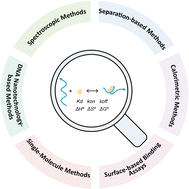
    Molecular interactions involving nucleic acids constitute a fundamental paradigm in biological systems, governing processes ranging from gene expression to cellular signaling. Quantitative characterization of the thermodynamic and kinetic parameters of these interactions is critical not only for deciphering molecular mechanisms but also for rational design in biomedical engineering and nanomaterials science. This review systematically surveys six major categories of quantitative methods used to study nucleic acid interactions: spectroscopic methods, separation-based methods, calorimetric methods, surface-based binding assays, single-molecule methods, and DNA nanotechnology-based methods. Each category is discussed with respect to its principal advantages and inherent limitations. While conventional methods such as electrophoretic mobility shift assays (EMSA), isothermal titration calorimetry (ITC), and spectroscopic titrations have provided foundational insights, they often exhibit constraints in sensitivity, throughput, or applicability under physiologically relevant conditions. Recent advances in DNA nanotechnology, leveraging its inherent programmability and structural precision, have enabled the development of novel quantitative platforms. These include DNA origami-based single-molecule methods and homogeneous assays that support accurate and native thermodynamic profiling, significantly enhancing sensitivity and adaptability in physiologically relevant contexts. This review systematically surveys established methodologies and critically evaluates emerging DNA nanotechnology-driven strategies, highlighting their potential to advance the quantitative analysis of nucleic acid interactions.
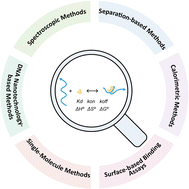
    Graphical abstract: Emerging quantitative techniques for characterizing nucleic acid-involved molecular interactions


    You have access to this article


    Please wait while we load your content…


    Something went wrong. Try again?


    Source link

    Share. Facebook Twitter Pinterest LinkedIn Tumblr Email

    Related Posts

    How AI and Nanotechnology Can Fix America’s Manufacturing Skills Gap

    May 29, 2026

    Large Hadron Collider detects strange particle behavior that could rewrite physics

    May 28, 2026

    Moving past size in nanoplastics research

    May 26, 2026

    Global funding, government initiatives and the company landscape

    May 25, 2026

    Flying focus wakefields open a new acceleration regime – Physics World

    May 24, 2026

    Automation-Driven Software for Reproducible Mechanical Testing Across Nano to Macro Scales

    May 23, 2026
    Top Posts

    Understanding U-Net Architecture in Deep Learning

    November 25, 202546 Views

    Hard-braking events as indicators of road segment crash risk

    January 14, 202630 Views

    Redefining AI efficiency with extreme compression

    March 25, 202627 Views
    Don't Miss

    Open source Euro-Office productivity suite to launch June 9 – Computerworld

    May 29, 2026

    Euro-Office consists of four browser-based applications: a document editor, spreadsheet program, presentation tool, and a…

    Open Source Ecosystems – O’Reilly

    May 29, 2026

    Our free-space optics links go where fiber won’t

    May 29, 2026

    The Download: unlocking lithium and controlling Ebola

    May 29, 2026
    Stay In Touch
    • Facebook
    • Instagram
    About Us

    At GeekFence, we are a team of tech-enthusiasts, industry watchers and content creators who believe that technology isn’t just about gadgets—it’s about how innovation transforms our lives, work and society. We’ve come together to build a place where readers, thinkers and industry insiders can converge to explore what’s next in tech.

    Our Picks

    Open source Euro-Office productivity suite to launch June 9 – Computerworld

    May 29, 2026

    Open Source Ecosystems – O’Reilly

    May 29, 2026

    Subscribe to Updates

    Please enable JavaScript in your browser to complete this form.
    Loading
    • About Us
    • Contact Us
    • Disclaimer
    • Privacy Policy
    • Terms and Conditions
    © 2026 Geekfence.All Rigt Reserved.

    Type above and press Enter to search. Press Esc to cancel.