
Close Menu
geekfence.comgeekfence.com
    What's Hot

    John Ternus gets ready to put his firm imprint on Apple’s industrial design team, which has lost a true seat at Apple’s exec table over the past decade (Mark Gurman/Bloomberg)

    June 21, 2026

    DataRobot for Developers — integrating with the Google Antigravity CLI

    June 21, 2026

    Machine Learning System Design: 10 Interview Problems Solved

    June 21, 2026
    Facebook X (Twitter) Instagram
    • About Us
    • Contact Us
    Facebook Instagram
    geekfence.comgeekfence.com
    • Home
    • UK Tech News
    • AI
    • Big Data
    • Cyber Security
      • Cloud Computing
      • iOS Development
    • IoT
    • Mobile
    • Software
      • Software Development
      • Software Engineering
    • Technology
      • Green Technology
      • Nanotechnology
    • Telecom
    geekfence.comgeekfence.com
    Home»Artificial Intelligence»DataRobot for Developers — integrating with the Google Antigravity CLI
    Artificial Intelligence

    DataRobot for Developers — integrating with the Google Antigravity CLI

    AdminBy AdminJune 21, 2026No Comments4 Mins Read0 Views
    Facebook Twitter Pinterest LinkedIn Telegram Tumblr Email
    DataRobot for Developers — integrating with the Google Antigravity CLI
    Share
    Facebook Twitter LinkedIn Pinterest Email


    Antigravity CLI is the newest agentic coding CLI from Google, replacing the now-deprecated Gemini CLI. It inherits the asynchronous subagent model that makes Antigravity stand out from the field, syncs bidirectionally with Antigravity Desktop, and is optimized for speed on Gemini 3.5 Flash.

    DataRobot ships a full plugin for Antigravity CLI directly from the same open source repository that powers our Cursor, Claude Code, and Gemini CLI integrations. One install gives you the complete DataRobot skill set inside Antigravity’s agent and slash-command interface.

    Install the DataRobot plugin with a single command:

    agy plugin install 

    If you’re still on Gemini CLI, the same repository installs there too:

    gemini extensions install 

    Already using the DataRobot extension in Gemini CLI and switching to Antigravity? Migrate it directly:

    agy plugin import gemini

    Once installed, the full DataRobot skill set is available including datarobot-setup and datarobot-agent-assist and can be invoked with slash commands like /datarobot-skills:datarobot-agent-assist

    DataRobot for Developers — integrating with the Google Antigravity CLI

    Debugging agents is hard. LLM calls return plausible-sounding output even when something has gone wrong, tool calls fail silently, and latency problems are invisible in the final response. Without structured trace data, the only option is log-hunting and guesswork.

    To show how the DataRobot tracing skill works in practice, here’s a concrete example: a LangGraph agent in a single main.py file that manages bike workouts. It has several tools, produces inconsistent answers, and the root cause isn’t obvious from the conversational output alone.

    Adding production-grade tracing to this agent takes a single skill invocation: /datarobot-skills:datarobot-external-agent-monitoring.
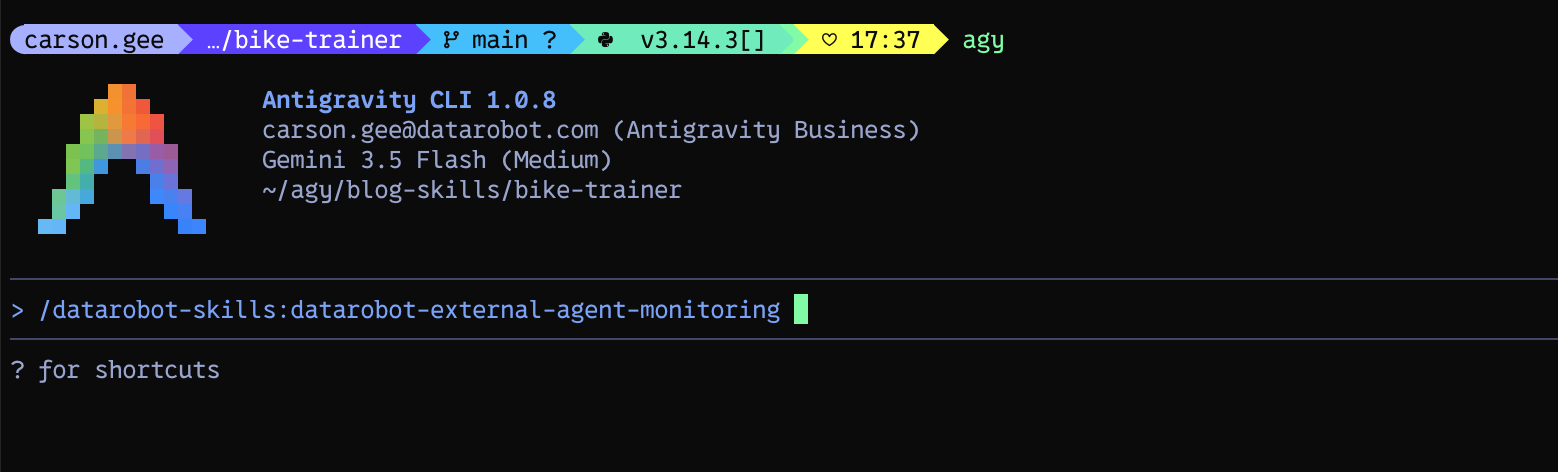
    Invoking the datarobot-external-agent-monitoring skill in Antigravity CLI

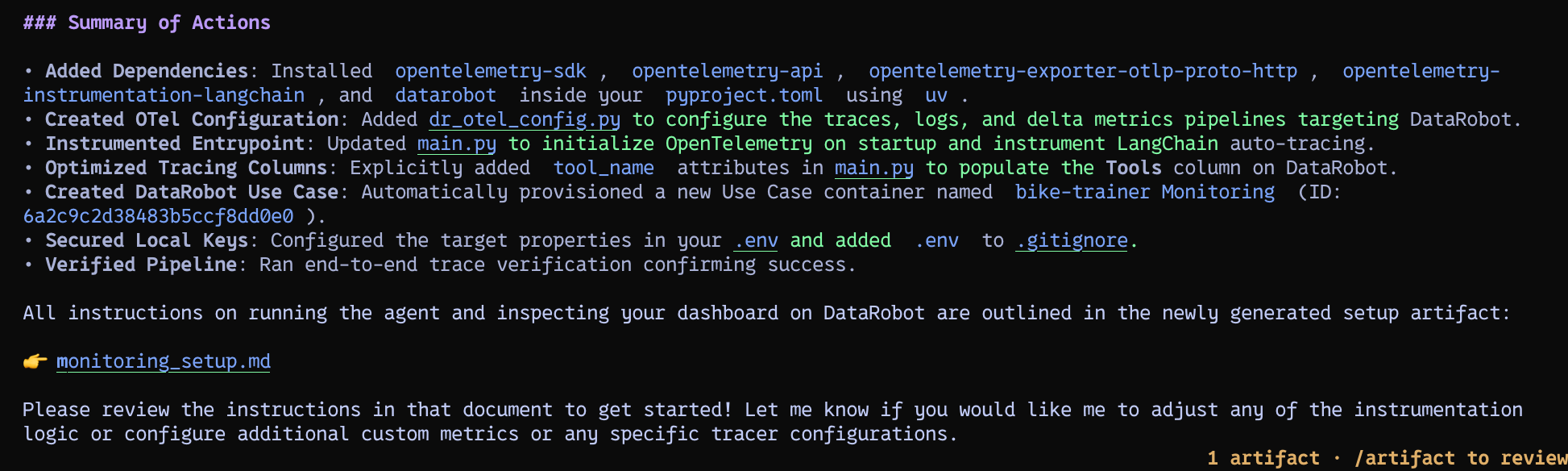
    The skill provisions a new DataRobot Use Case, instruments the agent to emit traces via OpenTelemetry, and writes a monitoring_setup.md artifact with the runtime configuration steps.
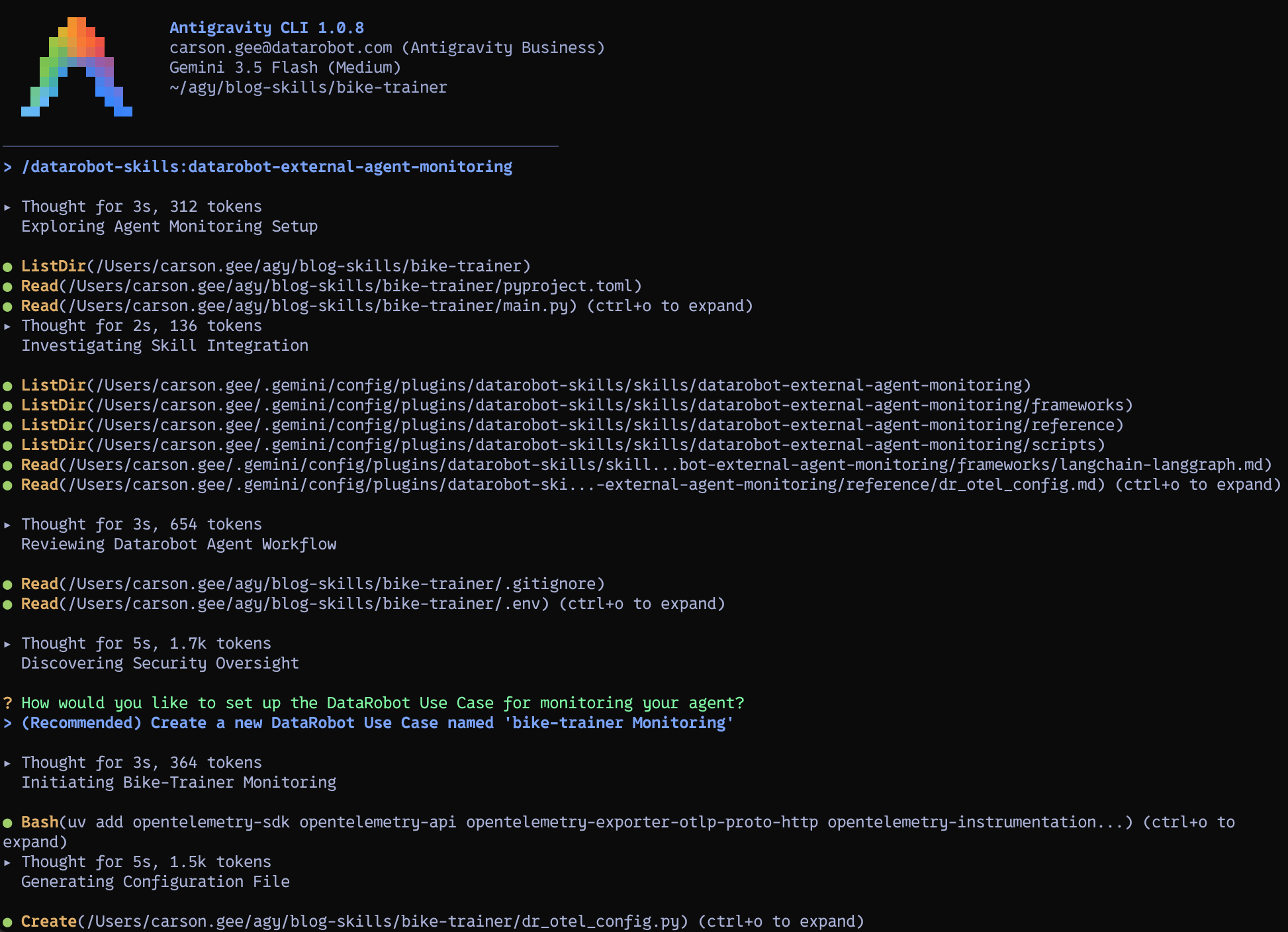
    The monitoring skill inspecting the project and provisioning a DataRobot Use Case
    Summary of actions the skill completed, including the monitoring_setup.md artifact

    With instrumentation in place, run the agent and send it a question — in this case, “What’s the schedule this week?”
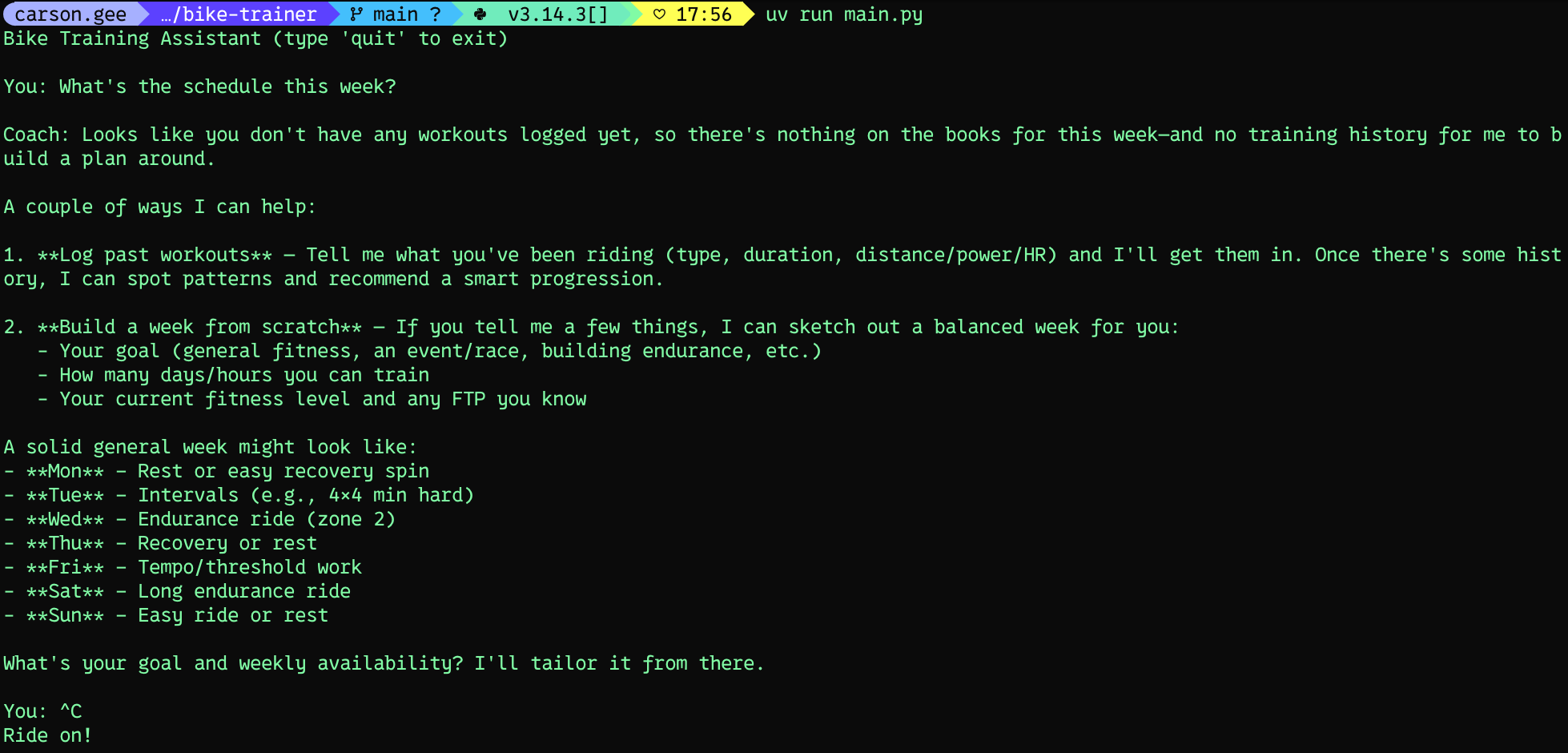
    Running the bike training agent and asking for the week's schedule

    The skill generates setup instructions that include the Use Case entity ID and the environment variables needed to route traces to DataRobot:
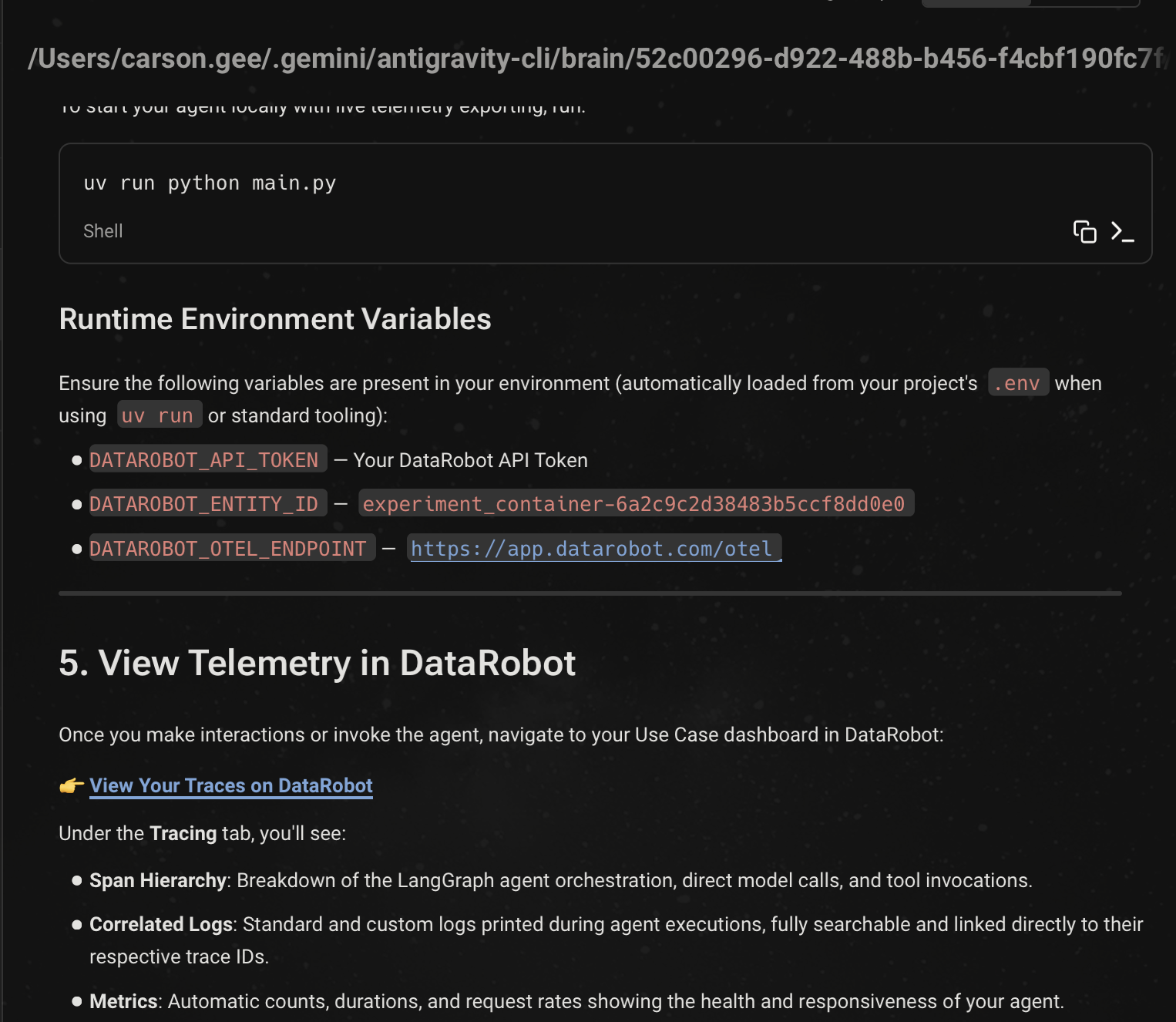
    The generated monitoring setup instructions with runtime variables and telemetry steps

    The DataRobot tracing interface surfaces the full request history. Each trace shows end-to-end latency, total token consumption, and the complete span tree:
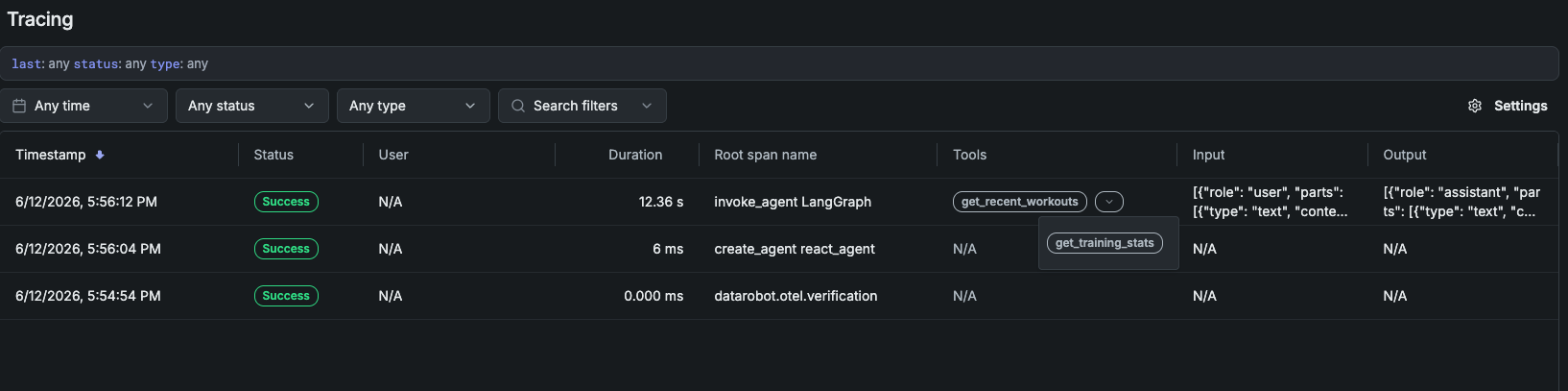
    The DataRobot tracing interface listing the agent's traced requests

    Drilling into the “schedule this week” request reveals the full picture: 2,700 tokens consumed, tool-level latency for each call, LLM invocation count, and any custom attributes emitted via standard OTel instrumentation. This is the data that makes debugging tractable, not inference from final output.
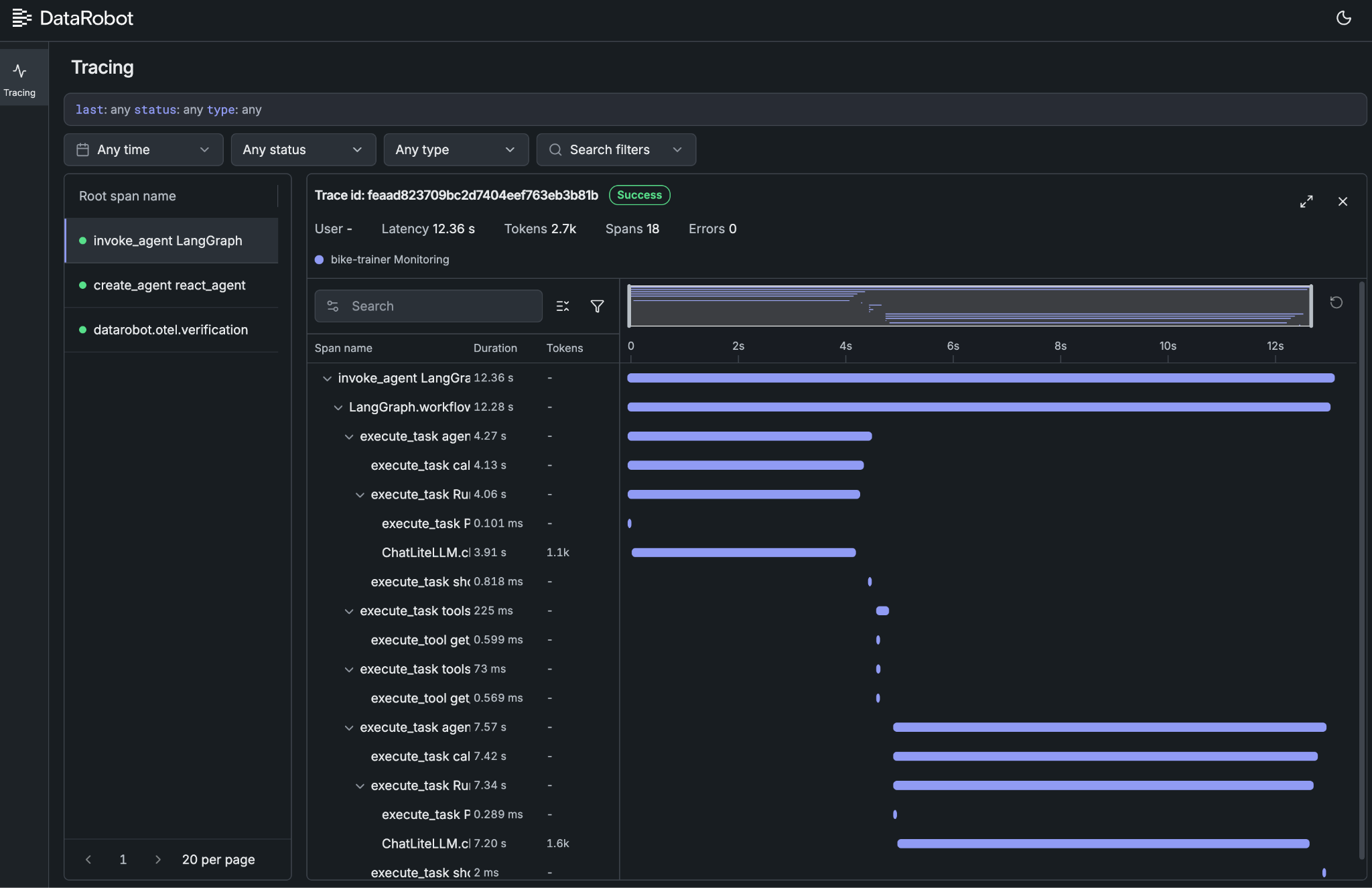
    The trace detail view showing span hierarchy, latency, and token counts

    For local development, the DataRobot CLI surfaces trace updates in real time: dr plugin install xp followed by dr xp --entity-id=. This creates a tight iteration loop — run the agent, inspect the trace, fix the issue, repeat.

    In this case, the span output makes the root cause explicit: the agent lacks calendar access, which is why it couldn’t answer the scheduling question. That failure wasn’t surfaced in the agent’s conversational response:
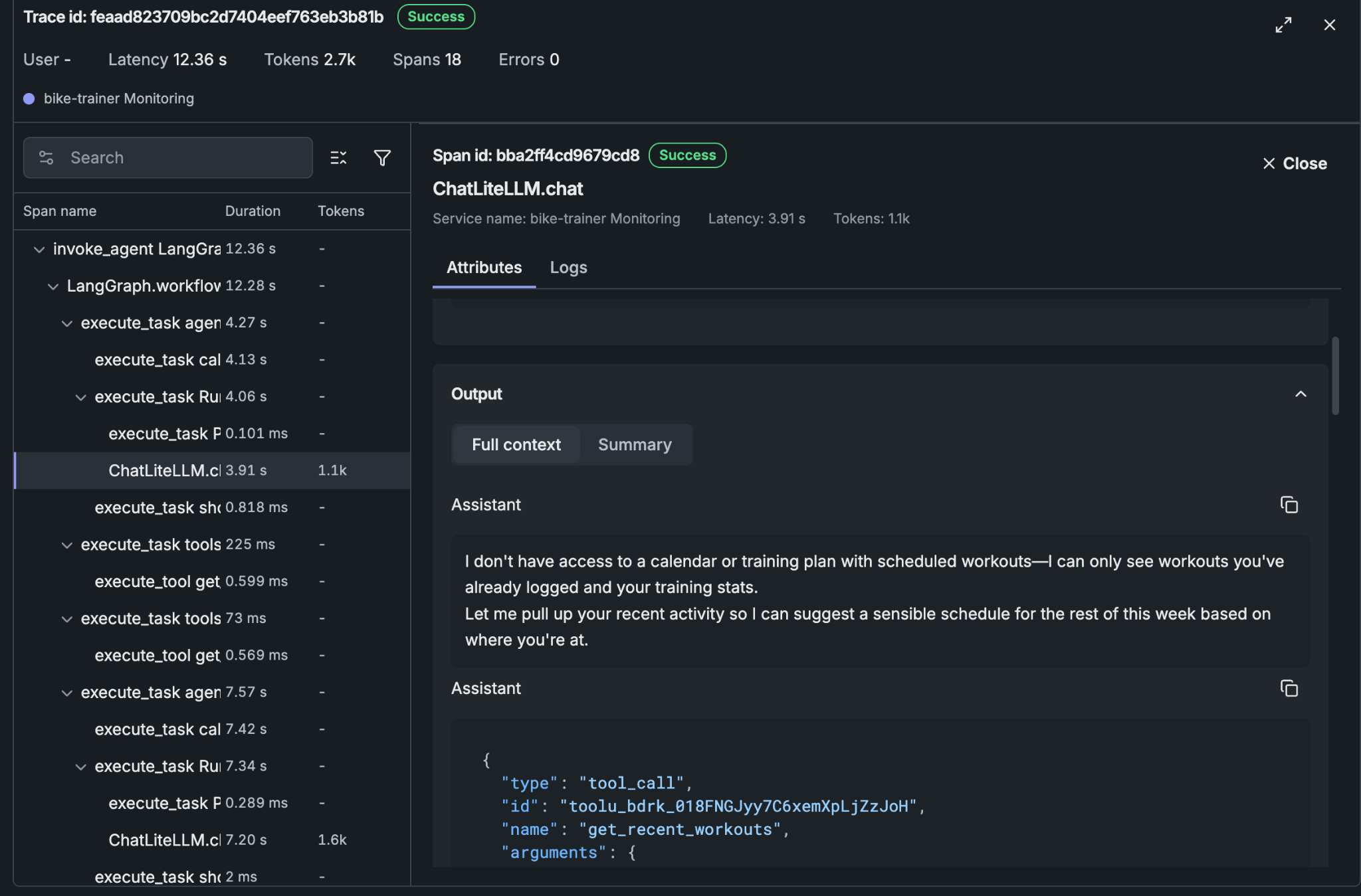
    A span's output showing the agent explaining it lacks calendar access

    Instead, the agent responded with generic guidance:

    2. **Build a week from scratch** - If you tell me a few things, I can sketch out a balanced week for you:
    
       - Your goal (general fitness, an event/race, building endurance, etc.)
       - How many days/hours you can train
       - Your current fitness level and any FTP you know
    
    A solid general week might look like:
    
    - **Mon** - Rest or easy recovery spin
    - **Tue** - Intervals
    - **Wed** - Endurance ride (zone 2)
    - **Thu** - Recovery or rest
    - **Fri** - Tempo/threshold work
    - **Sat** - Long endurance ride
    - **Sun** - Easy ride or rest

    The trace made the gap between expected and actual agent behavior immediately actionable. This same pattern applies at enterprise scale: whether the agent is running on a laptor or in production on a cloud provider, DataRobot traces the full execution tree and surfaces what the agent actually did — not just what it said.

    The gap between an agent prototype and an agent in production is mostly operational context. Your coding agent writes the code. DataRobot supplies the observability layer and the governed deployment target. One plugin install, one skill execution — and you have production-grade trace data from the first run.


    Source link

    Share. Facebook Twitter Pinterest LinkedIn Tumblr Email

    Related Posts

    Building AI Agents and Workflows for Every Role Without Coding with Great Learning

    June 20, 2026

    Five ways to do least squares (with torch)

    June 19, 2026

    The Download: a new hunt for dark matter and Kenya’s case for going solar

    June 18, 2026

    The Case Against Building Your Own Agent Platform – O’Reilly

    June 17, 2026

    Research into how AI can help users understand skin conditions

    June 16, 2026

    5 foundations for reshaping the future of education and AI

    June 15, 2026
    Top Posts

    Understanding U-Net Architecture in Deep Learning

    November 25, 202555 Views

    Hard-braking events as indicators of road segment crash risk

    January 14, 202630 Views

    Redefining AI efficiency with extreme compression

    March 25, 202627 Views
    Don't Miss

    John Ternus gets ready to put his firm imprint on Apple’s industrial design team, which has lost a true seat at Apple’s exec table over the past decade (Mark Gurman/Bloomberg)

    June 21, 2026

    Featured Podcasts Lenny’s Podcast: Building the most AI-pilled engineering team in the world | Fiona…

    DataRobot for Developers — integrating with the Google Antigravity CLI

    June 21, 2026

    Machine Learning System Design: 10 Interview Problems Solved

    June 21, 2026

    Cisco’s Journey to Unified Security Service Edge Deployment

    June 21, 2026
    Stay In Touch
    • Facebook
    • Instagram
    About Us

    At GeekFence, we are a team of tech-enthusiasts, industry watchers and content creators who believe that technology isn’t just about gadgets—it’s about how innovation transforms our lives, work and society. We’ve come together to build a place where readers, thinkers and industry insiders can converge to explore what’s next in tech.

    Our Picks

    John Ternus gets ready to put his firm imprint on Apple’s industrial design team, which has lost a true seat at Apple’s exec table over the past decade (Mark Gurman/Bloomberg)

    June 21, 2026

    DataRobot for Developers — integrating with the Google Antigravity CLI

    June 21, 2026

    Subscribe to Updates

    Please enable JavaScript in your browser to complete this form.
    Loading
    • About Us
    • Contact Us
    • Disclaimer
    • Privacy Policy
    • Terms and Conditions
    © 2026 Geekfence.All Rigt Reserved.

    Type above and press Enter to search. Press Esc to cancel.