

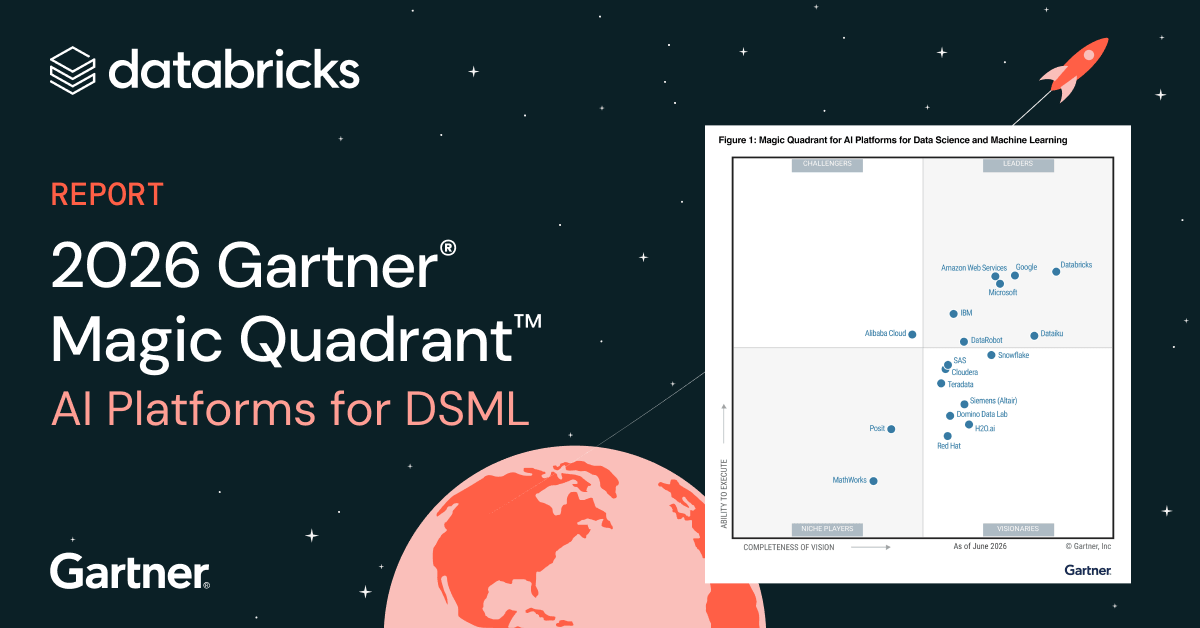
Enterprises are rapidly deploying agentic applications at scale, from back-office micro apps that automate routine tasks to agents that power customer experiences across industries and departments. But general-purpose foundation models, disconnected from enterprise data and lacking centralized governance controls, can’t deliver the accuracy, compliance, or business context these agents and applications demand. Equally critical, they introduce risk: uncontrolled model and data access, inconsistent policies, lack of observability, and fragmented audit trails.
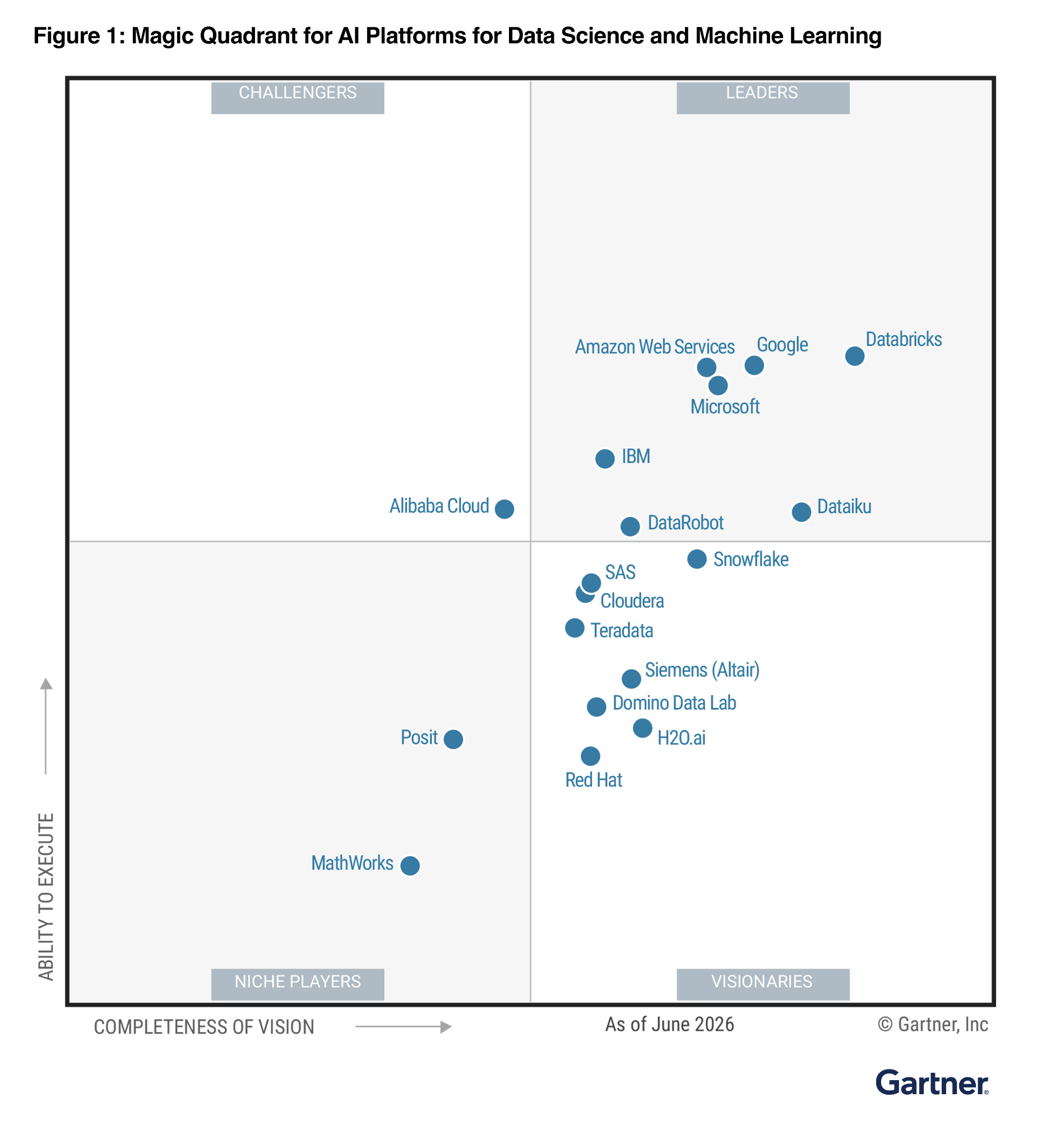
We believe Gartner’s decision to reclassify this category from “Data Science and Machine Learning” to “AI Platforms for Data Science and Machine Learning” confirms our longstanding view: AI is no longer a peripheral experiment — it’s the operating model of the modern enterprise, grounded in business context.
Download a complimentary copy of the report here
The strategy: build, orchestrate, and govern agentic applications on a unified platform
We believe our position as a Leader in this category is rooted in a singular philosophy: you cannot have an AI strategy without a data strategy — and you cannot scale either without a governance strategy. While many vendors stitch together separate products for data, models, agents, and governance, Databricks delivers one unified platform.
That means one copy of your data, one governance layer across data and AI, and one consistent way to build, monitor, and control agents in production. By unifying the lakehouse, Lakebase, Agent Bricks, and Unity Catalog, we give every team, from developers to business users, a single place to turn enterprise data into trusted, compliant, production-grade agents and applications. With Unity AI Gateway, organizations gain centralized policy enforcement, model access controls, usage tracking, cost management, and real-time guardrails across every request and response.
Core innovations for the agentic era
1. Agentic AI that reasons on your data
Agents are only as useful as the data and context they can reason over. With Agent Bricks, teams build production-ready custom agents that are automatically optimized for cost and quality, grounded in governed enterprise data in the Databricks lakehouse and backed by Lakebase, our serverless, Postgres-compatible operational store for agent state and applications. Agents retrieve the right information, interpret business semantics consistently, and act with the accuracy and reliability enterprises require. YipitData used this approach to scale unstructured data intelligence, achieving a 20x increase in company coverage and 92–95% tagging accuracy out of the box.
Business users can get trusted insights and take agentic actions through Databricks Genie One and Genie Agents, powered by Genie Ontology which provides business context, grounded in your data. easyJet is using this flexibility to reimagine airline retailing on top of Lakebase, Agent Bricks, and Apps.
2. Open and flexible by design
Builders need the freedom to move fast without getting locked in. Databricks natively serves every frontier model (OpenAI, Anthropic, Google) and leading open source models (Meta, Qwen, DeepSeek, etc.), so teams can swap models without renegotiating contracts or rewriting applications. Developers vibe code with their preferred AI coding agents such as Cursor or Replit, as well as the new meta-harness Omnigent. They can connect to governed lakebases, and ship agentic apps in days with Databricks Apps.
3. Unified governance across data, models, agents, and apps
Innovation without governance doesn’t scale. Unity Catalog and Unity AI Gateway provide end-to-end governance across every data asset, model, agent, MCP server, app, and tool hosted on Databricks and externally — in a single system of record. End-to-end permissions ensure nothing accesses more than it is allowed to, whether it’s a frontier model or an autonomous agent embedded in a customer-facing app. Block uses Unity Catalog to unify its AI and data estate across business units, and Novo Nordisk has attributed $157M+ in net new value to governed, AI-driven clinical trial optimization.
What’s next
We believe this recognition validates what we see playing out across every industry: the gap is widening between unified, governed Data and AI platforms and the fragmented stacks that slowed the first wave of enterprise AI. As agentic applications move from experiment to business-critical, they require unified data, AI, and governance. We invite you to join us on this journey as we continue to transform how the world builds, governs, and scales intelligence.
[Read the full 2026 Gartner® Magic Quadrant™ for Data Science and AI Platforms report]
Gartner, Magic Quadrant for AI Platforms Data Science and Machine Learning Platforms, Yogesh Bhatt, Afraz Jaffri, Diarmuid Curran, June 22, 2026.
GARTNER is a registered trademark and service mark of Gartner, Inc. and/or its affiliates in the U.S. and internationally, and MAGIC QUADRANT is a registered trademark of Gartner, Inc. and/or its affiliates and are used herein with permission. All rights reserved.
Gartner does not endorse any vendor, product or service depicted in its research publications, and does not advise technology users to select only those vendors with the highest ratings or other designation. Gartner research publications consist of the opinions of Gartner’s research organization and should not be construed as statements of fact. Gartner disclaims all warranties, expressed or implied, with respect to this research, including any warranties of merchantability or fitness for a particular purpose.
This graphic was published by Gartner, Inc. as part of a larger research document and should be evaluated in the context of the entire document. The Gartner document is available upon request from Databricks.