

Support CleanTechnica’s work through a Substack subscription, on Patreon, or on Stripe. Help us produce all of the high-quality, original content we publish week after week despite the challenges of content-scraping AI, antisocial media, inflation, and other hurdles.
By Ray Wills and Peter Newman
CleanTechnica allows comments, and there are always great comments by readers, as well as the obligatory smattering of naysaying trolls. We thought we might collate and comment on the good stuff that came in on our article “China’s Electric Truck Moment Has Arrived — And It’s About To Hit Global Diesel Demand.”
If the electric car was the opening chapter of China’s transport transition, battery-electric heavy trucks are now the freight-system sequel — and readers are rightly asking what this means for global diesel demand, for Western economic narratives, and for regions like rural Australia that still run on imported fuel.
Readers of our recent CleanTechnica piece asked five core questions:
- How quickly can China’s truck boom reshape oil markets?
- Is slowing fossil fuel use just a sign of a weakening economy?
- Can other countries build the kind of corridor-based infrastructure China is rolling out?
- What is the interplay between diesel, LNG and energy security? and
- What is the distinction between oil-demand forecasts and crude-import data?
How quickly can China’s truck boom reshape oil markets?
Several readers asked if the surge in Chinese electric trucks is a passing spike or a structural change. Our answer lies in the way policy is designed. China is not simply nudging a few fleets with purchase subsidies; it is building an integrated freight system around electric drivetrains, and has been planning this for some time with a strong emphasis on how cleantech is likely to be the global next economy.

The heavy-truck program targets roughly 40% new-energy heavy-truck sales by 2030, around 1.6 million vehicles in operation, and about 20% of the national heavy-truck fleet — but more importantly, it aims for 18% of highway freight volume concentrated in commercially active fleets and high-use corridors. This is where the diesel story changes: it is not about converting every truck today; it is about first converting the trucks that move the most freight and burn the most fuel.
Readers correctly pointed out that in ports, mines, steel mills, and similar operations with predictable routes and high utilisation, electric heavy trucks already captured about a quarter of new sales in 2025, with penetration rising further in 2026. In such segments, a minority of vehicles can remove a majority of diesel, because they run longer hours, carry heavier loads, and repeat their routes day after day.
Is slowing fossil fuel use just a sign of a weakening economy?
This question is what we have labelled “Western economists’ disease” — the reflex to interpret slowing fossil-fuel consumption in China as evidence of a faltering economy, rather than as a sign of deliberate structural change.
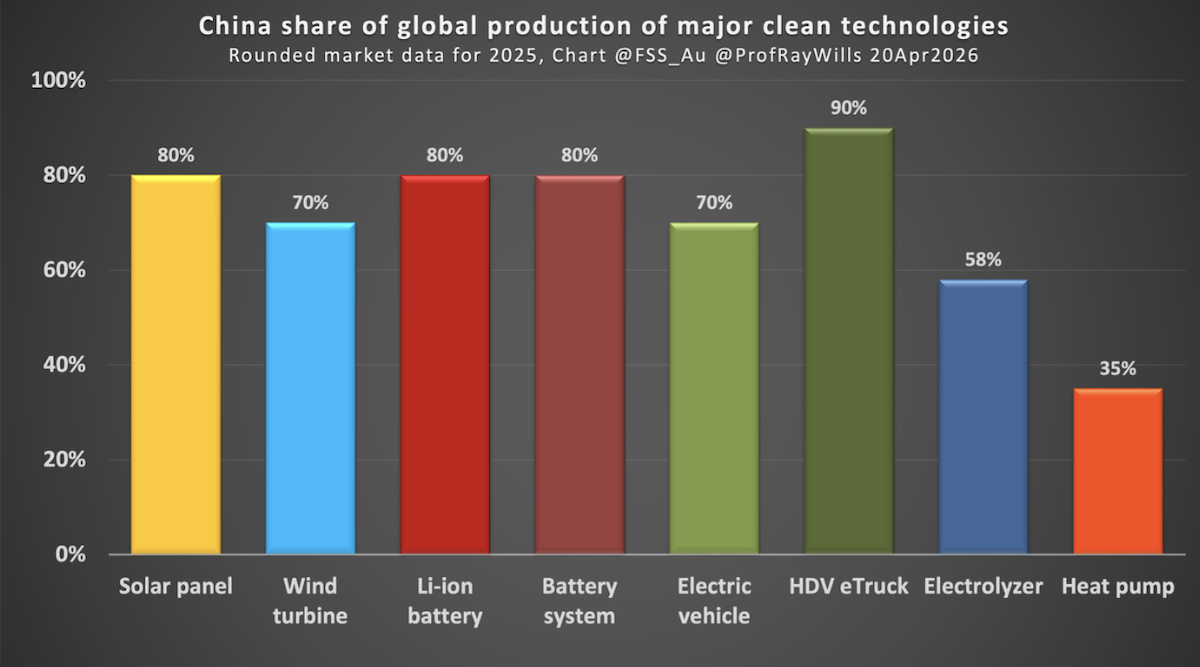
Over the past decade, China added nearly 6 million barrels per day of predicted oil demand due to growth in new vehicles, which was expected to supply around 60% of global oil growth between 2015 and 2024. For many forecasters, this embedded an expectation that China would remain a durable fossil fuel combustion-growth engine: more cars, more diesel trucks, more road freight, and steadily rising fuel use. Many politicians fell into the trap of believing that China was already doing this predicted consumption, but it wasn’t so!
The new data break that story. Electric heavy trucks, passenger EVs, LNG trucks, and high-speed rail together erode the road-fuel denominator that older models still assume. The International Energy Agency has shifted its Oil 2025 outlook and now expects Chinese oil demand to peak this decade, based on weakening road-fuel consumption and structural changes in the economy.
Yet many analyses in Western media still treat falling diesel or coal consumption as an unambiguous sign of “weak demand,” “overcapacity,” or “economic malaise.” Readers were right to challenge this. The professional task is to separate cyclical issues — property markets, debt, over-investment in specific sectors — from the deliberate rewiring of the energy and transport system — to one that is showing how rapidly economic growth can be decoupled from fossil fuel use through renewables and efficiency.
When a policy-driven truck program concentrates electric vehicles and charging infrastructure along 30,000 kilometres of zero-carbon freight corridors, backed by thousands of charging and battery-swap stations and explicit grid-planning mandates, that is not cyclical noise. It is a freight-system redesign aimed at diesel displacement and energy-security gains. It’s all clearly helping economic growth.
Can other countries build the kind of corridor-based infrastructure China is rolling out?
Several readers asked whether other countries can simply “copy the Chinese model.” The corridor-based design is attractive: logistics parks, depots, ports, mines, and highway service areas that are all linked into zero-carbon routes with high-capacity charging and swap stations, and grid companies are mandated to plan for truck charging demand.

But this is not just technology; it is industrial geography. China’s truck transition is emerging from regional clusters like Changsha, Guangzhou, and similar hubs. These clusters allow SANY and other manufacturers not only to build trucks cheaply, but to deliver whole fleets into corridors where charging, swapping, maintenance, and route planning are already in place.
Countries that treat electrification as a “vehicle problem” — a matter of subsidies and individual fleet purchases — will struggle to match this. Without corridor-scale planning and industrial ecosystems, they risk importing trucks from China without all the necessary support infrastructure. It’s simply suggesting that as with all other aspects of economic change (like AI), there will be new infrastructure requirements. Other countries will need to build their own integrated freight systems.
What is the interplay between diesel, LNG, and energy security?
From Beijing’s perspective, LNG and EV trucks were not simply a climate solution, but an opportunity to displace oil-based diesel and diversify fuel sources as a part of their productivity and economic security. There was a clear plan to work on China’s own economy to enable mass production to generate a quality and cost-effective export market. Thus, as electric trucks were beginning to cut into local LNG truck sales, firms like CATL and Sinopec were planning charging and swap networks that went beyond governmental targets.
For regions like rural Australia, this raises real questions for how we can maintain markets. Our recent Energy Sovereignty for Regional Australia report argued that diesel dependence is a structural vulnerability for farms and regional economies, not just a line item in the fuel budget. They are going to make us more uncompetitive, as the fossil fuel-based products will not be able to compete with those that simply depend on local sun and wind. When China accelerates electric freight and reduces diesel imports, global prices and availability do not simply follow Australian assumptions; they follow the new demand reality of the renewable energy transition.
Readers who connected China’s freight corridors to Australian regional development are pointing in the right direction: the same logic of “concentrate electric vehicles where they move the most freight” applies to grain routes, livestock corridors, and regional supply chains in Australia. What we lack is the coordinated planning and capital deployment that China is now demonstrating.
What is the distinction between oil-demand forecasts and crude-import data?
This question was raised by several readers who noted that China’s crude imports remain high — about 11.55 million barrels per day in 2025, with part of that driven by stockbuilding and discounted crude. That can obscure the underlying decline in road-fuel demand, tempting analysts to conclude that “nothing fundamental has changed.”
Consumption models and trade statistics are telling different stories.
Forecasting agencies model end-use demand; exporters and refiners experience physical flows, inventories, and margins. China can import heavily while filling tanks or exploiting discounts, yet still be structurally weakening gasoline and diesel use through electrification and modal shifts.
The professional distinction is between a plateau in structural demand and a later, sometimes delayed, contraction in headline import numbers. For planners and investors, the risk lies in waiting for the cliff rather than recognising the plateau: by the time import data clearly show falling volumes, the demand erosion may already be embedded in fleet composition and corridor infrastructure.
That is where the comments on our article are most valuable, as they highlight the importance of the time we are in: a rapidly accelerating time of transition away from fossil fuels. Once that is seen, the reactions to our data are not just reactions to the latest truck numbers; they are early warnings that freight-system design, regional energy sovereignty, and oil-market modelling are moving on different clocks but are all part of a much bigger global process.
If China’s electric trucks are already rewriting diesel’s future, the question for Australia, Europe, and North America is simple: do we treat this as a distant curiosity, or do we begin building our own corridors and clusters now, before the global diesel story has moved on without us?
Professor Ray Wills is Managing Director of Future Smart Strategies and an adjunct professor at The University of Western Australia, working at the intersection of electrification, regional energy sovereignty and industrial transformation.
Professor Peter Newman AO is Professor of Sustainability at Curtin University and was a Coordinating Lead Author for transport with the IPCC, recognised for coining the term “automobile dependence” and for his contributions to sustainable transport and urban design.
Sign up for CleanTechnica’s Weekly Substack for Zach and Scott’s in-depth analyses and high level summaries, sign up for our daily newsletter, and follow us on Google News!
Have a tip for CleanTechnica? Want to advertise? Want to suggest a guest for our CleanTech Talk podcast? Contact us here.
Sign up for our daily newsletter for 15 new cleantech stories a day. Or sign up for our weekly one on top stories of the week if daily is too frequent.


CleanTechnica uses affiliate links. See our policy here.
CleanTechnica’s Comment Policy