

Modern artificial intelligence (AI) systems, from robotic surgery to high-frequency trading, rely on processing streams of raw data in real time. Extracting important features quickly is critical, but conventional digital processors are hitting physical limits. Traditional electronics can no longer reduce latency or increase throughput enough to keep up with today’s data-heavy applications.
Turning to Light for Faster Computing
Researchers are now looking to light as a solution. Optical computing — using light instead of electricity to handle complex calculations — offers a way to dramatically boost speed and efficiency. One promising approach involves optical diffraction operators, thin plate-like structures that perform mathematical operations as light passes through them. These systems can process many signals at once with low energy use. However, maintaining the stable, coherent light needed for such computations at speeds above 10 GHz has proven extremely difficult.
To overcome this challenge, a team led by Professor Hongwei Chen at Tsinghua University in China developed a groundbreaking device known as the Optical Feature Extraction Engine, or OFE2. Their work, published in Advanced Photonics Nexus, demonstrates a new way to perform high-speed optical feature extraction suitable for multiple real-world applications.
How OFE2 Prepares and Processes Data
A key advance in OFE2 is its innovative data preparation module. Supplying fast, parallel optical signals to the core optical components without losing phase stability is one of the toughest problems in the field. Fiber-based systems often introduce unwanted phase fluctuations when splitting and delaying light. The Tsinghua team solved this by designing a fully integrated on-chip system with adjustable power splitters and precise delay lines. This setup converts serial data into several synchronized optical channels. In addition, an integrated phase array allows OFE2 to be easily reconfigured for different computational tasks.
Once prepared, the optical signals pass through a diffraction operator that performs the feature extraction. This process is similar to a matrix-vector multiplication, where light waves interact to create focused “bright spots” at specific output points. By fine-tuning the phase of the input light, these spots can be directed toward chosen output ports, enabling OFE2 to capture subtle variations in the input data over time.
Record-Breaking Optical Performance
Operating at an impressive 12.5 GHz, OFE2 achieves a single matrix-vector multiplication in just 250.5 picoseconds — the fastest known result for this type of optical computation. “We firmly believe this work provides a significant benchmark for advancing integrated optical diffraction computing to exceed a 10 GHz rate in real-world applications,” says Chen.
The research team tested OFE2 across multiple domains. In image processing, it successfully extracted edge features from visual data, creating paired “relief and engraving” maps that improved image classification and increased accuracy in tasks such as identifying organs in CT scans. Systems using OFE2 required fewer electronic parameters than standard AI models, proving that optical preprocessing can make hybrid AI networks both faster and more efficient.
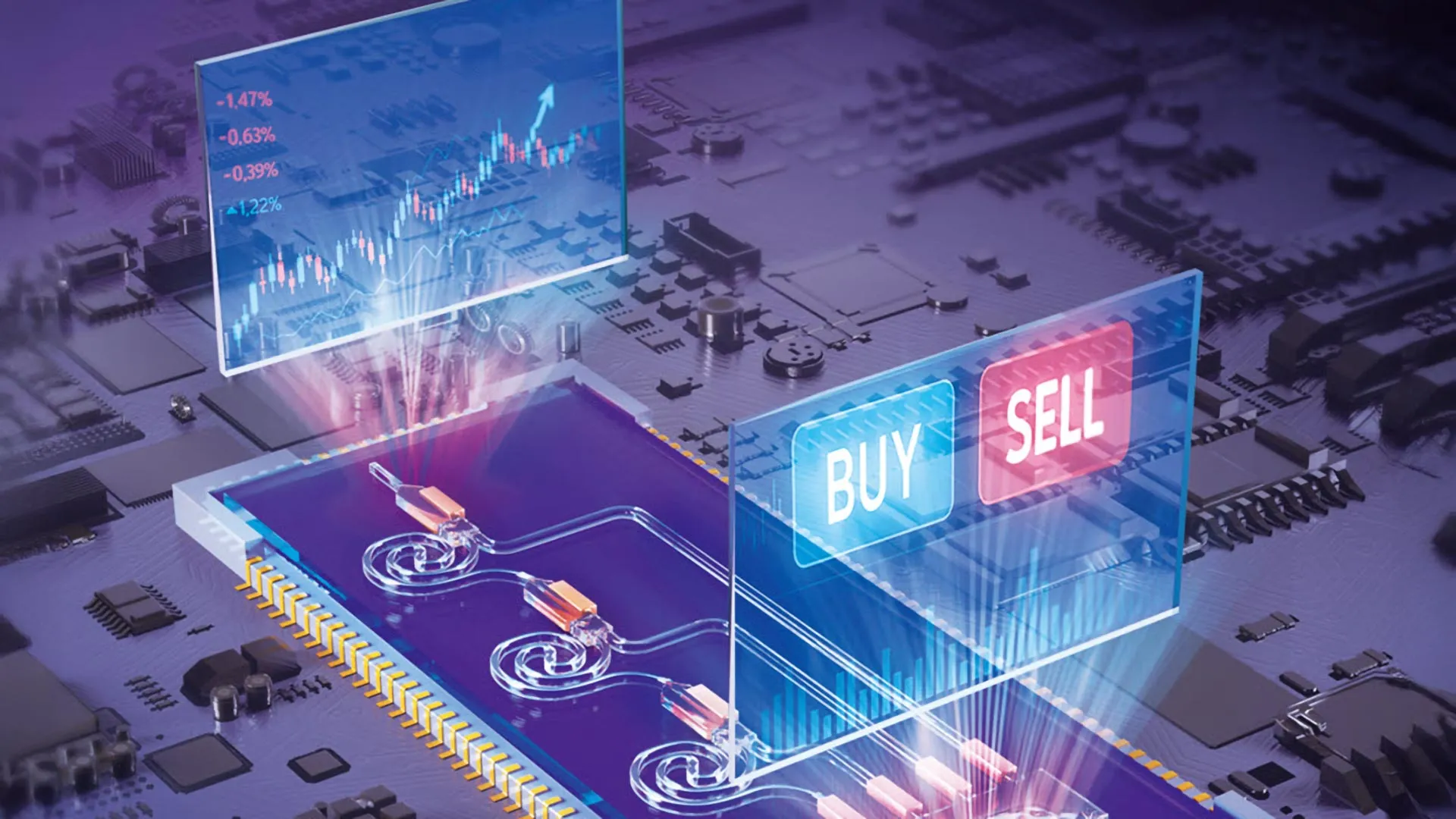
The team also applied OFE2 to digital trading, where it processed live market data to generate profitable buy and sell actions. After being trained with optimized strategies, OFE2 converted incoming price signals directly into trading decisions, achieving consistent returns. Because these calculations happen at the speed of light, traders could act on opportunities with almost no delay.
Lighting the Way Toward the Future of AI
Together, these achievements signal a major shift in computing. By moving the most demanding parts of AI processing from power-hungry electronic chips to lightning-fast photonic systems, technologies like OFE2 could usher in a new era of real-time, low-energy AI. “The advancements presented in our study push integrated diffraction operators to a higher rate, providing support for compute-intensive services in areas such as image recognition, assisted healthcare, and digital finance. We look forward to collaborating with partners who have data-intensive computational needs,” concludes Chen.