


Beyond Volume: Countering the Stealth Tactics of Modern DDoS Attacks
In our previous post, we explored how the network edge has become the primary shield against the hyper-volumetric DDoS attacks that defined 2025. However, for the modern CxO, the threat landscape has shifted. It is no longer just about the sheer size of the “pipe” being hit; attackers have evolved beyond brute force, employing tactical stealth methodologies to bypass traditional defenses.
Today, we examine the three most disruptive trends to emerge in the last year—Pulse Attacks, Carpet Bombing, and Outbound attacks—and how Cisco Secure DDoS Edge Protection leverages advanced machine learning to neutralize them before they even register on traditional monitoring systems.
The Blind Spot: Why Traditional Defenses Struggle
Traditional DDoS defenses often rely on “out-of-path” scrubbing center architectures. While powerful, these systems suffer from a fundamental flaw: latency in detection and redirection. Modern botnets—such as AlSuru, Kimwolf, and ShadowV2—exploit the delayed response and static thresholds of legacy systems with surgical precision.
Pulse Attacks: The “Flash Flood”
Pulse attacks involve short, high-volume bursts of traffic lasting between 30 to 120 seconds.
- The Evasion: Because traditional out-of-path architectures can take 90 seconds or more to initiate mitigation, these attacks often conclude before defenses even engage. If they do trigger, the attacker has already shifted vectors, rendering the previous mitigation obsolete.
- The Impact: These consecutive, short bursts go unmitigated, causing collateral damage to network elements and individual hosts through repeated micro-outages that accumulate into significant downtime.
Carpet Bombing: The “Pernicious Attack”
Instead of targeting a single IP, carpet bombing strikes hundreds of different IPs within the same subnet using low-rate traffic that stays below individual host thresholds.
- The Evasion: By keeping traffic per host below volumetric triggers, the attack remains invisible to traditional peering-edge systems.
- The Impact: This traffic aggregates at access routers and nodes, overwhelming aggregation links and triggering a domino effect that can take down entire network segments.
Outbound Attacks: The Internal Threat
Modern residential proxy botnets can generate massive, short-burst attacks directly from infected subscriber devices.
- The Evasion: Traditional DDoS systems are typically uni-directional and fail to monitor bi-directional traffic, allowing outbound attacks to go undetected within the originating network.
- The Impact: This traffic quietly consumes aggregation bandwidth and triggers upstream congestion, often leading to the blacklisting of the provider’s peering IP addresses.
Intelligence at the Edge: A New Paradigm
To counter these stealth tactics, Cisco Secure DDoS Edge Protection moves away from simple, pre-configured threshold-based triggers. Instead, it employs a dual-pass Machine Learning (ML) system that profiles network behavior in real-time.
Bi-Directional Profiling: The “In/Out” Ratio
The core innovation of our algorithm is its ability to learn per-host baselines for both incoming and outgoing traffic.
- The Principle: By definition, a DDoS attack is inherently unidirectional.
- The Detection: Edge Protection learns the typical inbound-to-outbound traffic ratios for every protocol and application port. When a surge occurs, the system doesn’t just look at volume; it identifies when the ratio of inbound-to-outbound traffic has drastically skewed, signaling a malicious event.
Dual-Pass Validation
This two-stage process ensures high precision and near-zero false positives:
- Stage 1: Identifies volumetric spikes based on self-learning thresholds adapted to individual host baselines.
- Stage 2: Performs critical validation by analyzing traffic ratio behavior. If the ratio deviates from the statistically learned norm, it is flagged as malicious.
Using k-means clustering, the system intelligently groups hosts with similar behavioral profiles to enhance baseline accuracy and scalability. A major differentiator is our “context analysis,” which uses these proportional relationships to differentiate between benign traffic bursts and malicious events like DDoS or data exfiltration. Furthermore, this self-learning capability allows the system to mitigate zero-day attacks without relying on external feeds or static signatures, keeping false positives to an absolute minimum.
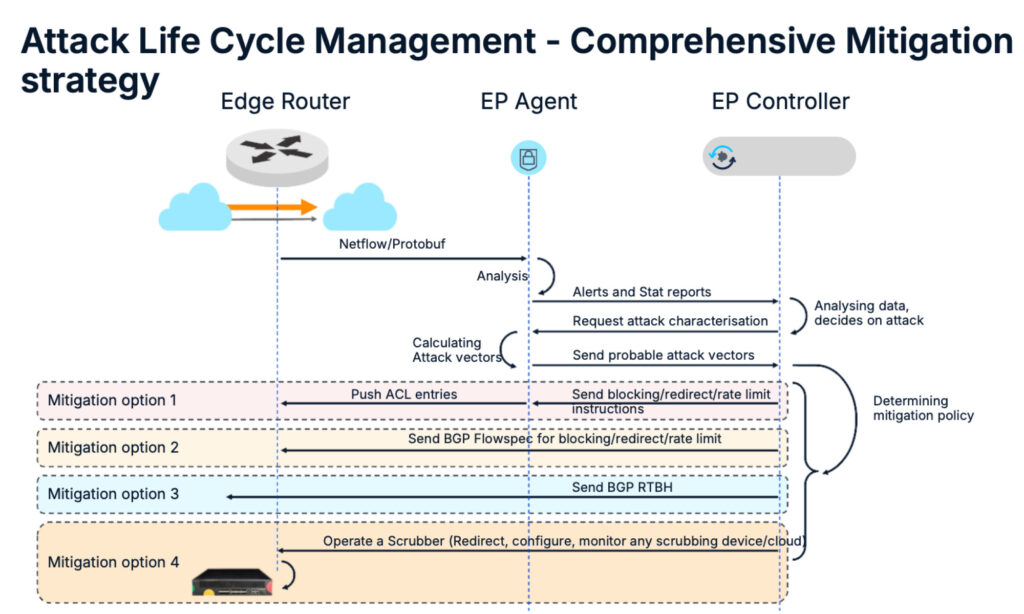
Attack Lifecycle Mitigation
Comprehensive Mitigation Strategy
A modern protection mechanism must be versatile. Cisco Secure DDoS Edge Protection is a full orchestration platform that supports all critical mitigation options:
- Granular ACLs: Applying blocking rules directly to the router ingress with zero impact on performance.
- Traditional BGP Flowspec: For automated, protocol-based rate limiting across the network.
- BGP RTBH (Remotely Triggered Black Hole): For neutralizing attacks that exceed the capacity of individual routers.
- Scrubber Redirection: Seamlessly off-ramping traffic to traditional scrubbing centers or cloud services when specialized, deep-packet cleaning is required.
Summary: Preparing for the Next Generation
By integrating ML-driven profiling directly into the network edge, Cisco provides a distributed security shield that is as agile as the threats it faces. This approach allows Service Providers to reduce TCO by up to 60%, creating a CFO-friendly solution while simultaneously unlocking new revenue streams through a tiered MSSP model.
Learn how Cisco Secure DDoS Edge Protection uses distributed agents to block attacks at the source and prevent core network saturation.
Additional resources