

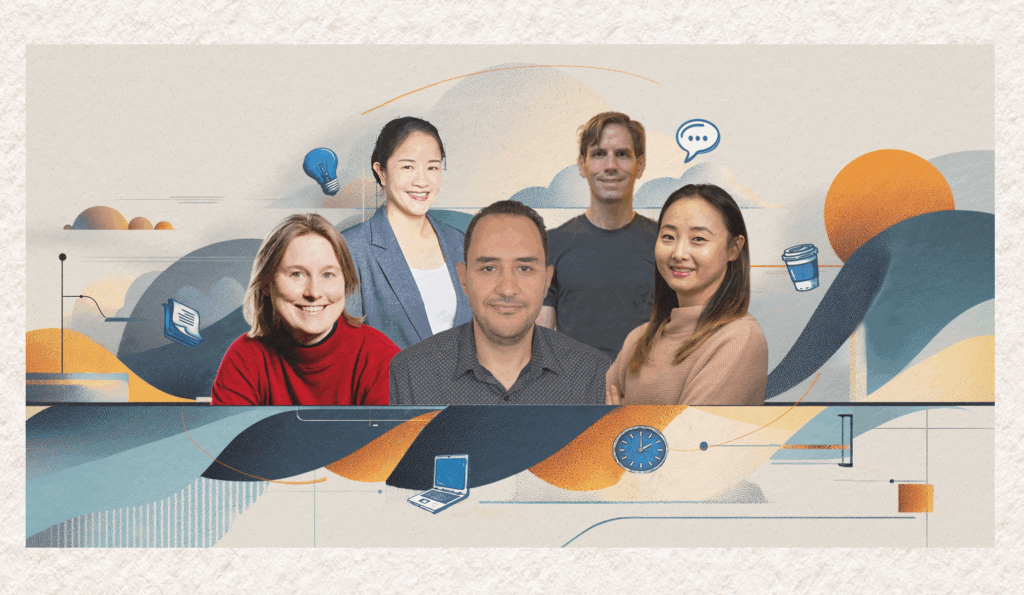
We’re in the middle of an AI transformation. Much has been said about what technology could do, but what about the people who are literally building it? Five Microsoft researchers shared their stories with Forward Future, a daily AI newsletter, about the big problems they’re tackling and the trends shaping their work in the middle of an ever changing AI era.
Here’s a look at the people building the systems that are becoming part of our daily lives in the era of AI:
Trista Chen, director of Microsoft’s AI Research Center
Chen is focused on building trustworthy AI — leading work in face recognition, liveness detection and anti-spoofing technologies. Her team is making sure AI can tell it’s talking to a real, live human — because in a world of deepfakes and generative everything, trust isn’t just nice-to-have, it’s the whole foundation.
“If AI can’t tell whether it’s interacting with a real person in real time, its power risks doing more harm than good,” Chen says. “Our focus is the essence of live personhood and machine-person agency: ensuring AI knows not just who it interacts with, but that the interaction is real, current and trustworthy.”
Flavio Griggio, research manager at Microsoft Quantum
Griggio is building superconducting circuits to help realize Microsoft’s vision for a reliable, scalable quantum computing system. He says the “big goal” is to create a quantum machine that stays reliable, even when things go wrong.
“My team’s readout circuits are key to making this happen — they help us actually see and use the power of topological qubits,” Griggio explains. “When we get this right, it could have a tremendous impact — helping research in medicine, energy, environmental science, smart materials and much more.”
Ahmed Awadallah, partner research manager at Microsoft Research
Awadallah works on agentic AI systems like AutoGen and on small, high-performance language models such as Phi-4-reasoning. He is advancing how AI agents reason, collaborate and solve increasingly complex tasks. These agents can interact with their environments and learn to improve over time, all while maintaining strong oversight, alignment and transparency.
“We are already witnessing significant progress in both capabilities and adoption of AI agents, and I’m eager to see continued advancements in the near future — particularly in making them more reliable and trustworthy, so they can increasingly augment human capabilities in everyday life,” Awadallah says.
Jina Suh, principal researcher at Microsoft
Suh is designing AI with psychological safety at its core — reshaping how we think about the intersection of AI and mental health. She says her research focuses on two things: trying to understand the potential psychological harms or risks of AI and identifying ways AI can be designed to maximize human potential and wellbeing.
“We are at the early stages of understanding a phenomenon that could unfold over decades and that could impact not just individuals but society,” Suh says. “Success to me looks like the technology/AI industry recognizing their role in shaping and influencing people’s mental health, regardless of whether that technology is intentionally designed for mental health.”
Cecily Morrison, senior principal research manager at Microsoft Research Cambridge
Morrison is leading efforts to ensure AI reflects human diversity — bringing community voices into model development and evaluation to make AI teachable, inclusive and extensible to everyone.
“The world is a kaleidoscope of people — rich in history, cultural nuance and different ways of being. My research team focuses on how we bring that plurality into AI models,” Morrison says. “AI should be the mirror of the full richness of our societies, but it is currently limited by data, architectures and evaluation approaches.”
Lead image: From left to right — Cecily Morrison, Trista Chen, Ahmed Awadallah, Flavio Griggio and Jina Suh.