

Agile frameworks like Scrum are built on two fundamental principles: iterative development and incremental development. These terms are so frequently used (and misused) that their impact can be lost, but understanding how each approach works—and why combining them is so powerful—is key to building better software, faster.
This article breaks down each approach, uses real-world analogies, and explores why the combination is more effective than either one alone.
What Is Iterative Development?
An iterative process makes progress through refinement.
An iterative approach to work starts with a rough version of a feature or product, then improves it through repeated cycles—each one getting closer to the final form.
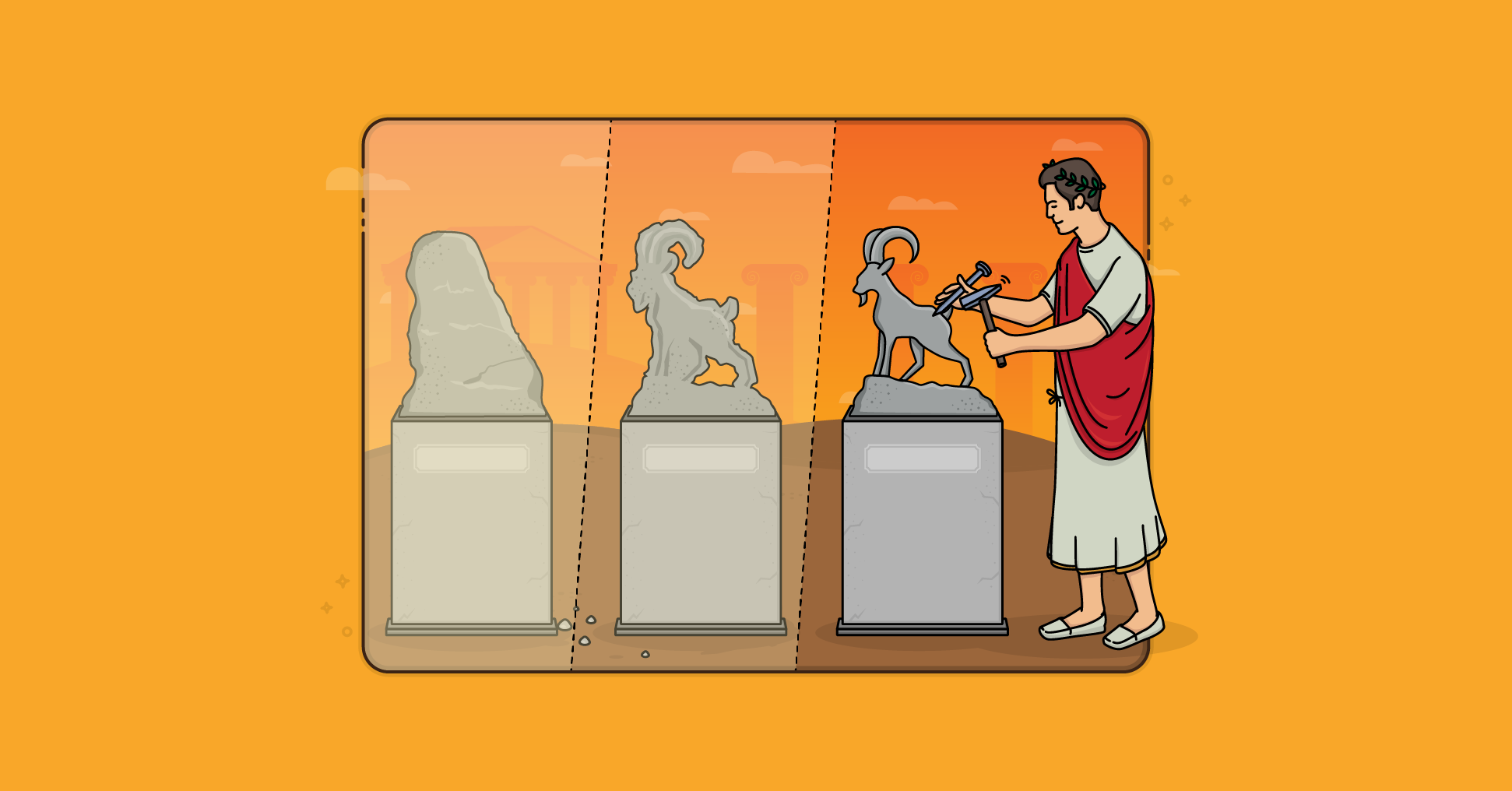
For example, a sculptor who approaches work iteratively might begin by roughly carving a block of stone. With each pass, they would refine the form—adding details, smoothing edges, and continuously improving until the sculpture reaches its final shape. The sculpture isn’t done until the whole piece is complete.
What Is Incremental Development?
An incremental process builds and delivers features and products in pieces. Each piece, or increment, represents a complete subset of functionality.
Increments may be either small or large. The focus is on finishing each increment of functionality in its entirety before moving on to the next, with no need to go back and revisit that work later. Each completed increment can be released on its own.
Returning to the sculpting analogy, an incremental sculptor would pick one element of the sculpture and focus on it until it’s finished. They may select small increments (first the nose, then the eyes, then the mouth, and so on) or large increments (head, torso, legs and then arms). However, regardless of the increment size, the incremental sculptor would attempt to finish the work of that increment as completely as possible before moving on.
Agile Teams Combine Incremental and Iterative
Agile development combines both approaches to get the best of both worlds:
- It’s iterative because the plan is for each piece to be refined and improved over time.
- It’s incremental because usable pieces of working software are delivered throughout the project.
This blend allows teams to deliver value early, get feedback, and adapt.
The video below demonstrates how comedian Jerry Seinfeld approaches his work in a way that is also both incremental and iterative.
Real-world Example: Building a Dating App
Imagine you’re developing a dating website. Here’s how each approach would work:
Purely Iterative
- Build and a little bit of every feature—profiles, search, chat, etc.
- Go back and enhance each one across multiple cycles.
- Over time, the entire system is perfected and then, finally, delivered.
Purely Incremental
- Build and deliver a perfect version of the profile management feature. Don’t start on anything else until this is finished.
- Build and deliver a perfect version of a second area, say search. Then move on to the next.
- Each feature is perfect before the next begins.
Iterative + Incremental (Agile)
- Start with a basic version of the user profile, ship it. Get feedback.
- Add the ability to add a picture to the user profile and ship a basic version of search functionality. Get feedback again.
- Reorder the fields on the user profile to improve the user experience. Add filters to the search functionality. Create a wireframe of the chat feature. Get more feedback.
- Subsequent sprints might include enhancements to previous features and releases of new, usable functionality. Or both.
An agile approach allows early releases, low-risk experimentation, and frequent course corrections—hallmarks of high-performing teams.
Agile Is Iterative and Incremental
Neither incremental development nor iterative development brings much value alone. But together, they form the backbone of agility.
Iterative helps teams refine and adapt. Incremental ensures steady progress and value delivery. Combined, they enable agility, responsiveness, and real-world results.
Last update: September 24th, 2025