
Close Menu
geekfence.comgeekfence.com
    What's Hot

    Wilkie refers gambling concerns to anti-corruption commission

    August 13, 2026

    Lumen ready for AI traffic rush – with programmable fabric and “more fiber than anyone”

    August 13, 2026

    With a feel for physics, AI models simulate a wider range of real-world scenarios | MIT News

    August 13, 2026
    Facebook X (Twitter) Instagram
    • About Us
    • Contact Us
    Facebook Instagram
    geekfence.comgeekfence.com
    • Home
    • UK Tech News
    • AI
    • Big Data
    • Cyber Security
      • Cloud Computing
      • iOS Development
    • IoT
    • Mobile
    • Software
      • Software Development
      • Software Engineering
    • Technology
      • Green Technology
      • Nanotechnology
    • Telecom
    geekfence.comgeekfence.com
    Home»Nanotechnology»Advanced simulations of exotic quantum matter – Physics World
    Nanotechnology

    Advanced simulations of exotic quantum matter – Physics World

    AdminBy AdminJuly 12, 2026No Comments2 Mins Read6 Views
    Facebook Twitter Pinterest LinkedIn Telegram Tumblr Email
    Advanced simulations of exotic quantum matter – Physics World
    Share
    Facebook Twitter LinkedIn Pinterest Email


    A new method allows physicists to study fractional quantum Hall systems and anyon behaviour at unprecedented scale and accuracy
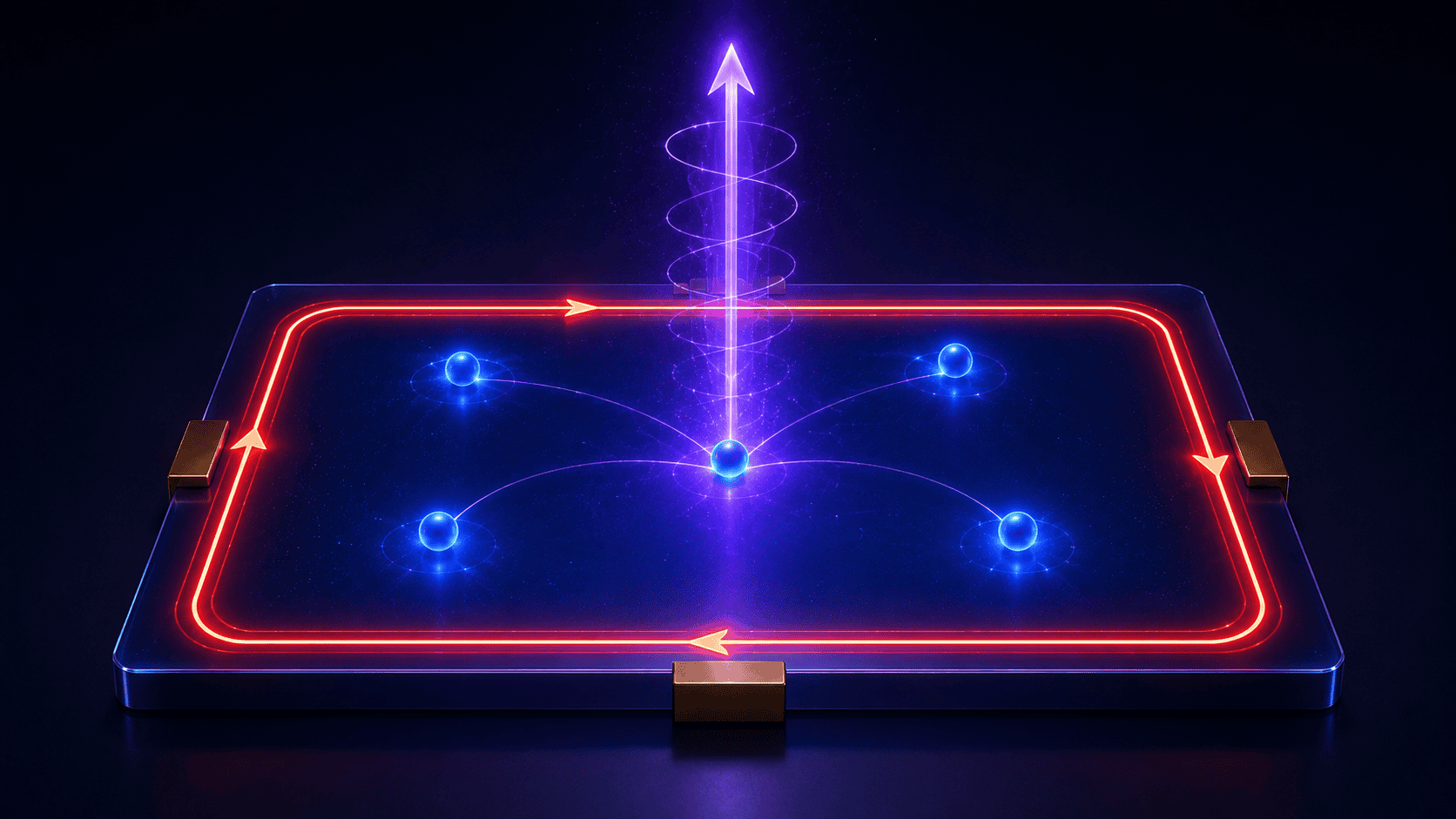
    AI generated research concept

    AI generated research concept (Courtesy: Ting-Tung Wang/University of Hong Kong)

    When electrons are placed in a strong magnetic field and cooled to very low temperatures, they stop behaving independently and instead act as a collective fluid. This is known as a fractional quantum Hall (FQH) system. In this regime, the electrons lose their individual behaviour and act as one correlated system. The strong interactions between them produce quasiparticles called anyons. These are not real particles but effective ones that emerge from the collective behaviour, and they have unusual properties that do not occur in ordinary systems.

    Anyons exhibit braiding behaviour: when they are moved around each other, the system remembers the path taken. In Abelian braiding, this only adds a simple phase, so the quantum state is effectively unchanged. In contrast, non-Abelian braiding transforms the quantum state into a different one, which can be measured and used to encode information.
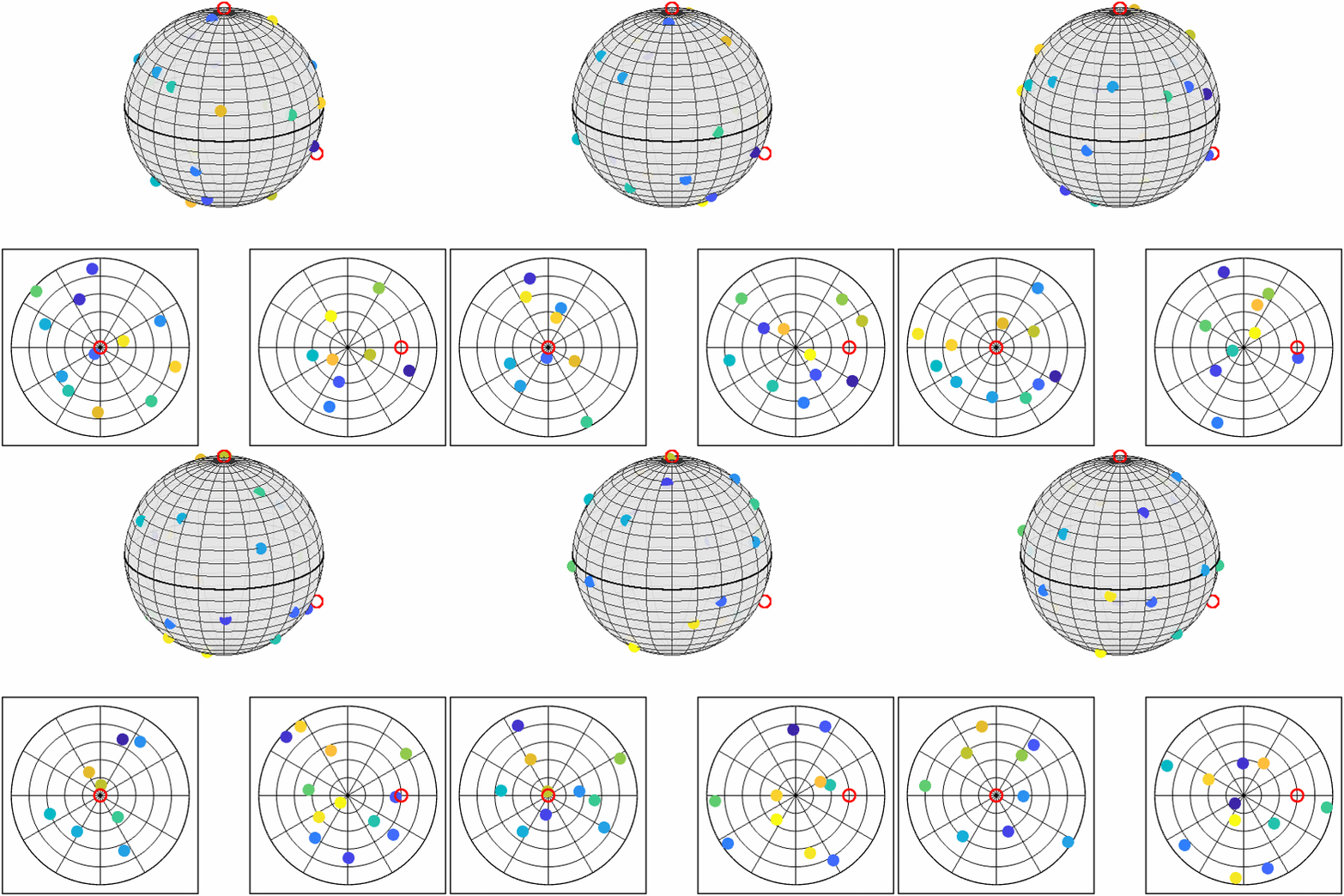
    A Moore–Read state of 20 electrons on a sphere, with two quasiholes pinned at fixed positions
    A Moore–Read state of 20 electrons (solid dots) on a sphere, with two quasiholes pinned at fixed positions (red open circles). The lower panel presents a double stereographic projection, showing the electrons in the northern and southern hemispheres, respectively. (Courtesy: Ting-Tung Wang/University of Hong Kong)

    To study these systems, physicists must compute measurable properties from complicated wave functions, which is computationally challenging, especially for large systems. The traditional method, Metropolis Monte Carlo, is slow and struggles with large numbers of electrons, limiting system size, accuracy, and the ability to test advanced theories.

    In this work, the researchers developed a new simulation method, Hybrid Monte Carlo (HMC), for FQH wave functions. It includes global updates (updating many electrons at once) and double stereographic projection to more accurately sample particle positions, making it much faster and more efficient than the Metropolis method.

    Using this improved method, they accurately computed edge properties that reveal the system’s topology, as well as high-quality braiding matrices of non-Abelian quasiholes, which are crucial because such braiding underpins topological quantum computing. Overall, this work enables fast, large-scale simulations, allowing more accurate study of exotic quantum states and their anyon behaviour, advancing both fundamental physics and topological quantum computing.

    Do you want to learn more about this topic?

    A review of the quantum Hall effects in MgZnO/ZnO heterostructures by Joseph Falson and Masashi Kawasaki (2018)


    Source link

    Share. Facebook Twitter Pinterest LinkedIn Tumblr Email

    Related Posts

    A programmable DNA origami nanosyringe for directed membrane translocation

    August 12, 2026

    Magnetic molecules explain a puzzling material – Physics World

    August 11, 2026

    Pomegranate Peel Nanomaterials Give TiO₂ New Control Over CO₂ Reduction

    August 10, 2026

    New fuel cell breakthrough could help power energy-hungry data centers

    August 9, 2026

    Spectral biophysical cytometry with nanosensors reveals remodelling of immune cells in atherosclerosis

    August 7, 2026

    Kristian Dominek Barajas – ‘I’m able to take a really complicated problem and give it my best guess’ – Physics World

    August 6, 2026
    Top Posts

    Understanding U-Net Architecture in Deep Learning

    November 25, 202577 Views

    The Next Paradigm in Efficient Inference Scaling – The Berkeley Artificial Intelligence Research Blog

    May 16, 202642 Views

    Is it too late to start learning AI and machine learning in my 30s or 40s?

    April 9, 202638 Views
    Don't Miss

    Wilkie refers gambling concerns to anti-corruption commission

    August 13, 2026

    Independent MP Andrew Wilkie has taken the fight over gambling reform to the National Anti-Corruption…

    Lumen ready for AI traffic rush – with programmable fabric and “more fiber than anyone”

    August 13, 2026

    With a feel for physics, AI models simulate a wider range of real-world scenarios | MIT News

    August 13, 2026

    Monitoring beyond SNMP: Turning your network into a sensor

    August 13, 2026
    Stay In Touch
    • Facebook
    • Instagram
    About Us

    At GeekFence, we are a team of tech-enthusiasts, industry watchers and content creators who believe that technology isn’t just about gadgets—it’s about how innovation transforms our lives, work and society. We’ve come together to build a place where readers, thinkers and industry insiders can converge to explore what’s next in tech.

    Our Picks

    Wilkie refers gambling concerns to anti-corruption commission

    August 13, 2026

    Lumen ready for AI traffic rush – with programmable fabric and “more fiber than anyone”

    August 13, 2026

    Subscribe to Updates

    Please enable JavaScript in your browser to complete this form.
    Loading
    • About Us
    • Contact Us
    • Disclaimer
    • Privacy Policy
    • Terms and Conditions
    © 2026 Geekfence.All Rigt Reserved.

    Type above and press Enter to search. Press Esc to cancel.