
Close Menu
geekfence.comgeekfence.com
    What's Hot

    OpenAI launches GPT-5.2 as it battles Google’s Gemini 3 for AI model supremacy – Computerworld

    December 14, 2025

    The Download: Expanded carrier screening, and how Southeast Asia plans to get to space

    December 14, 2025

    How Bayer transforms Pharma R&D with a cloud-based data science ecosystem using Amazon SageMaker

    December 14, 2025
    Facebook X (Twitter) Instagram
    • About Us
    • Contact Us
    Facebook Instagram
    geekfence.comgeekfence.com
    • Home
    • UK Tech News
    • AI
    • Big Data
    • Cyber Security
      • Cloud Computing
      • iOS Development
    • IoT
    • Mobile
    • Software
      • Software Development
      • Software Engineering
    • Technology
      • Green Technology
      • Nanotechnology
    • Telecom
    geekfence.comgeekfence.com
    Home»Artificial Intelligence»A single beam of light runs AI with supercomputer power
    Artificial Intelligence

    A single beam of light runs AI with supercomputer power

    AdminBy AdminNovember 27, 2025No Comments3 Mins Read0 Views
    Facebook Twitter Pinterest LinkedIn Telegram Tumblr Email
    A single beam of light runs AI with supercomputer power
    Share
    Facebook Twitter LinkedIn Pinterest Email


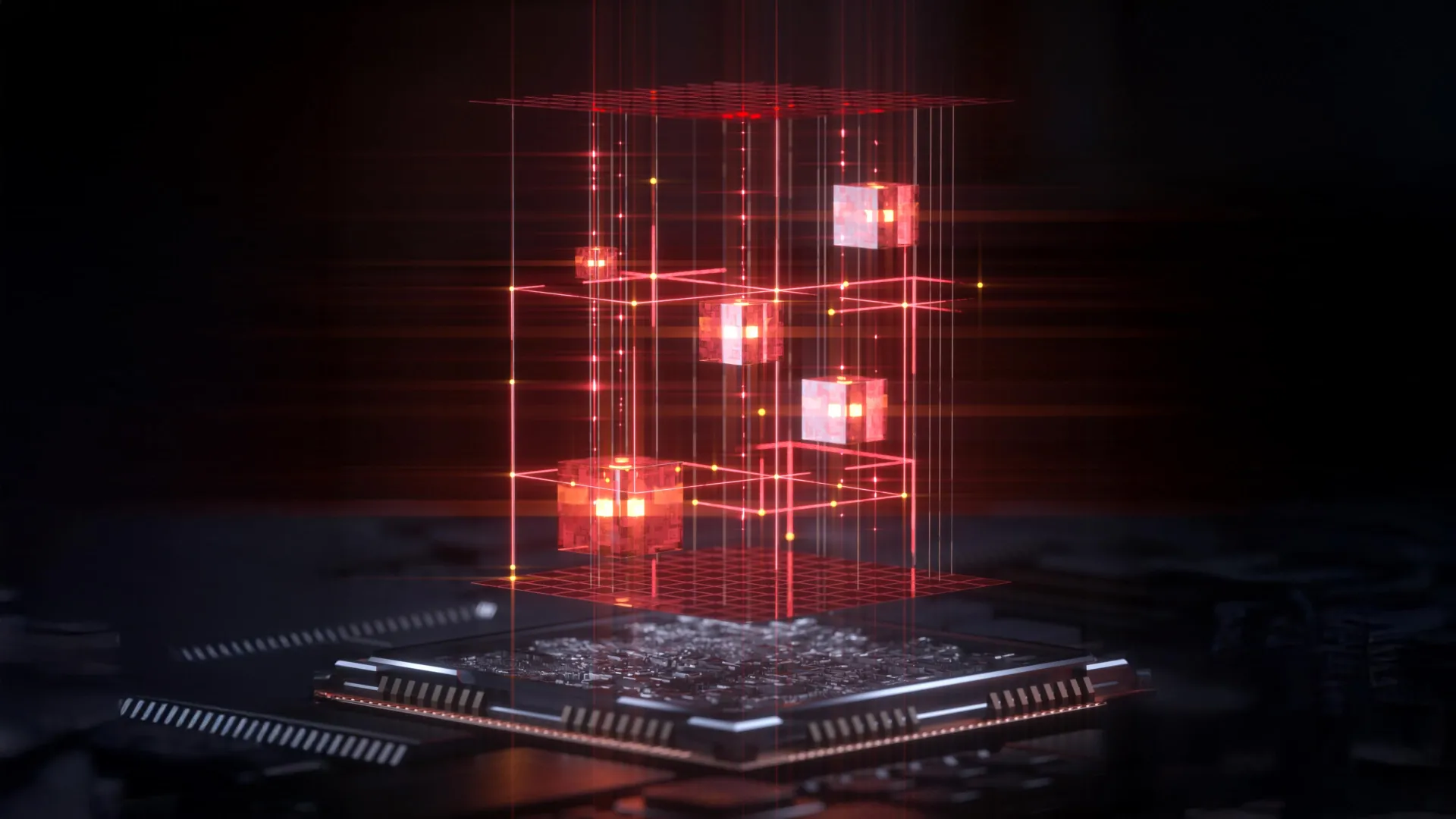
    Tensor operations are a form of advanced mathematics that support many modern technologies, especially artificial intelligence. These operations go far beyond the simple calculations most people encounter. A helpful way to picture them is to imagine manipulating a Rubik’s cube in several dimensions at once by rotating, slicing, or rearranging its layers. Humans and traditional computers must break these tasks into sequences, but light can perform all of them at the same time.

    Today, tensor operations are essential for AI systems involved in image processing, language understanding, and countless other tasks. As the amount of data continues to grow, conventional digital hardware such as GPUs faces increasing strain in speed, energy use, and scalability.

    Researchers Demonstrate Single-Shot Tensor Computing With Light

    To address these challenges, an international team led by Dr. Yufeng Zhang from the Photonics Group at Aalto University’s Department of Electronics and Nanoengineering has developed a fundamentally new approach. Their method allows complex tensor calculations to be completed within a single movement of light through an optical system. The process, described as single-shot tensor computing, functions at the speed of light.

    “Our method performs the same kinds of operations that today’s GPUs handle, like convolutions and attention layers, but does them all at the speed of light,” says Dr. Zhang. “Instead of relying on electronic circuits, we use the physical properties of light to perform many computations simultaneously.”

    Encoding Information Into Light for High-Speed Computation

    The team accomplished this by embedding digital information into the amplitude and phase of light waves, transforming numerical data into physical variations within the optical field. As these light waves interact, they automatically carry out mathematical procedures such as matrix and tensor multiplication, which form the basis of deep learning. By working with multiple wavelengths of light, the researchers expanded their technique to support even more complex, higher-order tensor operations.

    “Imagine you’re a customs officer who must inspect every parcel through multiple machines with different functions and then sort them into the right bins,” Zhang says. “Normally, you’d process each parcel one by one. Our optical computing method merges all parcels and all machines together — we create multiple ‘optical hooks’ that connect each input to its correct output. With just one operation, one pass of light, all inspections and sorting happen instantly and in parallel.”

    Passive Optical Processing With Wide Compatibility

    One of the most striking benefits of this method is how little intervention it requires. The necessary operations occur on their own as the light travels, so the system does not need active control or electronic switching during computation.

    “This approach can be implemented on almost any optical platform,” says Professor Zhipei Sun, leader of Aalto University’s Photonics Group. “In the future, we plan to integrate this computational framework directly onto photonic chips, enabling light-based processors to perform complex AI tasks with extremely low power consumption.”

    Path Toward Future Light-Based AI Hardware

    Zhang notes that the ultimate objective is to adapt the technique to existing hardware and platforms used by major technology companies. He estimates that the method could be incorporated into such systems within 3 to 5 years.

    “This will create a new generation of optical computing systems, significantly accelerating complex AI tasks across a myriad of fields,” he concludes.

    The study was published in Nature Photonics on November 14th, 2025.


    Source link

    Share. Facebook Twitter Pinterest LinkedIn Tumblr Email

    Related Posts

    The Download: Expanded carrier screening, and how Southeast Asia plans to get to space

    December 14, 2025

    Building Applications with AI Agents – O’Reilly

    December 13, 2025

    Helping AI have long-term memory

    December 12, 2025

    A 100-AV Highway Deployment – The Berkeley Artificial Intelligence Research Blog

    December 11, 2025

    Windows PC gaming in 2025: Handheld innovation, Arm progress and DirectX advances

    December 10, 2025

    MIT affiliates named 2025 Schmidt Sciences AI2050 Fellows | MIT News

    December 9, 2025
    Top Posts

    Understanding U-Net Architecture in Deep Learning

    November 25, 20256 Views

    Microsoft 365 Copilot now enables you to build apps and workflows

    October 29, 20256 Views

    Here’s the latest company planning for gene-edited babies

    November 2, 20255 Views
    Don't Miss

    OpenAI launches GPT-5.2 as it battles Google’s Gemini 3 for AI model supremacy – Computerworld

    December 14, 2025

    Rachid ‘Rush’ Wehbi, CEO of e-commerce platform Sell The Trend, has tested GPT-5.2 under real-world…

    The Download: Expanded carrier screening, and how Southeast Asia plans to get to space

    December 14, 2025

    How Bayer transforms Pharma R&D with a cloud-based data science ecosystem using Amazon SageMaker

    December 14, 2025

    How cloud infrastructure shapes the modern Diablo experience 

    December 14, 2025
    Stay In Touch
    • Facebook
    • Instagram
    About Us

    At GeekFence, we are a team of tech-enthusiasts, industry watchers and content creators who believe that technology isn’t just about gadgets—it’s about how innovation transforms our lives, work and society. We’ve come together to build a place where readers, thinkers and industry insiders can converge to explore what’s next in tech.

    Our Picks

    OpenAI launches GPT-5.2 as it battles Google’s Gemini 3 for AI model supremacy – Computerworld

    December 14, 2025

    The Download: Expanded carrier screening, and how Southeast Asia plans to get to space

    December 14, 2025

    Subscribe to Updates

    Please enable JavaScript in your browser to complete this form.
    Loading
    • About Us
    • Contact Us
    • Disclaimer
    • Privacy Policy
    • Terms and Conditions
    © 2025 Geekfence.All Rigt Reserved.

    Type above and press Enter to search. Press Esc to cancel.