

Automating data security and analytics for legal documents presents a unique challenge when your legal team stores documents with strong access controls, organized by client and matter, encrypted at rest, and governed by well-defined policies. But what happens when you want to run analytics across those repositories? The typical path is extracting content into separate data pipelines or third-party tools, which fragments your governance model and introduces new risks. Law firms and corporate legal departments operate under distinct obligations that make data governance non-negotiable. Attorney-client privilege, work product doctrine, and professional conduct rules impose strict duties around how client information is handled, accessed, and disclosed. Governance failure in this context isn’t just a compliance gap, it can result in privilege waiver, disqualification from representation, or disciplinary action.
Legal professionals use ethical walls, also called information barriers, as structural safeguards that prevent the flow of confidential information between teams within a firm that represent adverse or potentially conflicting interests. Professional conduct rules mandate these barriers, and failure to maintain them can result in firm disqualification, malpractice liability, or regulatory sanctions.
Privilege boundaries are equally critical. Attorney-client privilege and work product protection apply only when you properly control access to the underlying material. If you expose privileged documents or metadata about their contents to unauthorized individuals, you risk losing your privilege protection. When organizations fail to maintain reasonable controls over privileged material, courts might find that they have waived their privilege. You should therefore actively manage your access governance, not only as a security concern but as a legal preservation requirement.When you extract content into separate analytics systems or grant broader access than your matter structures support, you create pressure on both protections. You gain visibility but lose confidence in your controls.
In this post, we show you a reference architecture that automates sensitive data discovery across legal document repositories on Amazon Web Services (AWS), demonstrate how to capture structured findings as a compliance dataset, and guide you through building a governed analytics workspace that maintains your security boundaries. You walk away with a practical model for building security and analytics into the same lifecycle, without moving documents outside their system of record.
Analytics shouldn’t weaken governance
Most legal organizations have invested heavily in securing their document repositories. You store documents in structured storage, organized by client and matter. You access controls map to matter boundaries (the organizational and access structures that separate one client engagement from another). You establish retention and hold policies.The difficulty starts when teams want to analyze what’s inside those repositories. Running analytics typically means copying content into a separate system, standing up a new data pipeline, or granting broader access than existing matter structures support. Each of these steps introduces governance gaps. Manual reporting fills some of the void, but it doesn’t scale and can’t provide continuous visibility. What’s missing is a model where security controls and analytics reinforce each other, where the act of discovering sensitive data also produces the dataset that you use for reporting, and where governance applies once and carries through every downstream operation.
Automation addresses this by combining continuous sensitive data discovery with governed analytics, built on discovery metadata rather than document copies. This automated approach delivers four key advantages:
- No document movement. Your files stay in their system of record. Analytics runs against structured discovery metadata, not document content, so governance boundaries remain intact.
- Continuous discovery instead of manual scanning. Automated classification identifies regulated and sensitive information on an ongoing basis, replacing periodic manual reviews with on demand visibility.
- Unified governance. You define matter-aligned access policies once, and they carry through from document storage to findings analytics and compliance reporting.
- Built-in audit readiness. A durable record of discovery findings and remediation actions accumulates automatically over time, giving you structured evidence for client reviews and regulatory inquiries.
Reference Architecture
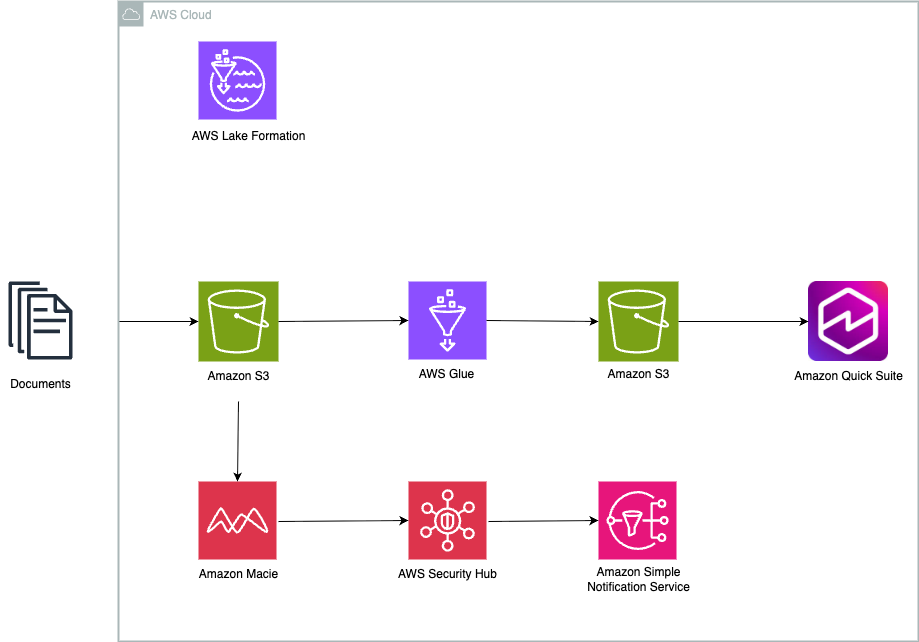
The following architecture shows how continuous discovery, governance, and compliance operations can work together without copying legal documents into analytics systems.
Architecture walkthrough
Store and protect documents in Amazon Simple Storage Service (Amazon S3)
Store your legal documents in Amazon S3, which serves as the system of record for document content. Align your buckets and prefixes to client and matter structures so that access controls map directly to matter boundaries. Where your retention or legal hold requirements demand it, apply S3 Object Lock to enforce immutability. You can encrypt your data using AWS Key Management Service (AWS KMS), which gives you centralized control over encryption keys and policies.
Discover and classify sensitive data with Amazon Macie
You will configure Amazon Macie to continuously analyze your document repositories. Macie identifies regulated information such as personally identifiable information (PII), financial data, and other sensitive content and produces structured findings that describe what Macie identified and where it exists. This provides ongoing visibility into data exposure without requiring document movement or manual scanning.
Catalog and govern findings with AWS Glue and AWS Lake Formation
You will use AWS Glue to catalog the findings dataset and maintain its schema so it stays query-ready. Apply AWS Lake Formation tag-based policies to govern access, aligning tags to client, matter, and confidentiality tier. This approach enforces ethical walls and least-privilege access consistently across analytics and reporting activities.
AI-powered chat agent using Amazon Quick Suite
You can create custom chat agents to tailor conversational interfaces for specific legal business needs. These agents can be configured with legal-specific knowledge bases, connected to relevant document repositories, and customized with instructions appropriate for legal workflows. You can use this chat agent to interact with your legal documents through natural language conversation for capabilities like:
- E-Discovery:Search and analyze large volumes of legal documents to quickly find relevant information across your document repository.
- Contract Analysis:Review contracts and automatically extract key terms, clauses, and obligations to streamline your contract review process.
The chat agent can help you navigate complex document sets through conversational queries, making legal research and document review more efficient and accessible.
Analyze and report with Amazon Quick Sight
You will use Amazon Quick as your compliance operations workspace. Quick provides a unified environment where your teams can query findings, generate dashboards, track remediation actions, and produce audit-ready reports. The agentic AI capabilities of Amazon Quick can autonomously build analyses, surface anomalies across matters, generate executive summaries for client reviews, and proactively recommend remediation priorities based on finding severity and trends. Combined with built-in data stories for automated narrative generation and pixel-perfect paginated reports for regulatory submissions, Quick reduces the time from discovery to action while keeping your teams within a governed interface aligned to matter-based permissions. Rather than switching between separate visualization, workflow, and reporting tools, your legal and compliance teams can review findings, manage response activities, and collaborate all within a single workspace that respects ethical walls and privilege boundaries.
Escalate high-severity findings
For high-severity findings that demand immediate attention, route alerts through AWS Security Hub or Amazon Simple Notification Service (Amazon SNS) to trigger escalation workflows. This connects visibility directly to action when your teams identify sensitive data risks.
Why this approach works for legal
Documents stay where they belong. Your files remain in Amazon S3, aligned to client and matter boundaries. No content moves into separate analytics pipelines.Ethical walls remain intact. Because analytics is built on discovery findings and not document copies, you can govern access to findings using the same matter-aligned controls that apply to documents. Compliance and security teams gain visibility without expanding document access.Discovery runs continuously, not periodically. Rather than scheduling quarterly or annual scans, you maintain a current view of sensitive data across your repositories.
Governance applies once and carries through. Lake Formation tag-based policies govern findings access at the catalog level. You define your matter and confidentiality mappings once, and they carry through to every dashboard, query, and report.Audit readiness is built in. Instead of assembling reports manually before a client review or regulatory inquiry, you maintain a historical record of discovery findings and remediation actions. You can demonstrate your posture over time with consistent, structured evidence.
Security and analytics reinforce each other. Your analytics capability is built on top of your security controls, not alongside them. Strengthening one strengthens the other.
Cost considerations
The primary cost drivers for this architecture include:
- Amazon Macie: You pay based on the number of S3 buckets evaluated and the volume of data inspected for sensitive data discovery. Review Amazon Macie pricing for current rates.
- Amazon S3: Storage costs for both your document repositories and the compliance intelligence bucket. Consider S3 lifecycle policies to tier older findings into lower-cost storage classes.
- AWS Glue and AWS Lake Formation: Charges for crawlers and catalog storage. For most implementations, these costs are modest.
- Amazon QuickSight: Per-user pricing based on the edition that you select (Standard or Enterprise). Enterprise edition supports row-level and column-level security, which aligns well with matter-based governance.
- Amazon EventBridge, AWS Security Hub, and Amazon SNS: Charges based on event volume and notifications delivered. For findings-based workflows, these costs are generally low.
Use the AWS Pricing Calculator to estimate costs based on your repository size, user count, and discovery frequency.
Getting started
Start by identifying a representative set of document repositories in Amazon S3. We recommend that you start with two or three matters that span different practice areas and confidentiality tiers.
- Turn on Amazon Macie for those repositories and configure automated sensitive data discovery.
- Catalog the findings dataset with AWS Glue and apply Lake Formation tag-based access policies aligned to your matter structure.
- Build your first Amazon Quick Sight dashboard to visualize findings by matter, sensitivity type, and severity.
- Define escalation rules in AWS Security Hub or Amazon SNS for high-severity findings.
After you validate this workflow against your initial repositories, expand gradually. Add more repositories to Macie discovery. Refine your governance tags to reflect practice areas and confidentiality tiers. Extend your dashboards from basic posture visibility to trend analysis and remediation tracking.The goal isn’t to build a comprehensive analytics solution all at once. Start with a secure foundation where discovery findings, governance, and reporting operate together in a way that aligns with your legal workflows, and then expand from there.
Conclusion
You don’t have to choose between protecting client data and understanding it. By building analytics on top of governed discovery findings and using a unified compliance workspace, you gain visibility into your data posture without weakening confidentiality boundaries.This approach brings security, governance, and analytics together in a way that reflects how legal work is actually structured. It provides continuous visibility, supports audit readiness, and delivers insight without requiring documents to move outside their system of record.
Next steps
Review the Amazon Macie User Guide to understand sensitive data discovery configuration options and Amazon Quick Sight documentation to evaluate dashboard and row-level security capabilities.
Contact your AWS account team to discuss implementation support for legal and compliance workloads.
About the authors