
Close Menu
geekfence.comgeekfence.com
    What's Hot

    Enterprise Network Trends & Strategy: WAN Manager Survey Insights

    March 28, 2026

    Posit AI Blog: De-noising Diffusion with torch

    March 28, 2026

    The Path to Agentic-Ready Data: Takeaways from the Gartner Data & Analytics Summit

    March 28, 2026
    Facebook X (Twitter) Instagram
    • About Us
    • Contact Us
    Facebook Instagram
    geekfence.comgeekfence.com
    • Home
    • UK Tech News
    • AI
    • Big Data
    • Cyber Security
      • Cloud Computing
      • iOS Development
    • IoT
    • Mobile
    • Software
      • Software Development
      • Software Engineering
    • Technology
      • Green Technology
      • Nanotechnology
    • Telecom
    geekfence.comgeekfence.com
    Home»Nanotechnology»Superconductivity’s new contender
    Nanotechnology

    Superconductivity’s new contender

    AdminBy AdminMarch 28, 2026No Comments3 Mins Read0 Views
    Facebook Twitter Pinterest LinkedIn Telegram Tumblr Email
    Superconductivity’s new contender
    Share
    Facebook Twitter LinkedIn Pinterest Email


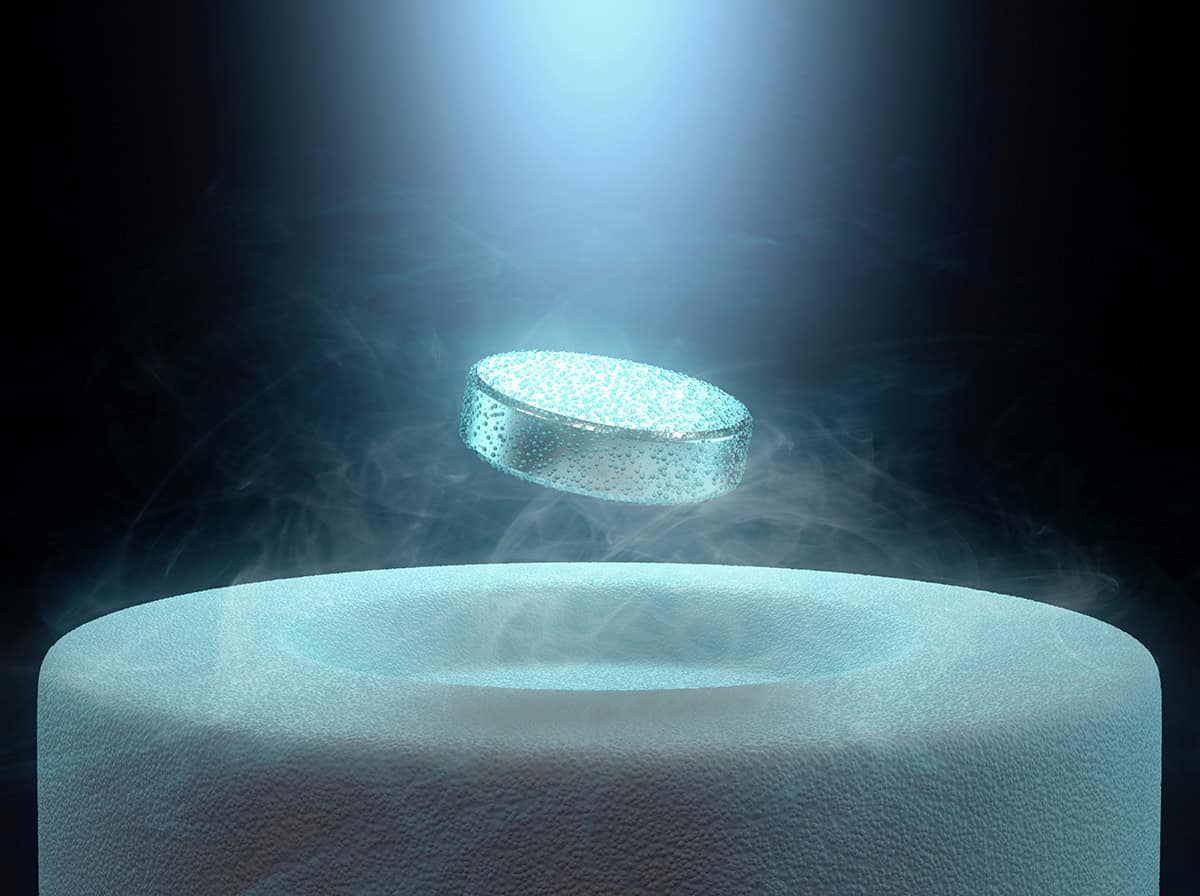
    Researchers have experimentally observed a new kind of particle in transition‑metal dichalcogenide bilayers called doubly charged excitons, or quaternions. A single exciton is an electron bound to a hole, and combining an even number of fermions can create a boson with integer spin. In this system, one electron and three holes (or one hole and three electrons) bind together into a stable, doubly charged bosonic complex. Because bosons can occupy the same quantum state, these quaternions could in principle form a Bose-Einstein condensate, a collective phase in which all particles share a single macroscopic wavefunction. For charged bosons, such a condensate could carry electrical current with zero resistance, opening a pathway to a new kind of superconductivity.

    The researchers confirmed the existence of quaternions through two key measurements. By continuously tuning the electron and hole densities, they observed the expected population behaviour of the bound state, and by applying magnetic fields, they identified the complex as a spin‑triplet. These signatures match theoretical predictions for a doubly charged exciton.

    Unlike exciton or polariton condensates, a quaternion condensate is not expected to emit coherent light, and the experiments indeed show no signs of spectral narrowing or other coherence effects. Achieving condensation will require overcoming practical challenges, including heating from the optical pump and nonradiative Auger recombination at high densities, both of which raise the critical density for condensation. Better cooling and possible lateral confinement could help reach the required regime.

    Although true Bose-Einstein condensation is not possible in an infinite two‑dimensional system, finite 2D systems can still undergo a transition that is effectively indistinguishable from condensation if the coherence length exceeds the system size. This makes it reasonable to search for superfluidity, and potentially superconductivity, in this platform. The strong long‑range Coulomb repulsion between quaternions also raises the possibility of entirely different quantum phases, such as a bosonic Wigner crystal or even a supersolid.

    The establishment of these doubly charged exciton complexes in screened transition‑metal dichalcogenide bilayers opens a promising new direction in quantum materials research, with the real prospect of discovering a non‑BCS form of superconductivity (one that does not rely on the conventional Cooper‑pair mechanism) and other exotic states of matter.

    Read the full article

    Light-induced electron pairing in a bilayer structure

    Qiaochu Wan et al 2026 Rep. Prog. Phys. 89 018003

    Do you want to learn more about this topic?

    Bose–Einstein condensation and indirect excitons: a review by Monique Combescot, Roland Combescot and François Dubin (2017)

    The post Superconductivity’s new contender appeared first on Physics World.


    Source link

    Share. Facebook Twitter Pinterest LinkedIn Tumblr Email

    Related Posts

    6-Channel Piezo Driver for Piezo Stacks, Transducers, Scanner Tubes, and Precision Actuators

    March 27, 2026

    First ever atomic movie reveals hidden driver of radiation damage

    March 26, 2026

    Advancing traumatic brain injury diagnosis through nanomaterial-based imaging technologies

    March 24, 2026

    Magnetic circular dichroism imaging of atomic-scale antiferromagnetic order at a buried interface

    March 23, 2026

    Revealing hidden orbital topology in light-element materials – Physics World

    March 22, 2026

    Possible Dual-Channel Encryption with Silicon Metasurfaces

    March 21, 2026
    Top Posts

    Understanding U-Net Architecture in Deep Learning

    November 25, 202527 Views

    Hard-braking events as indicators of road segment crash risk

    January 14, 202624 Views

    Redefining AI efficiency with extreme compression

    March 25, 202618 Views
    Don't Miss

    Enterprise Network Trends & Strategy: WAN Manager Survey Insights

    March 28, 2026

    Since 2018, we’ve been tracking the evolving nature of corporate enterprise networks through our WAN…

    Posit AI Blog: De-noising Diffusion with torch

    March 28, 2026

    The Path to Agentic-Ready Data: Takeaways from the Gartner Data & Analytics Summit

    March 28, 2026

    Iran war: John Bolton on why even he’s against Trump’s campaign.

    March 28, 2026
    Stay In Touch
    • Facebook
    • Instagram
    About Us

    At GeekFence, we are a team of tech-enthusiasts, industry watchers and content creators who believe that technology isn’t just about gadgets—it’s about how innovation transforms our lives, work and society. We’ve come together to build a place where readers, thinkers and industry insiders can converge to explore what’s next in tech.

    Our Picks

    Enterprise Network Trends & Strategy: WAN Manager Survey Insights

    March 28, 2026

    Posit AI Blog: De-noising Diffusion with torch

    March 28, 2026

    Subscribe to Updates

    Please enable JavaScript in your browser to complete this form.
    Loading
    • About Us
    • Contact Us
    • Disclaimer
    • Privacy Policy
    • Terms and Conditions
    © 2026 Geekfence.All Rigt Reserved.

    Type above and press Enter to search. Press Esc to cancel.