
Close Menu
geekfence.comgeekfence.com
    What's Hot

    UJET’s Agentic Experience Orchestration (AXO): A bold bet on orchestration over infrastructure 

    March 17, 2026

    OURA Ring 4 Officially Launched in India: Check Price

    March 17, 2026

    Posit AI Blog: torch 0.10.0

    March 17, 2026
    Facebook X (Twitter) Instagram
    • About Us
    • Contact Us
    Facebook Instagram
    geekfence.comgeekfence.com
    • Home
    • UK Tech News
    • AI
    • Big Data
    • Cyber Security
      • Cloud Computing
      • iOS Development
    • IoT
    • Mobile
    • Software
      • Software Development
      • Software Engineering
    • Technology
      • Green Technology
      • Nanotechnology
    • Telecom
    geekfence.comgeekfence.com
    Home»Nanotechnology»The search for new bosons beyond Higgs – Physics World
    Nanotechnology

    The search for new bosons beyond Higgs – Physics World

    AdminBy AdminMarch 16, 2026No Comments2 Mins Read0 Views
    Facebook Twitter Pinterest LinkedIn Telegram Tumblr Email
    The search for new bosons beyond Higgs – Physics World
    Share
    Facebook Twitter LinkedIn Pinterest Email


    CMS researchers probed top‑quark pairs for signs of new scalar and pseudoscalar particles
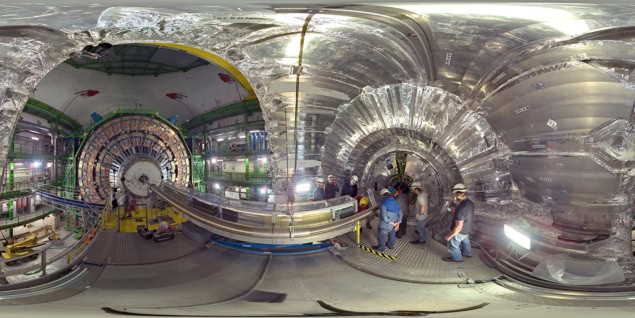
    Inside the CMS

    Inside the CMS (Courtesy: CERN)

    Particle physicists have been searching for new fundamental scalar and pseudoscalar bosons because, if discovered, they could reveal physics beyond the Standard Model and help explain mysteries such as dark matter and even why the Higgs exists. The Higgs remains the only confirmed scalar boson, and no pseudoscalar bosons have yet been observed, though they are predicted, for example, in theories involving axions and axion‑like particles. One promising way to find them is to look for their decay into a top quark and antiquark pair (tt̄).

    Using the CMS detector at the Large Hadron Collider, researchers analysed 138 fb⁻¹ of proton–proton collision data. They reconstructed the invariant mass of the tt̄ system and used angular variables sensitive to its spin and parity to distinguish potential signals from the Standard Model background. Crucially, the analysis includes interference between any new boson and the Standard Model tt̄ production, which can create peak-dip distortions in the invariant mass of the tt̄ system rather than a simple bump. The observed event yield is consistent with the Standard Model prediction over the majority of the invariant mass spectrum, thus excluding a contribution from a potential new boson.

    However, CMS observed a significant excess near the threshold of tt̄  production where the energy of colliding particles is just enough to produce top quarks and antiquarks. This excess has a local significance above five standard deviations and the kinematics of these events is more consistent with a pseudoscalar than a scalar interpretation. However, the excess could also be explained by a predicted tt̄ quasi‑bound state, known as toponium, which fits the data without requiring new particles beyond the Standard Model.

    The researchers set upper limits on how strongly new bosons could couple to top quarks across masses from 365 to 1000 GeV and widths from 0.5% to 25%. These constraints exclude couplings down to around 0.3 for pseudoscalars and 0.4 for scalars, providing the most stringent limits to date for scalar resonances decaying to tt̄.

    Do you want to learn more about this topic?

    Prospects for Higgs physics at energies up to 100 TeV by Julien Baglio, Abdelhak Djouadi and Jérémie Quevillon (2016)


    Source link

    Share. Facebook Twitter Pinterest LinkedIn Tumblr Email

    Related Posts

    Hybrid perovskite–nanograting photonic architecture enables supersolidity at room temperature

    March 17, 2026

    Nanotube Composites and 3D-Printable Shields for Electronics

    March 15, 2026

    A lab mistake at Cambridge reveals a powerful new way to modify drug molecules

    March 14, 2026

    Deep tumor penetration of supramolecular Fmoc-Glyco/ Fmoc-diphenylalanine-DOX drug loaded nanorods for targeted chemotherapy

    March 12, 2026

    AND logic nanoparticle for precision immunotherapy of metastatic cancers

    March 11, 2026

    Resolving the spin of sound – Physics World

    March 10, 2026
    Top Posts

    Hard-braking events as indicators of road segment crash risk

    January 14, 202620 Views

    Understanding U-Net Architecture in Deep Learning

    November 25, 202520 Views

    How to integrate a graph database into your RAG pipeline

    February 8, 202610 Views
    Don't Miss

    UJET’s Agentic Experience Orchestration (AXO): A bold bet on orchestration over infrastructure 

    March 17, 2026

    UJET’s launch of Agentic Experience Orchestration (AXO) marks its entry into agentic Customer Experience (CX) and reflects where…

    OURA Ring 4 Officially Launched in India: Check Price

    March 17, 2026

    Posit AI Blog: torch 0.10.0

    March 17, 2026

    Machine Learning Is Changing iGaming Software Development

    March 17, 2026
    Stay In Touch
    • Facebook
    • Instagram
    About Us

    At GeekFence, we are a team of tech-enthusiasts, industry watchers and content creators who believe that technology isn’t just about gadgets—it’s about how innovation transforms our lives, work and society. We’ve come together to build a place where readers, thinkers and industry insiders can converge to explore what’s next in tech.

    Our Picks

    UJET’s Agentic Experience Orchestration (AXO): A bold bet on orchestration over infrastructure 

    March 17, 2026

    OURA Ring 4 Officially Launched in India: Check Price

    March 17, 2026

    Subscribe to Updates

    Please enable JavaScript in your browser to complete this form.
    Loading
    • About Us
    • Contact Us
    • Disclaimer
    • Privacy Policy
    • Terms and Conditions
    © 2026 Geekfence.All Rigt Reserved.

    Type above and press Enter to search. Press Esc to cancel.