

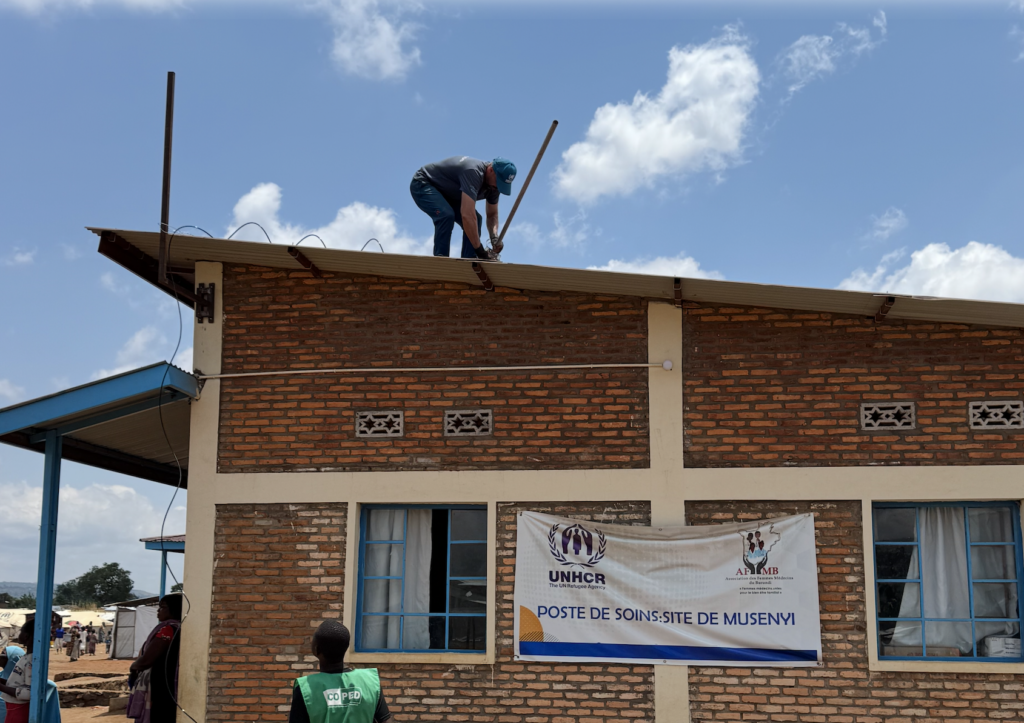
Reliable internet access may not be the first thing that comes to mind when you think about humanitarian responses. But, for the UN Refugee Agency (UNHCR) and its partners responding to urgent needs at Musenyi refugee camp, connectivity is a critical enabler of their work.
Musenyi is located in Burundi, a small, landlocked country in East Africa. In 2025, thousands of children and families arrived at Musenyi seeking safety and assistance, placing pressure on a site that wasn’t built for that scale. Shelter, food, and medical care were among the most urgent priorities, but none of it could be coordinated effectively with limited internet connectivity.
With so many vulnerable people depending on a coordinated, effective response, UNHCR turned to its trusted partnership with Cisco Crisis Response (CCR) to work together on a solution.
A first-of-its-kind deployment: Bringing industrial-grade Cisco technology to Musenyi
When UNHCR’s Refugee Emergency Telecommunications Sector (RETS) team reached out to CCR in late March 2025, the ask was clear: design and deploy a network solution for Musenyi that could connect multiple sites across difficult terrain and in harsh outdoor conditions, with limited existing infrastructure to build on. There was no underground fiber cabling, no reliable cellular signal, and no viable way to run physical cables across the terrain. The solution had to work in conditions that would defeat standard networking equipment.
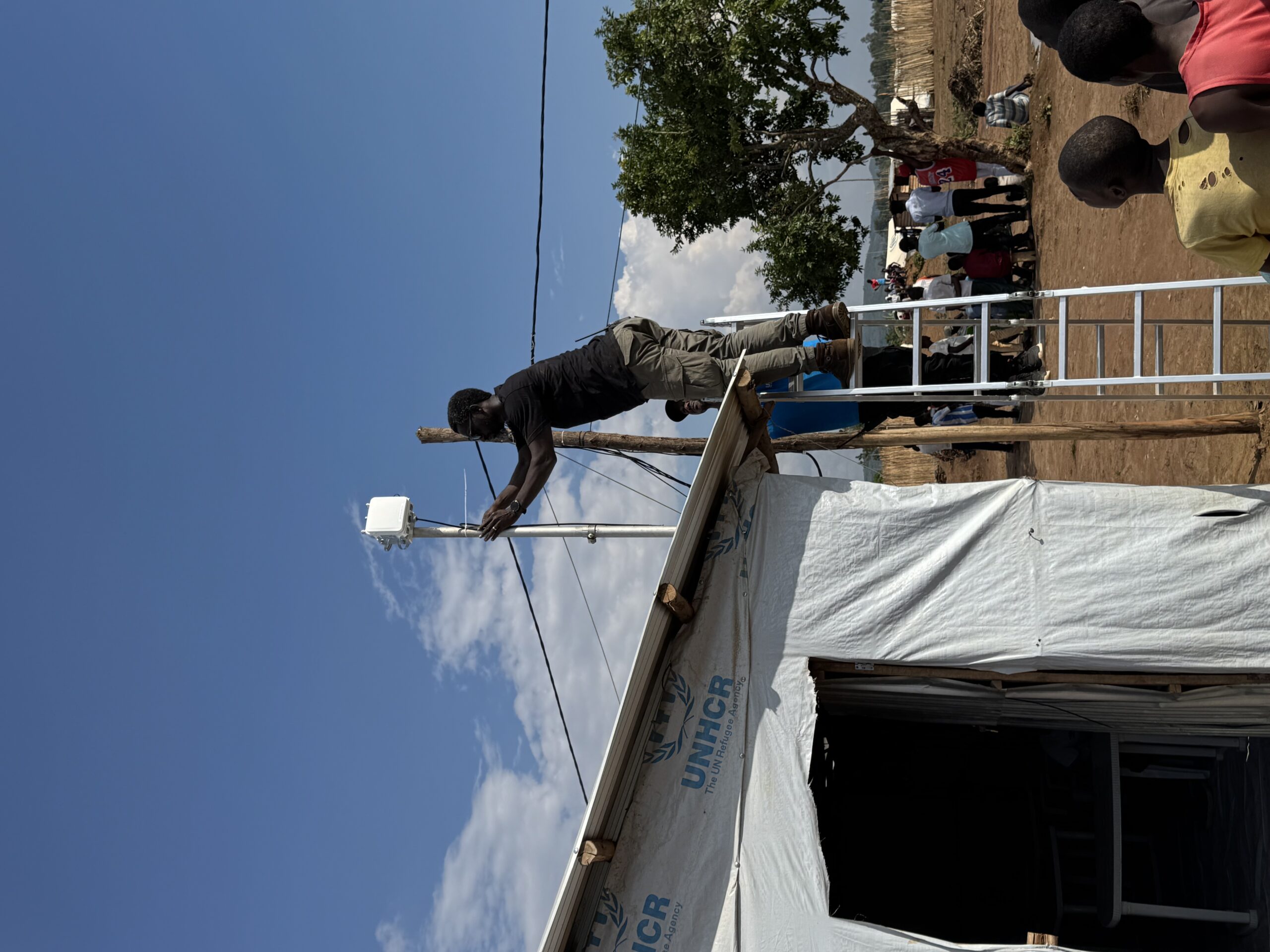
For the first time, CCR deployed Cisco’s industrial-grade wireless technology in an active humanitarian field operation — and the conditions at Musenyi were exactly what this equipment was built for. Ruggedized to withstand heat, dust, and rain, it created high-speed connections between sites up to 1,000 feet apart without a single cable in the ground. Much of it had been pre-configured before the team left for Burundi, minimizing setup time on arrival.
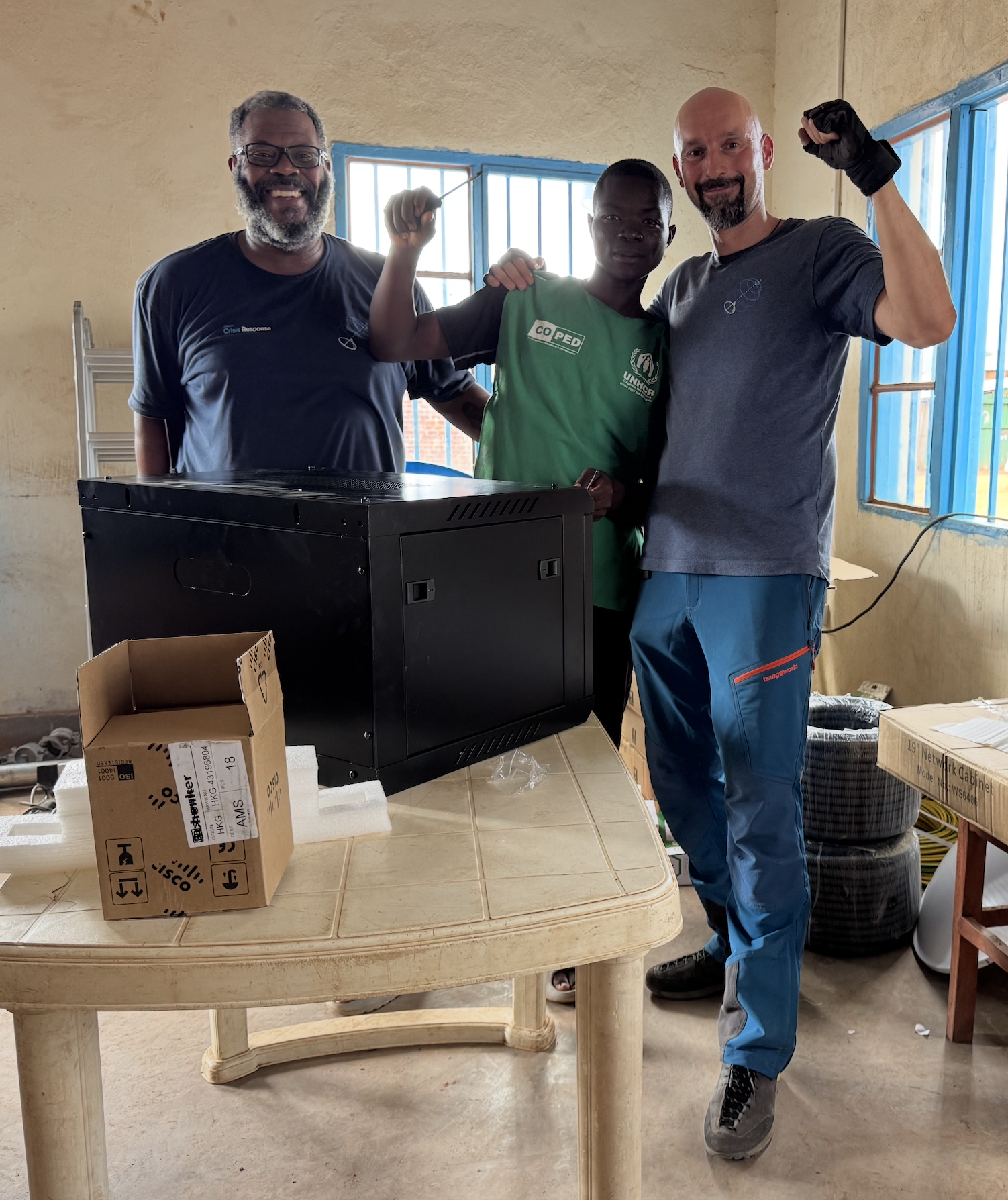
Once on the ground, the CCR team worked closely with UNHCR’s local IT staff to upgrade Musenyi’s network and expand connectivity across the site, linking key facilities and enabling more efficient coordination across relief agencies.
“The first thing we did when we got to Musenyi was position an antenna at elevation, so it could broadcast simultaneously to multiple hubs across the site below,” explains Matt Altman, CCR’s technical leader in systems engineering. “The point-to-multipoint capability was essential here, because it meant we could connect the health center, school, the main operations center, and facilities without running a single physical cable.”
From field operations to family calls: Putting the network to work
For humanitarian workers, reliable connectivity is critical to their day-to-day work. Once the upgraded wireless network was in place, Musenyi’s operations began to shift. UNHCR teams could register new arrivals more efficiently, while health workers could consult with remote specialists to help families get the medical care they need. UN agencies and local partners could share real-time information about medical needs, food distributions, and protection cases. Coordination across agencies could happen more easily over secure video calls, freeing up valuable time and resources.
For the refugee and host community, the network opened a different kind of door. Musenyi’s two internet connections — a microwave link and a low earth orbit satellite — are allocated based on time of day. During business hours, humanitarian workers have dedicated bandwidth for daily operations while refugees use the other connection; at night, automated scripts reconfigure the network, rendering the full capacity of both connections available to the community so they can access information and connect with loved ones.
Underpinning all of it is a security architecture designed to keep sensitive information safe without limiting access for those who need it. Cisco Identity Services Engine (ISE) gives UNHCR’s IT team precise control over who can access what: partner NGOs onboard through a self-service portal, and sensitive systems — such as refugee registration data, protection case files, and medical records — remain protected throughout. Cisco SecureConnect layers DNS filtering, firewall protection, and web security across all users, protecting both humanitarian operations and the refugee community from online threats. And with Cisco Meraki’s cloud-managed dashboard, CCR engineers can monitor network health and resolve issues remotely, while local UNHCR IT staff trained during the deployment handle day-to-day management on the ground.
“When equipped with the right technology, humanitarian teams can focus on supporting families and managing urgent needs,” says Kevin Murphy, CCR operations manager.
“Ultimately, our goal is to provide the site managers with the tools and training they need to stay efficient, connected, and secure. It’s rewarding to see our solutions help others deliver aid more effectively and connect communities that were previously out of reach.” — Kevin Murphy, CCR operations manager
The investment in infrastructure and hands-on training put Musenyi in a stronger position to handle whatever came next. When more families arrived in the following months, UNHCR and partners were better equipped to respond. To keep pace with the site’s evolving needs, we also shipped Cisco-donated equipment from UNHCR’s emergency stockpile in Geneva to Burundi while continuing to procure additional materials and coordinate a follow-up deployment.
Beyond the bandwidth: The human impact of connectivity during times of crisis
The progress at Musenyi is a demonstration of what’s possible when the right technology meets the right partnership, and what that means for the thousands of people depending on both. UNHCR’s operational expertise paired with Cisco’s technology and technical capabilities meant that the team was able to co‑design a solution that was fit for the context and the people it is meant to serve.
From the humanitarian worker who can pull up a case file in moments rather than searching through stacks of paper records, to the family separated across borders who can finally see each other’s faces on a screen: reliable connectivity changes what’s possible in a crisis.
For Altman, this work isn’t simply about providing internet service. “We’re giving humanitarian workers the tools to do their jobs more effectively while giving people who are enduring incredible hardship the ability to maintain connections to family, to access information, to have a voice,” he reflects. “It’s a reminder that one of the most meaningful things we can do with Cisco technology is to make sure — even in times of crisis when everything else is uncertain — that help, hope, and human connection are always within reach.”