
Close Menu
geekfence.comgeekfence.com
    What's Hot

    Emerald Fennell’s Wuthering Heights Review

    February 14, 2026

    Infrastructure, Not Compute, is the Real AI Bottleneck

    February 14, 2026

    ALS stole this musician’s voice. AI let him sing again.

    February 14, 2026
    Facebook X (Twitter) Instagram
    • About Us
    • Contact Us
    Facebook Instagram
    geekfence.comgeekfence.com
    • Home
    • UK Tech News
    • AI
    • Big Data
    • Cyber Security
      • Cloud Computing
      • iOS Development
    • IoT
    • Mobile
    • Software
      • Software Development
      • Software Engineering
    • Technology
      • Green Technology
      • Nanotechnology
    • Telecom
    geekfence.comgeekfence.com
    Home»Nanotechnology»What shape is a uranium nucleus? – Physics World
    Nanotechnology

    What shape is a uranium nucleus? – Physics World

    AdminBy AdminFebruary 13, 2026No Comments2 Mins Read1 Views
    Facebook Twitter Pinterest LinkedIn Telegram Tumblr Email
    What shape is a uranium nucleus? – Physics World
    Share
    Facebook Twitter LinkedIn Pinterest Email


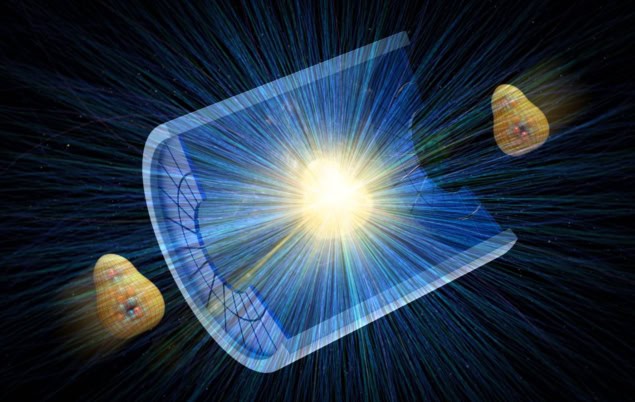
    The STAR collaboration has released new results based on their imaging-by-smashing technique revealing uranium-238 could actually be pear-shaped
    Pear-shaped uranium-238

    Schematic illustration of high energy collisions of “pear-shaped” uranium-238 (exaggerated in size and shape) Courtesy: Chunjian Zhang (Fudan University) and Jiangyong Jia (Stony Brook University and Brookhaven National Lab)

    High-energy heavy-nuclei collisions, conducted at particle colliders such as CERN’s Large Hadron Collider (LHC) and BNL’s Relativistic Heavy Ion Collider (RHIC) are able to produce a state of matter called a quark-gluon plasma (QGP).

    A QGP is believed to have existed just after the Big Bang. The building blocks of protons and neutrons – quarks and gluons – were not confined inside particles as usual but instead formed a hot, dense, strongly interacting soup.

    Studying this state of matter helps us understand the strong nuclear force, the early universe, and how matter evolved into the forms we see today.

    In order to understand QGP created in a particle collider you need to know the initial conditions. In this case that is the shape and structure of the heavy nuclei that collided.

    A major complicating factor here is that most atomic nuclei are deformed. They are not spherical but rather squashed and ellipsoidal or even pear-shaped.

    Collisions of deformed nuclei with different orientations brings in a large amount of randomness and therefore hinders our ability to describe the initial conditions of the QGP.

    A new method called imaging-by-smashing was developed by the STAR experiment at RHIC, where atomic nuclei are smashed together at extremely high speeds. By studying the patterns in the debris from these collisions, researchers can infer the original shape of the nuclei.

    In this latest study, they compared collisions between two types of nuclei: uranium-238, which has a strongly deformed shape, and gold-197, which is nearly spherical.

    The differences between uranium and gold helped isolate the effects of uranium’s deformation. Their results matched predictions from advanced hydrodynamic simulations and earlier low-energy experiments.

    Most interestingly, they found hints that uranium might possess a pear-like (octupole) shape, in addition to its dominant football-like (quadrupole) shape. This feature had not previously been observed in high-energy collisions

    This method is still new, but in the future, it could give us key insights nuclear structure throughout the periodic table. These measurements probe nuclei at energy scales orders of magnitudes higher than traditional methods, potentially revealing how nuclear structure evolves across very different energy regimes.


    Source link

    Share. Facebook Twitter Pinterest LinkedIn Tumblr Email

    Related Posts

    Issue 86

    February 14, 2026

    First Look into the Electrostatic Landscape of a Moiré Unit Cell

    February 12, 2026

    Scientists finally solve a 100-year-old mystery in the air we breathe

    February 11, 2026

    Molecularly imprinted nanoreactors: Bridging enzyme mimicry and synthetic catalysis

    February 9, 2026

    Tandem architectures for electrochemical CO2 reduction: from coupled atomic sites to tandem electrolysers

    February 8, 2026

    Quantum states that won’t entangle – Physics World

    February 7, 2026
    Top Posts

    Hard-braking events as indicators of road segment crash risk

    January 14, 202617 Views

    Understanding U-Net Architecture in Deep Learning

    November 25, 202512 Views

    How to integrate a graph database into your RAG pipeline

    February 8, 20268 Views
    Don't Miss

    Emerald Fennell’s Wuthering Heights Review

    February 14, 2026

    Summary created by Smart Answers AIIn summary:Tech Advisor highlights six critical errors in Emerald Fennell’s…

    Infrastructure, Not Compute, is the Real AI Bottleneck

    February 14, 2026

    ALS stole this musician’s voice. AI let him sing again.

    February 14, 2026

    What is Prompt Chaining?

    February 14, 2026
    Stay In Touch
    • Facebook
    • Instagram
    About Us

    At GeekFence, we are a team of tech-enthusiasts, industry watchers and content creators who believe that technology isn’t just about gadgets—it’s about how innovation transforms our lives, work and society. We’ve come together to build a place where readers, thinkers and industry insiders can converge to explore what’s next in tech.

    Our Picks

    Emerald Fennell’s Wuthering Heights Review

    February 14, 2026

    Infrastructure, Not Compute, is the Real AI Bottleneck

    February 14, 2026

    Subscribe to Updates

    Please enable JavaScript in your browser to complete this form.
    Loading
    • About Us
    • Contact Us
    • Disclaimer
    • Privacy Policy
    • Terms and Conditions
    © 2026 Geekfence.All Rigt Reserved.

    Type above and press Enter to search. Press Esc to cancel.