

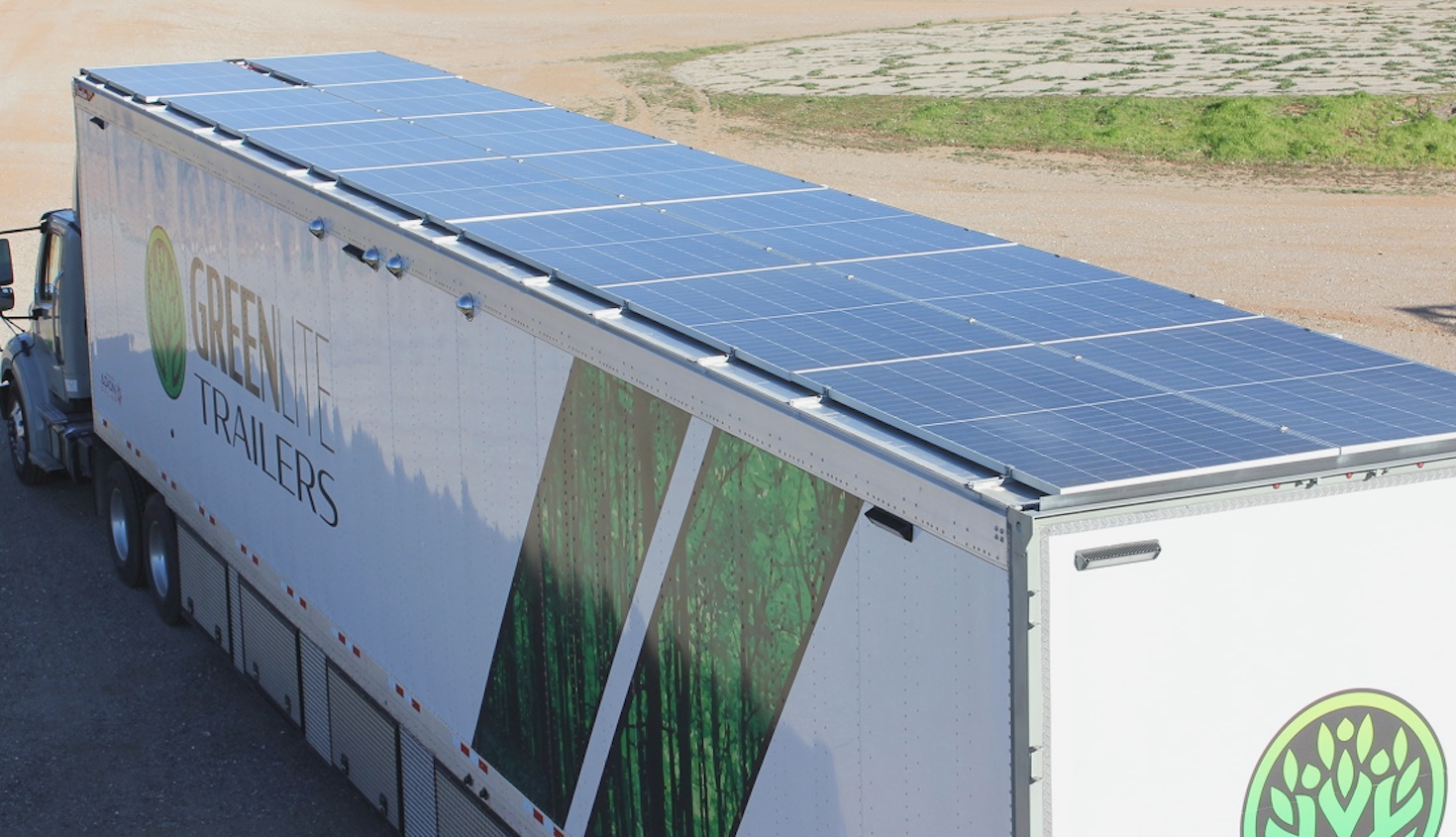
When Amazon’s MGM Studios filmed the second season of the Prime Video series “Fallout,” it substituted the diesel generators traditionally used to electrify movie and television productions with a network of solar-powered trailers.
The technology, Solar Ring, from GreenLite Trailers, provided 4,952 kilowatt-hours of electricity to 14 trailers in the production’s central basecamp over a 20-week trial. Elsewhere in the U.K., Amazon uses hydrogen fuel technology to charge mobile batteries on sets, reducing the need for diesel generators in places where the Solar Ring wouldn’t make sense.
“Film productions can’t plug all of their lights and equipment into house power if they are filming in the middle of a city, and we film in areas that have no power whatsoever, so we basically bring our own little power plants everywhere we go,” said Katherine Braver, global production sustainability project manager at Amazon, in a blog about the “Fallout” pilot. “Historically, these power plants are diesel-running generators.”
The heavy weight of diesel
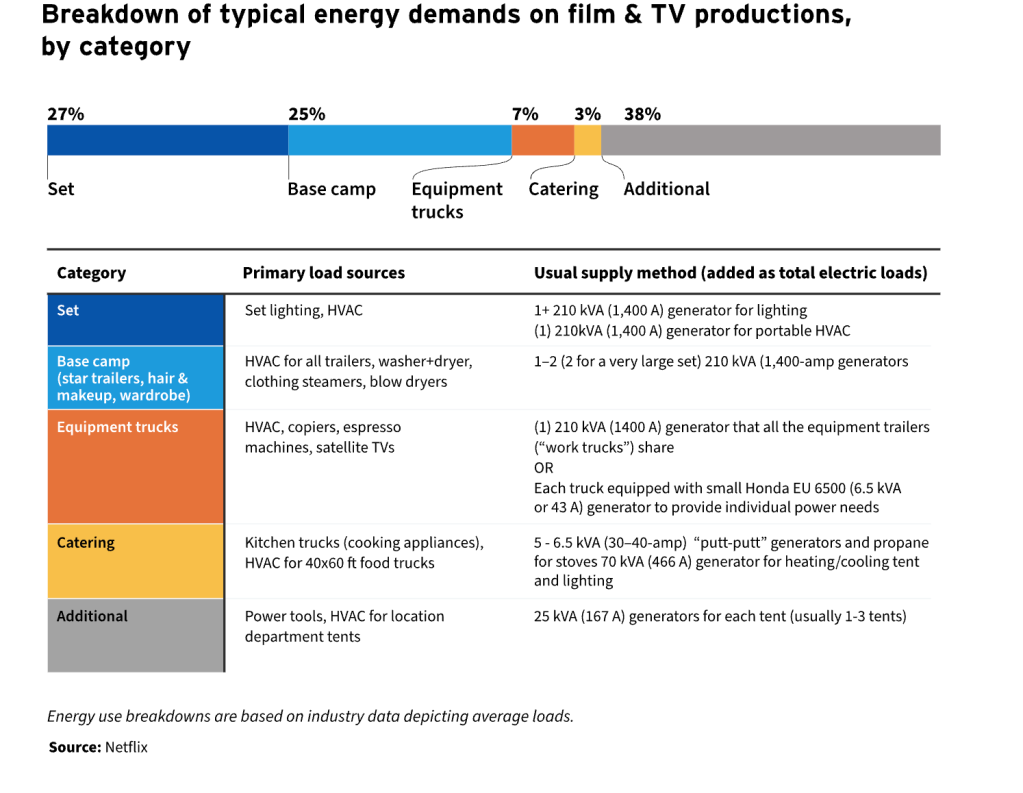
Diesel generators are typically the heaviest emission source on studio production sets, contributing an estimated 15 percent of a production’s carbon footprint, according to estimates by major studios. These generators support a wide range of on-set equipment including cameras and lights, sound stages, catering and base camp operations.
Amazon, Disney and Netflix are all piloting alternatives that produce less emissions and local air pollutants. Many of the technologies are also quieter, which means they can be placed closer to production sets and aren’t as disruptive in locations where many people live or do business.
Amazon uses an internal research and development fund and plans future investments through its climate-tech financing arm, while Disney and Netflix co-sponsored a two-year-long accelerator program called the Clean Mobile Power Initiative that covered 10 startups that received investments from Third Derivative, which backs early-stage climate-tech entrepreneurs.
Amazon didn’t disclose how much the Solar Ring system cut production emissions for “Fallout” through its recent trial.
Netflix uses clean mobile power on all productions under its direct control — although not necessarily to power all operations; in 2024, the company cut its generator fuel by 20 percent on half of its productions.
Disney doesn’t break its progress out as specifically, but says it has reduced emissions from its operations and energy use by 38 percent since 2019.
While the applications that these companies are testing are specific to Hollywood, the technologies are all suitable for other industries that rely heavily on diesel generators: live events; construction and disaster relief; islanded microgrids; and commercial building backup power, particularly for data centers and hospitals, which often have reliability requirements to meet.
“We’ve validated that this technology can be dropped pretty much everywhere,” said Caroline Winslow, manager of clean energy technology at Third Derivative. “It’s not a matter of will this work, it’s the use case for the technology.”

Big lesson: Solar alone doesn’t cut it
The mission of the Clean Mobile Power Initiative was to test portable energy storage systems: small enough to fit into a 9-foot-by-18-foot parking space and capable of providing 140-220 kilowatts of three-phase power for up to 14 hours.
Often these systems are powered by solar panels, but that’s not feasible in every location. In some places, for example, they’re hooked up to a centralized grid for recharging or even connected to diesel generators. “Our belief is that there is not a single solution,” Winslow said.
The 10 participating companies sell a mix of lithium-ion battery energy storage and hydrogen-fueled equipment: Allye, Ampd Energy, Electric Fish, H2 Portable Power, Hone, Instagrid, Joule Case, Lex Products, RIC Electronics and Sesame Solar. Most of these companies aren’t specifically focused on Hollywood.
Battery energy storage systems were the most cost-effective alternative to diesel generators studied by Disney and Netflix, according to an RMI analysis outlining the findings of their tests. On the other hand, hydrogen units allow for batteries to be recharged more quickly.
For context, power and utility bills represent about 0.8 percent of a typical film or TV production’s total budget. The Clean Mobile Power Initiative estimates that if solar and batteries were used instead, it would boost that budget by 2.4 percent; if hydrogen systems are used, it would result in a 3.2 percent increase.
Amazon, Disney and Netflix don’t typically own the power equipment on production sets: it’s generally provided by rental companies such as MBS Group, Sunbelt Rentals and Quixote by Sunset Studios, all of which participated in the Clean Mobile Power Initiative.
If clean mobile power is to become a reality, studios must establish procurement policies and financial incentives that convince rental companies and equipment suppliers to invest in more clean power units, Winslow said.
For example, if a studio would agree to rent a particular piece of equipment over several years rather than just for a single production — similar to the purchase agreements many corporations sign for renewable power — it would help lower the risk of a rental company’s investment. Special insurance policies are also needed to cover the equipment in case performance issues arise, the RMI analysis notes.
“We are hearing more and more from the studios that we worked with, and adjacent ones, that there is a demand for more of this power,” Winslow said. “We need alignment on this message, not only across studios but also with the suppliers that are the asset owners.”