After tracking prices for telecom transport services for more than two decades, there are two things we know for certain: telecom prices vary widely around the world, and they change over time.
As multinational corporations across industries grapple with price changes, they’re also reevaluating how cloud, security, SD-WAN—and eventually AI—will impact the configuration and costs of their WAN services. That’s why we created this WAN Market Size Forecast.
Our WAN Market Size Forecast model demonstrates the revenue impacts of these anticipated changes for the remainder of the 2020s, with internet and SD-WAN supplanting much of the revenue that came from MPLS circuits. Our assumptions were driven by our WAN Manager Survey, WAN Cost Benchmark and WAN Geography Benchmark customers, and our many conversations with decision makers from both the buy and sell sides of the business. This analysis is based on the data you can access in TeleGeography’s Cloud and WAN Research Service.
This WAN Market Size Forecast covers:
Key Takeaways
- Global WAN connectivity revenue is basically flat, with a slight decline from $442 billion in 2025 to $433 by 2030.
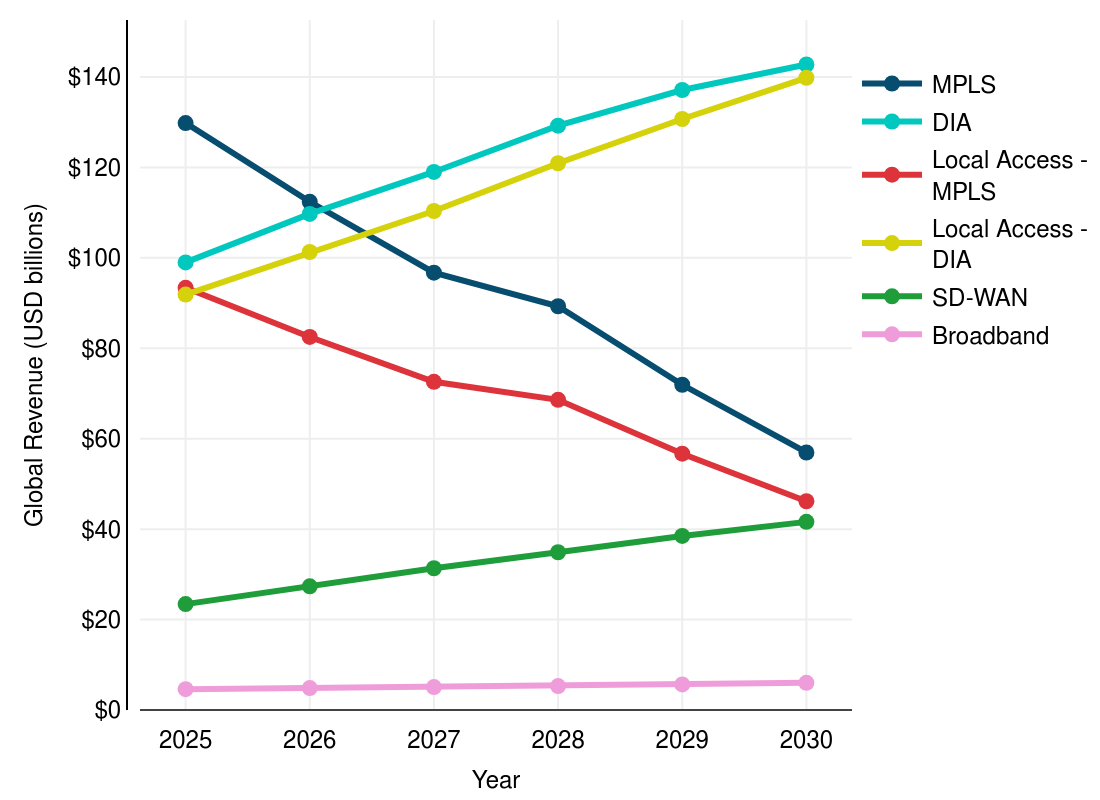
- MPLS revenue will fall off a cliff, going from $130 billion to $57 billion.
- However, DIA revenue, bolstered by a growing demand for high-speed ports, will pick up much of that slack, growing from $99 billion to $142 billion.
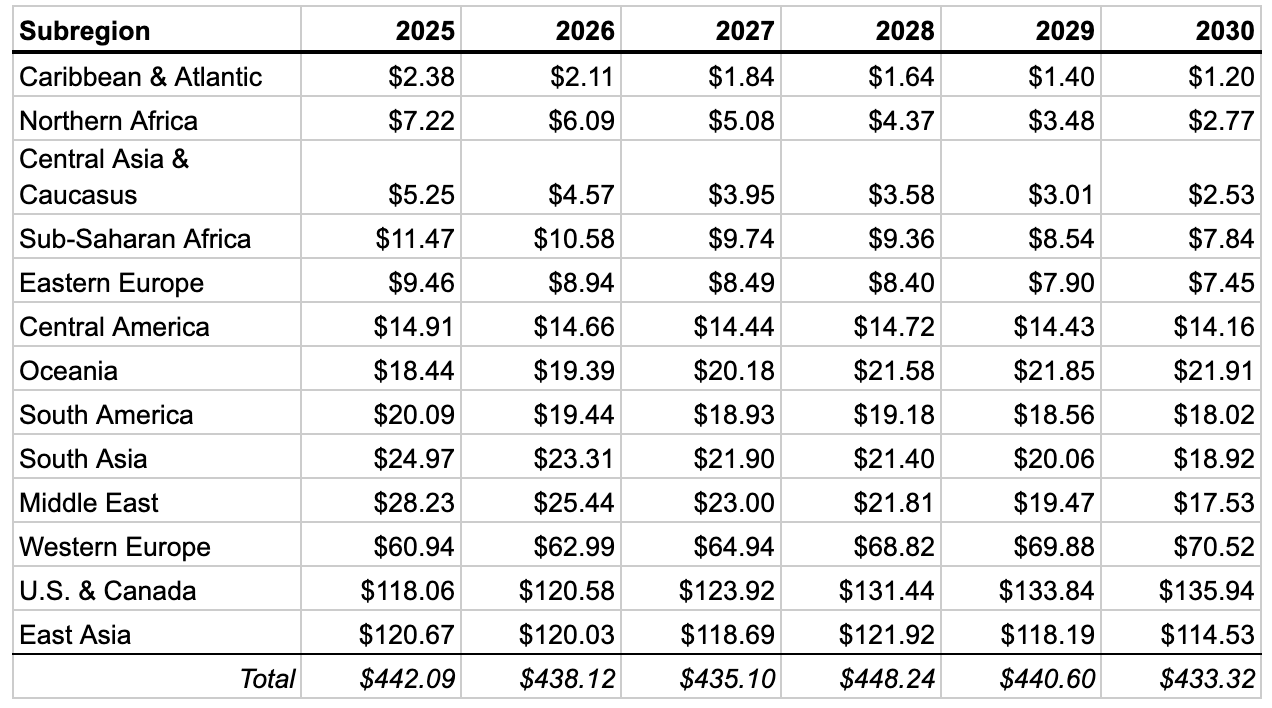
- Revenue growth is uneven around the world with some regions such as the U.S. & Canada and Western Europe poised to pick up additional revenue, while others like East and South Asia likely to lose revenue. This is likely due to slower bandwidth demand growth in more expensive countries.
- Many countries will stay steady in their placement on the top 25. The U.S. China, and Australia remain in the top three, however, some expensive markets like India, Saudi Arabia, and the United Arab Emirates lose ground in the model, due to lack of demand for high-speed ports.
Global WAN Connectivity Market Sizes: 2025-2030
Global Market Size by Major Product Division
The total global WAN market size is basically flat from 2025-2030, moving from $442 billion in 2025 to $433 billion in 2030. While the overall revenue appears stable, significant shifts are occurring beneath the surface between product categories.
Global Revenue Forecasts for Major WAN Products: 2025-2030
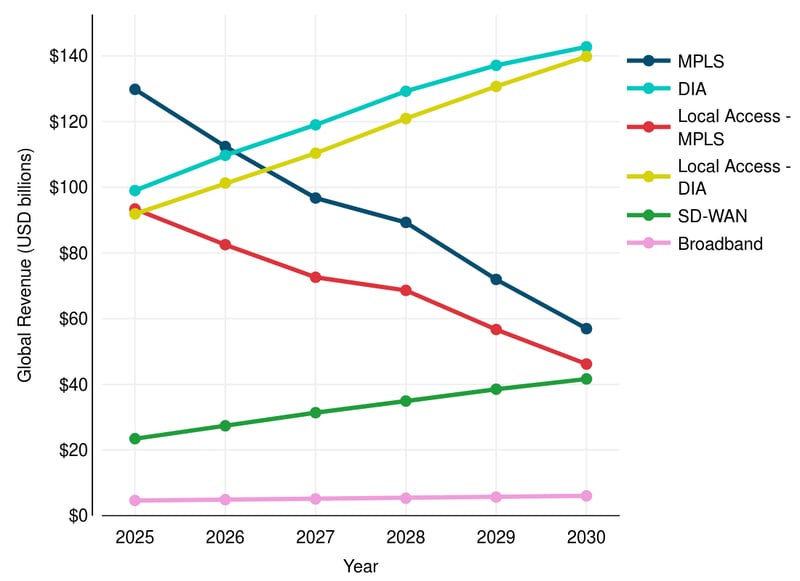
- MPLS: Forecasted to fall sharply from $130 billion in 2025 to $57 billion in 2030.
- DIA: Makes up for much of the MPLS loss, growing from $99 billion to $142 billion.
- Local Access: Remains basically flat as some access loops are lost to declining MPLS ports, but larger access lines are required for high-capacity DIA port connections.
- Broadband: Increases from $4.5 billion to $6 billion, though it remains a small part of global revenue.
- SD-WAN: Projected to nearly double from $23 billion to $42 billion.
Global WAN Market Size by Specific Product Set
Our model breaks out the specific product sets to forecast each individual type based on the number of sites and bandwidths they are likely to be at in all 231 countries. It can be useful to see how local access is split between MPLS and DIA, for example, to understand how access markets may absorb the decline of MPLS and rise of larger-port DIA. The following table highlights the shifting percentage contribution of specific products to the total WAN market revenue from 2025 to 2030:
Global WAN Revenues by Specific Product (Percentage of Market)
.png?width=1270&height=532&name=Global%20WAN%20Revenues%20by%20Specific%20Product%20(Percentage%20of%20Market).png)
Market Dynamics:
- Balance of Connectivity: There is a clear shift in dominance as MPLS declines from nearly 30% of global revenue in 2025 to just over 13% in 2030, while DIA grows to take nearly 33% of the market.
- Local Access Evolution: While local access for MPLS is declining, it is being offset by a rise in local access for off-net DIA. This revenue growth is driven by the need for larger access lines to support higher DIA port sizes, even as we assume more DIA is available on-net and thus without an additional access line.
- SD-WAN Growth: All SD-WAN service types are increasing in revenue share due to higher port/circuit sizes and increased encrypted throughput. Managed SD-WAN is particularly strong, as we assume later adopting enterprises will increasingly seek managed services, and others rely on more management for security purposes.
Regional WAN Connectivity Market Shares
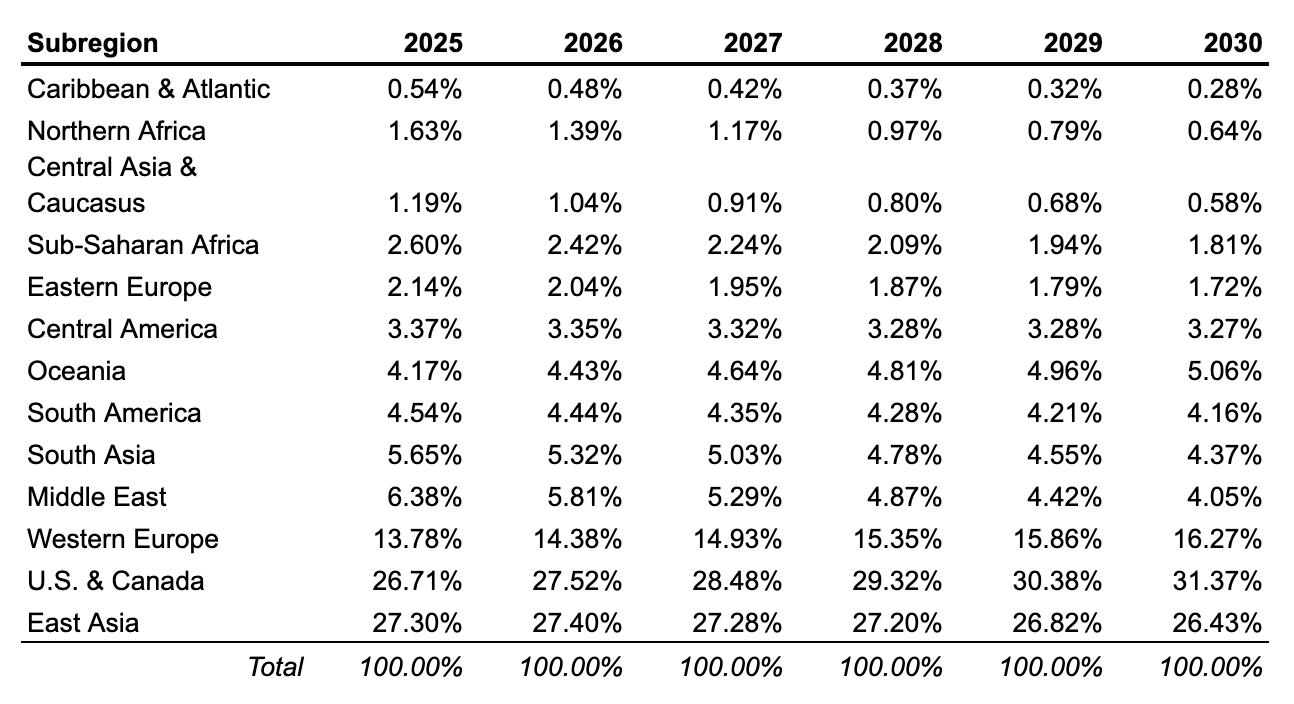
While U.S. & Canada were slightly behind East Asia in 2025, we project the region will outpace East Asia by 2030. Most other regions remain relatively flat as the growth in DIA, SD-WAN, and broadband offsets the loss of MPLS revenue. Regions with higher demand for very large ports will see more significant growth compared to those with smaller port size demand. This is despite the fact that for all network connectivity products (MPLS, DIA, and broadband) we assumed that prices would fall the fastest for larger capacity circuits. As capacity demand grows, even though high-speed ports come at a unit cost discount, the higher volume of capacity means more revenue than lower speed ports at a higher cost per bit.
Regional Total WAN Market Size Forecast: 2025-2030 (USD millions)
Regional Highlights:
- Growth Leaders: U.S. & Canada and Western Europe are set to grow their revenue share largely due to the demand for larger DIA port sizes.
- East Asia Contraction: East Asia is expected to fall slightly in total revenue. This is likely influenced by the dominance of China and a prevalence of lower port speeds and fewer high capacity upgrades.
- MPLS to DIA Transition: In many regions, actual revenues may fall because of the end of reliance on high-priced MPLS and the adoption of DIA and broadband, which offer a lower price per Mbps. As the price delta between MPLS and DIA varies globally, the loss of MPLS may be felt more in certain regions.
Regional Total WAN Market Size Distribution Forecast: 2025-2030
Regional Revenue Shares:
- Developed Market Growth: Despite already low prices and high competition, our model predicts that the share of global WAN revenue for the U.S. & Canada and Western Europe will grow slightly. Again, this is most likely due to strong bandwidth demand growth.
- East Asia Losing Share: We might have expected China to grow more, but depressed bandwidth demand there compared to other regions due to the high prices and the trio-polistic market, are likely to decrease revenue over time. Our model keeps the number of sites static, so perhaps this assumption is less true in China and reality might overcome that depressed bandwidth.
- Long Tail Regions: As in the annual model, the rest of the world are a long tail of comparatively small contributions to global WAN revenue. Most are flat or slightly declining. Again, regions with particularly expensive service are likely to shrink in revenue or revenue share due to depressed bandwidth demand growth.

Regional WAN Connectivity Market Sizes by Product
MPLS Regional Shares
Our model projects that global annual revenue for MPLS will fall from $130 billion to $57 billion. While we assumed global MPLS use is declining from 45% of sites in 2025 to just 18% in 2030, we assumed port speeds for the remaining MPLS ports will increase, though not as aggressively as DIA. Our assumptions about differences in geographic reliance on MPLS didn’t change. So places with more MPLS in 2025 like China will still have more MPLS in 2030.
Regional MPLS Port Revenues: 2025-2030 (USD millions)
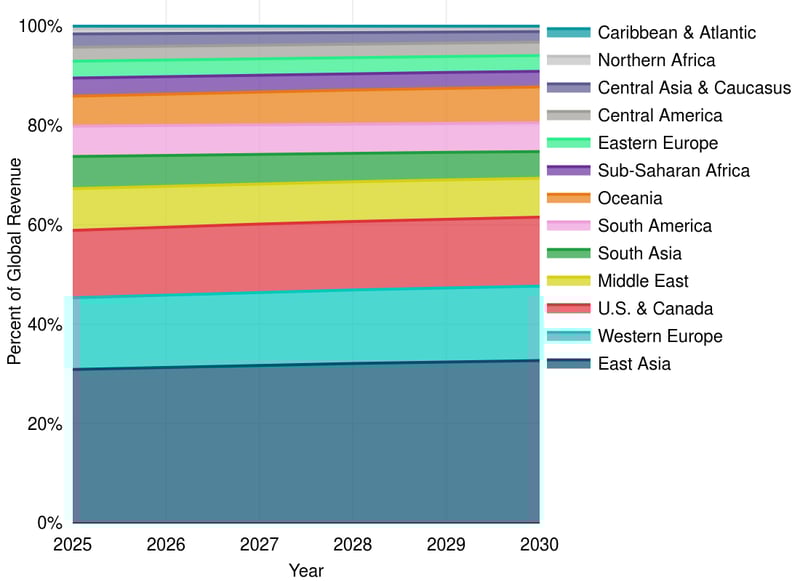
- Revenue Shifts: U.S. & Canada and Western Europe will see large revenue drops for MPLS, but their overall contribution to the MPLS market remains steady.
- High-Cost Markets: In East Asia (specifically China) and Oceania, the percentage contribution to the global MPLS market actually increases slightly because high-speed ports remain very expensive in those regions.
DIA Regional Shares
DIA revenue is increasing from $99 billion to $142 billion as demand grows from 65% of sites to 83% in the average enterprise network. This will supplant much of the lost MPLS revenue and make a large contribution to keeping global WAN revenues relatively steady during the decline of MPLS.
Regional DIA Port Revenues: 2025-2030 (USD millions)
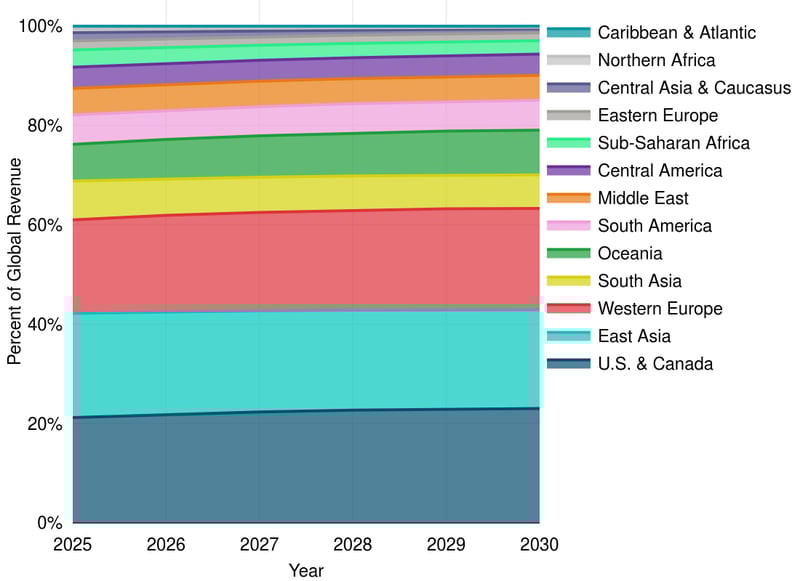
- Major Growth: Our model has the U.S. & Canada, Western Europe, and Oceania seeing significant DIA revenue growth, despite the fact that we assume the greatest price pressure for DIA in these regions at the larger port sizes.
- Port Size Influence: East Asia grows its DIA revenue, but its percentage contribution to the global total shrinks because DIA port sizes tend to be smaller in China compared to the U.S. or Europe.
- Smaller Regions Contract: Some smaller regions actually see a decrease in DIA revenue likely due to having comparatively less demand for larger ports, so despite an increase in sites running DIA, price declines outweigh more ports.
Access Regional Shares
Global revenue for local access is basically flat in the model. We assume no change to access prices as it is not subject to the normal network price declines. Access prices change over time, but not in the predictable downward direction we see in the more competitive and standardized network services market. Despite the loss of many MPLS loops, large-capacity loops connecting to off-net DIA are likely to pick up the revenue slack. Even though we assumed that more DIA would be available on-net by 2030, a majority is still off-net and this is enough, along with the move toward higher bandwidths, to keep local access revenue from falling.
Regional Access Revenues: 2025-2030 (USD millions)
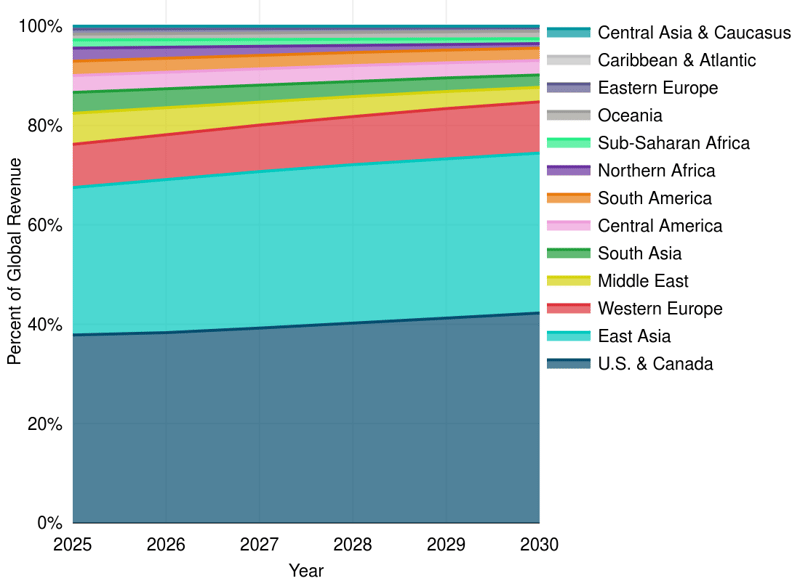
- Access Revenue Flat: Global access revenue is flat at approximately $185–$186 billion. While fewer loops are needed for MPLS, the move toward higher port sizes for both remaining MPLS and new DIA ports compensates for that loss.
Broadband Regional Shares
We decreased broadband prices, but only very slightly, with lower capacities seeing little to no change and higher capacities often around 0.5% to 1% annual declines. This is because broadband is already so inexpensive that there is little room for downward pressure year-on-year. While prices do experience some pressure at higher speeds, they do not decline at steady rates like we tend to see with network services. Many enterprises prefer DIA to broadband, because they prefer an uncontended service with SLAs, and because best-efforts broadband in many markets can have middle mile and other reliability issues. However, where quality broadband is available, the price points can be attractive. We assume broadband will remain a secondary or backup service for most sites, but still grow as enterprises leave behind MPLS. In markets with robust upstream connections and FTTx it may become more common even as primary connections.
Regional Broadband Port Revenues: 2025-2030 (USD millions)
.png?width=800&height=582&name=Regional%20Broadband%20Port%20Revenues%202025-2030%20(USD%20millions).png)
- Broadband: We assume broadband will grow from 35% of sites in 2025 to 47% in 2030. However, due to its very low price points, it remains a small contributor to the global market, growing from $4.6 billion to $6 billion.
- Major Regions’ Share is Flat: The major regions, U.S. & Canada, Western Europe, and East Asia, are relatively flat in terms of percentage contribution to the global broadband market. These regions are where most of that revenue growth comes from, but since prices and circuit speeds are much more uniform globally than network services, their contributions don’t change much.
- Smaller Regions Lose Share: As with other products, some smaller and more expensive regions contract in revenue share because we assumed customers won’t move up to much larger bandwidths.
SD-WAN Regional Shares
We did not adjust SD-WAN prices, both because we have not historically seen predictable price declines as we do in network services, and also because the market has consolidated drastically. The few remaining players are likely to be able to keep prices steady (or potentially even raise them). We assume that the transition to SD-WAN will continue through the decade and increase from 45% of sites on average to 76% by 2030. As such, global SD-WAN revenue is projected to grow from $23 billion to $42 billion.
Regional SD-WAN Port Revenues: 2025-2030 (USD millions)
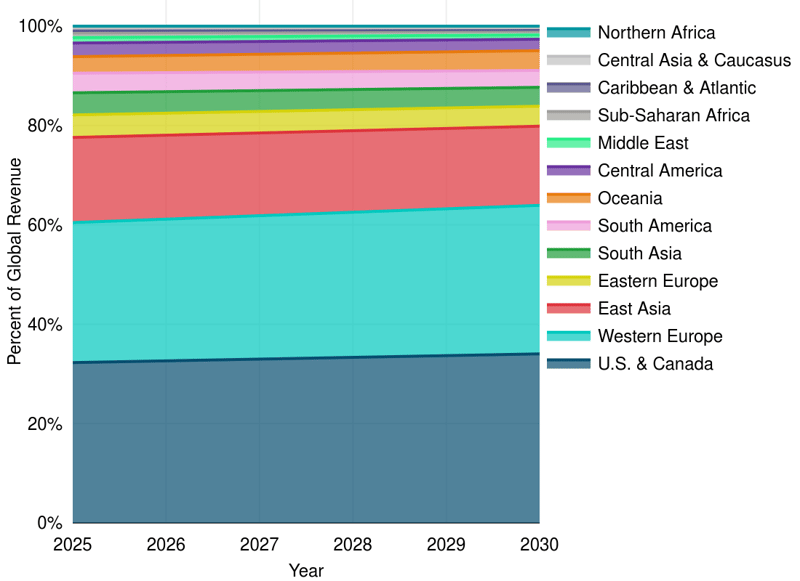
- Stability: Revenue increased across all regions, but of course the major regions saw the biggest absolute growth by far.
- East Asian decline: Contribution of East Asia shrank a bit likely due to less aggressive bandwidth growth.
- Concentrated Revenue: U.S. & Canada and Western Europe are expected to contribute more to the global totals by 2030 due to high bandwidth and encrypted throughput requirements.
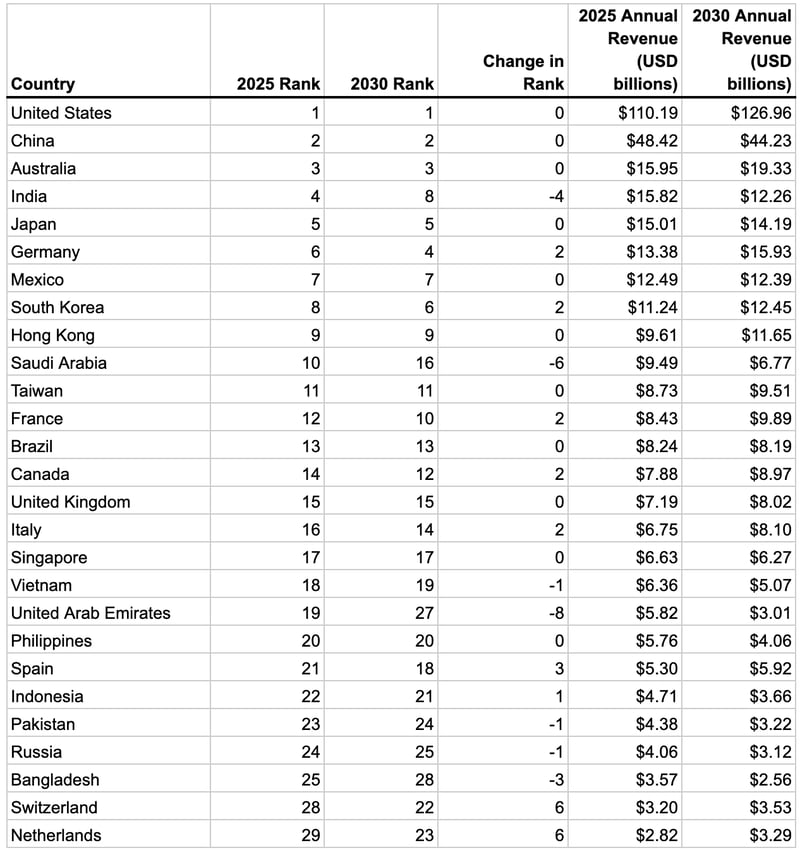
Country WAN Connectivity Market Sizes: 2025-2030
The impact of WAN transformation is unique to each country’s relative level of bandwidth demand, competitive landscape, and pricing structure. Key factors that went into determining revenue shares in the model were starting bandwidth demand and regional demand growth, starting prices and regional price declines, and product mix shifts away from expensive MPLS toward DIA.
Country WAN Connectivity Market Share: 2025-2030
Country Observations:
- Top Tier Stability: The United States and China are expected to remain the top two markets globally. Australia remains in third place due to high bandwidth demand and higher costs stemming from its geographic isolation.
- India’s Decline: India is projected to fall four places as its high costs lead to lower bandwidth demand compared to other countries moving toward higher-revenue large ports with lower unit costs.
- Middle East Slips: The biggest drops in ranking occur in the Middle East, with Saudi Arabia falling six places and the UAE falling eight. This is likely due to the persistence of high prices leading to lower demand for high-revenue generating larger ports. Even as circuit sizes grow globally, these smaller ports will be outpaced in revenue by the very large ports found in more competitive regions.
How We Forecast the WAN Market
Our predictive model used our 2025 WAN Market Size annual model as the baseline and drew our assumptions forward five years to 2030 based on prices we have collected for 20 years, enterprise demand trends we have collected since 2018, and our experiences benchmarking enterprise networks since 2013. The key assumptions that influenced the results are:
- Product mix: the percentage of sites that will be using MPLS, DIA, broadband, and SD-WAN. We assumed that MPLS use will continue to decline while DIA, broadband, and SD-WAN use will increase.
- Port and Circuit sizes: The percentage of sites that will fall into the port and circuit sizes for which we collect prices across all products. We assumed that port/circuit sizes would increase, and we varied this increase by product, with DIA increasing the most.
- MPLS backup strategies: As MPLS usage decreases and SD-WAN adoption ramps up, we assume that the majority of the remaining MPLS service will be without active backups, as DIA or broadband often complement the service.
- DIA on-net access: The percentage of sites that have “on-net” DIA that did not need an additional access line. We assumed that as ISPs expand networks, more DIA sites will be on-net.
- SD-WAN bandwidth ranges: The average total SD-WAN encrypted throughput we expect to see by site across all connectivity products. We assume that as MPLS, DIA, and broadband circuit sizes increase, the encrypted throughput amounts going through SD-WAN devices/service will increase accordingly.
- SD-WAN management levels: The percentage of SD-WAN sites falling within unmanaged, basic managed, and premium managed services—the three pricing tiers we collect. We assumed that as SD-WAN adoption moves to later adopters, managed services will become more popular, as the early adopters are more likely to want more control. We also assumed that as SD-WAN is increasingly a security technology, self management will become less common.
- Network service prices: We made assumptions about the prices for each service and how they might change over time. In this run, we assumed a slight decrease in prices globally. We adjusted the percentage annual decrease based on product, subregion, and port/circuit sizes, and our assumed annual decreases ranged from 0-5%. We assume DIA would have the most aggressive price declines, followed by MPLS, with the least pressure for broadband. For all three products, we assumed more expensive large circuits would be under slightly more price pressure. We did not deflate SD-WAN or local access prices at all, because market dynamics there are more likely to lead to price stability.
Assumed Constants
We also assumed certain factors will likely stay substantially the same over the next five years, or will not impact global revenue:
- We assumed global site counts for enterprises with at least 1,000 employees would stay the same, as some may grow, others shrink, some get acquired and others are absorbed.
- Geographic mix—the percentage of sites in each region or country—would stay substantially the same.
- Local access distances—percentage of sites within each access distance range by country—would stay the same.
We then ran each annual set of assumptions through the same model used for the 2025 annual report, with variables adjusted accordingly. This analysis is focused entirely on the median-median model run that we used for most of our analysis in the annual report in our Cloud and WAN Research Service.
Universe of Enterprise Networks
As in the 2025 annual model, we assumed there are 35,000 global enterprises with 1,000 or more employees. This results in approximately 13,000,000 global WAN sites to connect across 231 countries or political/geographical units in the median-median model.
Global WAN Market Outlook
Predicting the future of WAN revenue is complex, but current data suggests a slight decline in the WAN connectivity market through 2030. While overall revenue remains relatively stable, a massive transition is underway as enterprises move away from MPLS—long the market’s primary revenue driver—in favor of cloud-friendly, decentralized solutions like SD-WAN and DIA.
Key Takeaways:
- Bandwidth as a Revenue Offset: Although DIA offers a lower cost per bit, surging bandwidth demand for cloud services, video, and potentially AI is expected to offset much of the revenue lost from declining MPLS circuits.
- Stable Local Access: Despite the loss of MPLS loops, the access market remains stable as the transition to higher-bandwidth DIA ports requires larger, higher-capacity connections.
- Strategic Pivot for Carriers: Recognizing that pure connectivity is no longer a high-growth area, carriers are increasingly shifting their focus toward MSP services, AIOps, and moving “up the stack” to capture new revenue streams.
Unless AI adoption or other emerging technologies radically alter current trends, this model represents a plausible trajectory for a market undergoing fundamental structural change.
Get all this data—straight from the source
All of the data in this WAN market size forecast came from our Cloud and WAN Research Service platform. Access the most complete, unbiased global telecom data and analysis from TeleGeography experts. See a video tour of the platform and learn more here.