

By measuring an unusual energy gap, scientists at MIT have uncovered how twisted graphene can unlock a new kind of superconducting behavior.
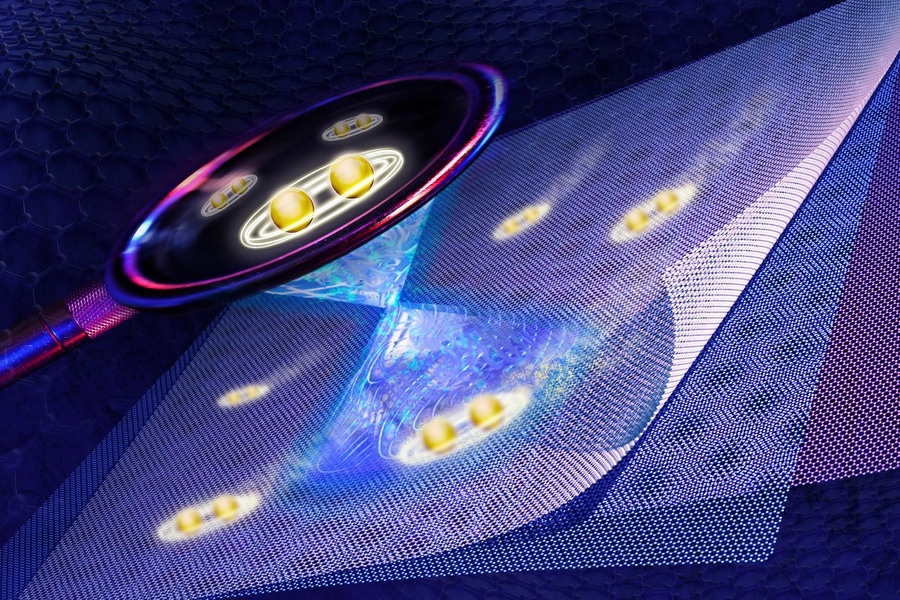
The MIT physicists reported that they had discovered new key evidence of unconventional superconductivity in “magic-angle” twisted tri-layer graphene (MATTG), a material created by stacking three atomically thin sheets of graphene at a specific angle, or twist, which allows exotic properties to emerge.
The results were reported in Science.
Superconductors are similar to the fast trains in a metro system. Electricity “boards” a superconducting material and can travel through it without halting or losing energy.
As a result, superconductors are incredibly energy efficient and are used to power a wide range of applications, including MRI machines and particle accelerators.
However, these “conventional” superconductors have limited applications since they must be cooled to ultra-low temperatures using complicated cooling systems to maintain their superconducting condition.
If superconductors could operate at higher, room-like temperatures, they would open up a whole host of technology, ranging from zero-energy-loss power lines and grids to realistic quantum computing systems.
So scientists at MIT and elsewhere are researching “unconventional” superconductors – materials that display superconductivity in ways that differ from, and potentially outperform, today’s superconductors.
MATTG has already revealed indirect clues of unusual superconductivity and other weird electronic phenomena. The latest discovery provides the most concrete proof yet of the material’s unusual superconductivity.
The researchers were able to quantify MATTG’s superconducting gap, which measures the robustness of a material’s superconducting state at specific temperatures.
They discovered that MATTG’s superconducting gap seems extremely different from that of a normal superconductor, implying that the mechanism by which the material becomes superconductive must also be unique and atypical.
There are many different mechanisms that can lead to superconductivity in materials. The superconducting gap gives us a clue to what kind of mechanism can lead to things like room-temperature superconductors that will eventually benefit human society.
Shuwen Sun, Study Co-Lead Author and Graduate Student, Department of Physics, Massachusetts Institute of Technology
The researchers discovered their finding using a unique experimental platform that allows them to virtually “watch” the superconducting gap as it arises in two-dimensional materials in real time. They intend to use the platform to investigate MATTG further and map the superconducting gap in additional 2D materials, which might uncover intriguing prospects for future applications.
Understanding one unconventional superconductor very well may trigger our understanding of the rest. This understanding may guide the design of superconductors that work at room temperature, for example, which is sort of the Holy Grail of the entire field.
Pablo Jarillo-Herrero, Study Senior Author, Cecil and Ida Green Professor, Massachusetts Institute of Technology
When a material is a superconductor, electrons that pass through can couple up instead of repelling and scattering. When electrons form “Cooper pairs,” they can glide through a material without friction, rather than colliding and flying away as lost energy.
This pairing of electrons is what allows for superconductivity; however, the manner in which they are bound varies.
In conventional superconductors, the electrons in these pairs are very far away from each other, and weakly bound. But in magic-angle graphene, we could already see signatures that these pairs are very tightly bound, almost like a molecule. There were hints that there is something very different about this material.
Jeong Min Park, Study Co-Lead Author, Department of Physics, Massachusetts Institute of Technology
Tunneling Through
Jarillo-Herrero and colleagues conducted a new investigation to directly see and validate unusual superconductivity in a magic-angle graphene lattice. To do so, they would need to determine the material’s superconducting gap.
“When a material becomes superconducting, electrons move together as pairs rather than individually, and there’s an energy ‘gap’ that reflects how they’re bound. The shape and symmetry of that gap tells us the underlying nature of the superconductivity,” explained Park.
Park and her colleagues created an experimental platform that combines electron tunneling with electrical transport, a technique used to determine a material’s superconductivity by sending current through it and continuously measuring its electrical resistance (zero resistance indicates that the material is superconducting).
The scientists used the novel platform to measure the superconducting gap in MATTG. By integrating tunneling and transport measurements in the same device, scientists were able to clearly distinguish the superconducting tunneling gap, which emerged only when the material had zero electrical resistance, a defining feature of superconductivity.
They then observed how this gap changed with temperature and magnetic fields. Surprisingly, the gap had a characteristic V-shaped profile, which differed significantly from the flat and uniform shape of normal superconductors.
This V shape depicts an unusual method by which electrons in MATTG team together to superconduct. The exact mechanism is unknown.
However, the fact that the form of the superconducting gap in MATTG differs from that of a standard superconductor gives compelling evidence that the material is an atypical superconductor.
In conventional superconductors, electrons couple up due to vibrations in the surrounding atomic lattice, essentially jostling the particles together. However, Park thinks that a distinct mechanism is at work in MATTG.
This V shape illustrates a particular unconventional mechanism through which electrons in MATTG form pairs to achieve superconductivity. The precise nature of this mechanism is still not fully understood. However, the distinct shape of the superconducting gap in MATTG, which differs from that of standard superconductors, offers crucial evidence that this material qualifies as an unconventional superconductor.
In traditional superconductors, electron pairing occurs via vibrations of the surrounding atomic lattice, which effectively nudges the particles together. Nevertheless, Park hypothesizes that an alternative mechanism may be functioning in MATTG.
“In this magic-angle graphene system, there are theories explaining that the pairing likely arises from strong electronic interactions rather than lattice vibrations. That means electrons themselves help each other pair up, forming a superconducting state with special symmetry,” added Park.
The researchers will now use the new experimental platform to explore various two-dimensional twisted constructions and materials.
“This allows us to both identify and study the underlying electronic structures of superconductivity and other quantum phases as they happen, within the same sample. This direct view can reveal how electrons pair and compete with other states, paving the way to design and control new superconductors and quantum materials that could one day power more efficient technologies or quantum computers,” concluded Park.
Journal Reference:
Park, J. M., et al. (2025) Experimental evidence for nodal superconducting gap in moiré graphene. Science. DOI: 10.1126/science.adv8376. https://www.science.org/doi/10.1126/science.adv8376.