

Close Menu
geekfence.comgeekfence.com
    What's Hot

    Designing trust & safety (T&S) in customer experience management (CXM): why T&S is becoming core to CXM operating model 

    January 24, 2026

    iPhone 18 Series Could Finally Bring Back Touch ID

    January 24, 2026

    The Visual Haystacks Benchmark! – The Berkeley Artificial Intelligence Research Blog

    January 24, 2026
    Facebook X (Twitter) Instagram
    • About Us
    • Contact Us
    Facebook Instagram
    geekfence.comgeekfence.com
    • Home
    • UK Tech News
    • AI
    • Big Data
    • Cyber Security
      • Cloud Computing
      • iOS Development
    • IoT
    • Mobile
    • Software
      • Software Development
      • Software Engineering
    • Technology
      • Green Technology
      • Nanotechnology
    • Telecom
    geekfence.comgeekfence.com
    Home»Cloud Computing»Three Benefits of Segmentation – Cisco Blog
    Cloud Computing

    Three Benefits of Segmentation – Cisco Blog

    AdminBy AdminJanuary 11, 2026No Comments4 Mins Read1 Views
    Facebook Twitter Pinterest LinkedIn Telegram Tumblr Email
    Three Benefits of Segmentation – Cisco Blog
    Share
    Facebook Twitter LinkedIn Pinterest Email


    In my last two blogs, I delved into the results of the 2025 Cisco Segmentation Report to highlight the importance of macro- and micro-segmentation and to identify the primary challenges hindering segmentation journeys. Today, I dive further into the survey results to discuss the benefits organizations can achieve when they successfully implement a dual macro- and micro-approach to segmentation. The goal, of course, is to continue highlighting insights into the current state of this critical cybersecurity concept and where it may be headed in the future.

    Three Benefits of a Successful Segmentation Strategy

    The good news is that the survey results indicate that organizations further along in their segmentation journeys are indeed achieving measurable benefits from their successful macro- and micro-segmentation implementations.

    1. Contain Breaches

    We all know that it’s not a matter of if your organization will get breached, it’s a matter of when. And, when it happens, you’ll need to detect the attack, identify its targets, understand the impact, contain the breach, and get systems back up and running as quickly as possible. Implementing both macro- and micro-segmentation enables faster breach response by providing organizations with pre-made defensive barriers. The survey responses support this. Respondents from organizations that have fully implemented macro- and micro-segmentation say that breach containment and recovery time take up to 20 days on average, compared with the reported 29 days for organizations without full implementation of both. This 31% faster recovery time is a real, measurable impact of a dual macro- and micro-segmentation approach. It is not hard to imagine how the reduction in containment and recovery comes about—after all, segmentation impedes attackers, thereby reducing the post-breach effort.
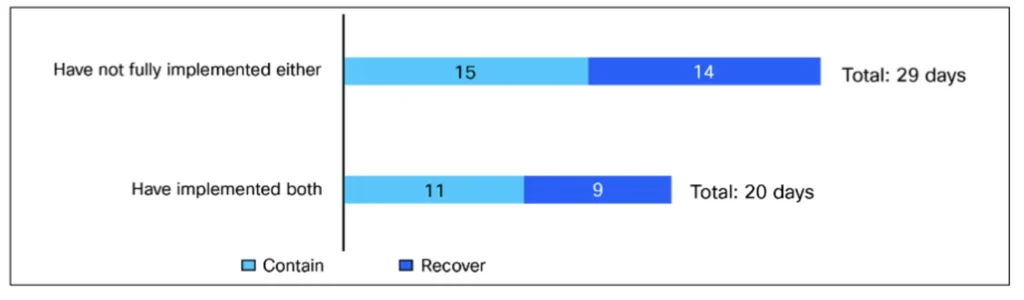
    Organizations that haven't fully implemented macro- and micro-segmentation take an average of 15 days to contain a breach and an additional 14 days to recover from a breach. Organizations that have implemented both macro- and micro-segmentation take an average of 11 days to contain a breach and 9 an additional 9 days to recover from a breach.
    The average time it takes organizations to contain and fully recover from their most recent breach. Base: 1,000 respondents; data split by organizations with full implementation of both macro-and micro-segmentation [327 respondents] and organizations who have not fully implemented either [667 respondents]

    2. Protect High-Value Assets

    According to the report, protecting high-value/critical assets (57%) is the most likely driver for organizations implementing segmentation, including sensitive data, applications, and systems that are critical for business operations and continuity. On its face, protecting critical assets is useful, but preventing these assets from falling into the hands of threat actors preserves the organization’s reputation among customers, employees, shareholders, and other stakeholders. For example, an organization’s financial information can be protected by deploying segmentation that takes into account the identity of users. With such segmentation, only employees in the finance group are allowed access to finance applications. While this type of segmentation doesn’t prevent all kinds of attacks, it does raise the barrier to successful attacks.
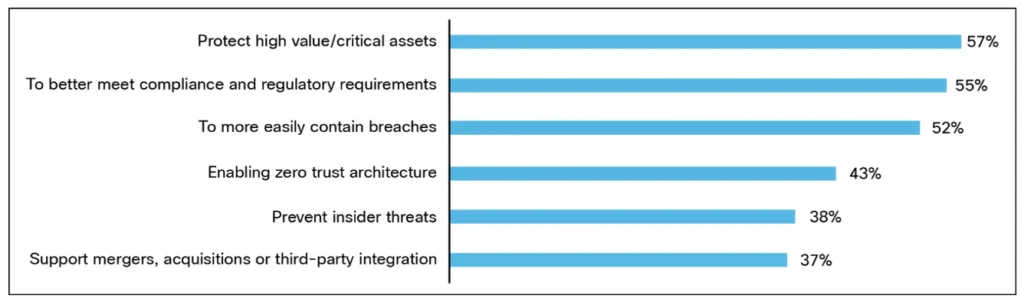
    The main drivers for pursuing segmentation are, by percentage of respondents: protecting high value/critical assets (57%), better meeting compliance and regulatory requirements (55%), more easily containing breaches (52%), enabling zero trust architecture (43%), preventing insider threats (38%), supporting mergers, acquisitions or third-party integrations (37%)
    Question: What are, or would be, the main drivers for your organization when pursuing segmentation within its network? Base: 1,000 respondents

    3. Meet Compliance Requirements

    Once the fundamentals of asset protection are in place, mature organizations extend segmentation into compliance-driven areas. This reflects both regulatory demands—in some major industry segments, such as retail, healthcare, and finance, organizations’ viability depends on their adherence to compliance standards, including PCI-DSS, HIPAA, and SOX (respectively)—and the pursuit of more comprehensive control across complex environments. The survey report shows that organizations with full segmentation deployment are more likely (67% vs 54%) to have also segmented workloads with compliance requirements.

    Acknowledging the Impact of Segmentation

    Organizations that have fully implemented a dual approach to segmentation (33% of respondents) can point to measurable impact—including better breach containment, asset protection, and higher focus on compliance. Clearly, these are adequate incentives for the remaining organizations (67% of respondents) that do not yet have full segmentation deployments to take action.

    If you haven’t already, check out the first two blogs in the series, which discuss the importance of segmentation and the challenges organizations face when implementing segmentation projects. In the meantime, download the 2025 Cisco Segmentation Report to learn more about the state of segmentation today and where you fit against similar organizations.


    We’d love to hear what you think! Ask a question and stay connected with Cisco Security on social media.

    Cisco Security Social Media

    LinkedIn
    Facebook
    Instagram
    X


    Source link

    Share. Facebook Twitter Pinterest LinkedIn Tumblr Email

    Related Posts

    GitHub Copilot SDK allows developers to build Copilot agents into apps

    January 24, 2026

    Accelerating Ethernet-Native AI Clusters with Intel® Gaudi® 3 AI Accelerators and Cisco Nexus 9000

    January 23, 2026

    Cisco URWB: Powering Industrial AI & Automation on the Factory Floor

    January 22, 2026

    AWS Weekly Roundup: Kiro CLI latest features, AWS European Sovereign Cloud, EC2 X8i instances, and more (January 19, 2026)

    January 20, 2026

    A pivotal 2026 for cloud strategy

    January 19, 2026

    Astro web framework maker merges with Cloudflare

    January 18, 2026
    Top Posts

    Understanding U-Net Architecture in Deep Learning

    November 25, 202511 Views

    Hard-braking events as indicators of road segment crash risk

    January 14, 20269 Views

    Microsoft 365 Copilot now enables you to build apps and workflows

    October 29, 20258 Views
    Don't Miss

    Designing trust & safety (T&S) in customer experience management (CXM): why T&S is becoming core to CXM operating model 

    January 24, 2026

    Customer Experience (CX) now sits at the intersection of Artificial Intelligence (AI)-enabled automation, identity and access journeys, AI-generated content…

    iPhone 18 Series Could Finally Bring Back Touch ID

    January 24, 2026

    The Visual Haystacks Benchmark! – The Berkeley Artificial Intelligence Research Blog

    January 24, 2026

    Data and Analytics Leaders Think They’re AI-Ready. They’re Probably Not. 

    January 24, 2026
    Stay In Touch
    • Facebook
    • Instagram
    About Us

    At GeekFence, we are a team of tech-enthusiasts, industry watchers and content creators who believe that technology isn’t just about gadgets—it’s about how innovation transforms our lives, work and society. We’ve come together to build a place where readers, thinkers and industry insiders can converge to explore what’s next in tech.

    Our Picks

    Designing trust & safety (T&S) in customer experience management (CXM): why T&S is becoming core to CXM operating model 

    January 24, 2026

    iPhone 18 Series Could Finally Bring Back Touch ID

    January 24, 2026

    Subscribe to Updates

    Please enable JavaScript in your browser to complete this form.
    Loading
    • About Us
    • Contact Us
    • Disclaimer
    • Privacy Policy
    • Terms and Conditions
    © 2026 Geekfence.All Rigt Reserved.

    Type above and press Enter to search. Press Esc to cancel.