

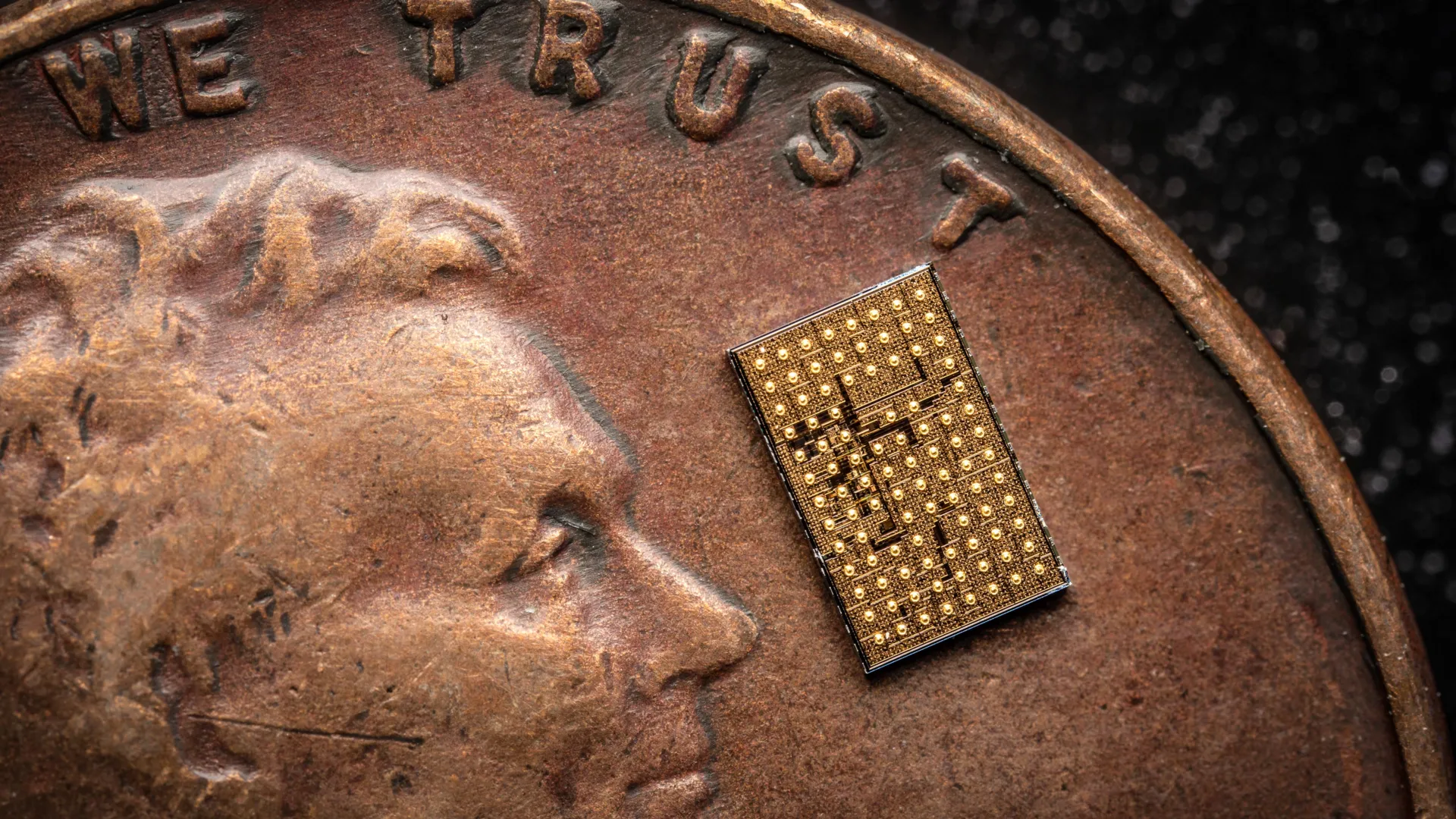
As data centers consume more energy to support growing digital demands, engineers at the University of California San Diego have introduced a new chip design that could make powering graphics processing units (GPUs) more efficient. The innovation focuses on a key function in electronics: converting high voltages into the lower levels required by computing hardware. In laboratory testing, a prototype chip successfully performed this type of voltage conversion with high efficiency under conditions similar to those found in modern data centers.
The findings, published in Nature Communications, suggest the potential for smaller and more energy-efficient systems in advanced computing environments.
Rethinking DC-DC Converters for Modern Electronics
At the center of the new design is an improved version of a widely used component known as a DC-DC step-down converter. These converters are found in nearly all electronic devices and serve as a critical link between power sources and sensitive circuits. Their job is to take a high incoming voltage and reduce it to the exact level needed for safe operation.
In data centers, electricity is often distributed at 48 volts, while GPU processors typically require much lower voltages, usually between 1 and 5 volts. Efficiently managing this large voltage drop has become increasingly challenging as computing systems grow more powerful and compact.
Limits of Traditional Power Conversion Technology
Conventional step-down converters often struggle when dealing with large differences between input and output voltage. As that gap increases, efficiency drops and it becomes harder to supply enough current. Most existing designs rely on magnetic components such as inductors. While these components have been refined over many years, they are approaching their practical limits and are becoming harder to improve further.
“We’ve gotten so good at designing inductive converters that there’s not really much room left to improve them to meet future needs,” said study senior author Patrick Mercier, professor in the Department of Electrical and Computer Engineering at the UC San Diego Jacobs School of Engineering.
Exploring Piezoelectric Resonators as an Alternative
To move beyond these limitations, Mercier and his team, including first author Jae-Young Ko, an electrical and computer engineering Ph.D. student at UC San Diego, investigated a different approach using piezoelectric resonators. These small devices store and transfer energy through mechanical vibrations rather than magnetic fields.
Converters based on piezoelectric components could offer several advantages. They have the potential to be smaller, more energy dense, more efficient, and easier to manufacture at scale. “They have a lot of room to grow and have the potential to deliver better performance than anything that’s come before them,” Mercier said.
However, earlier versions of piezoelectric converters have had difficulty maintaining efficiency and delivering sufficient power when handling large voltage differences.
Hybrid Design Achieves High Efficiency and Power Output
To overcome these issues, the researchers created a hybrid converter that combines a piezoelectric resonator with small, commercially available capacitors arranged in a carefully designed configuration. This setup enables the system to handle larger voltage conversions more effectively.
The team incorporated this design into a prototype chip and tested its performance. The device successfully converted 48 volts down to 4.8 volts — a level commonly required in data centers — with a peak efficiency of 96.2 percent. It also delivered roughly four times more output current than previous piezoelectric-based designs.
This hybrid approach offers several benefits. It creates multiple pathways for energy to move through the system, reduces wasted power, and lessens the strain on the resonator. Together, these improvements enhance both efficiency and power delivery while only slightly increasing the chip’s size.
Challenges and Next Steps for Real-World Use
Although the technology shows strong promise, it is still in the early stages of development. The researchers view it as an important step toward overcoming the constraints of current power conversion systems. Future efforts will focus on refining materials, improving circuit designs, and developing better packaging methods.
One challenge is that piezoelectric resonators physically vibrate, which means they cannot be attached to circuit boards using standard soldering techniques. New integration strategies will be needed to incorporate them into electronic systems, Mercier explained.
“Piezoelectric-based converters aren’t quite ready to replace existing power converter technologies yet,” Mercier added. “But they offer a trajectory for improvement. We need to continue to improve on multiple areas — materials, circuits and packaging — to make this technology ready for data center applications.”
This project was supported in part by the Power Management Integration Center (PMIC), an Industry-University Cooperative Research Center (IUCRC) funded by the National Science Foundation (award number 2052809).