

Using lasers as precision tools to study how clouds become electrically active may sound futuristic, but researchers at the Institute of Science and Technology Austria (ISTA) have turned it into practical laboratory work. By capturing and charging tiny airborne particles with focused beams of light, scientists can watch how their electrical state changes over time. Their findings, recently reported in Physical Review Letters, could help reveal what triggers lightning.
Aerosols are tiny droplets or solid particles suspended in the air, and they surround us constantly. Some are large enough to see, such as springtime pollen, while others, like viruses that circulate during flu season, are far too small for the human eye. A few can even be sensed by taste, including the fine salt particles carried on ocean winds.
PhD student Andrea Stöllner, a member of the Waitukaitis and Muller groups at ISTA, studies the behavior of ice crystals that form within clouds. To better understand how these crystals gather charge, she works with model aerosols made from very small, transparent silica spheres.
Together with former ISTA postdoc Isaac Lenton, ISTA Assistant Professor Scott Waitukaitis and collaborators, Stöllner has created a technique that uses two intersecting laser beams to trap, stabilize, and electrically charge a single silica particle. This setup opens the door to new investigations into how cloud electrification begins and how lightning is sparked.
Building a Stable Laser Trap
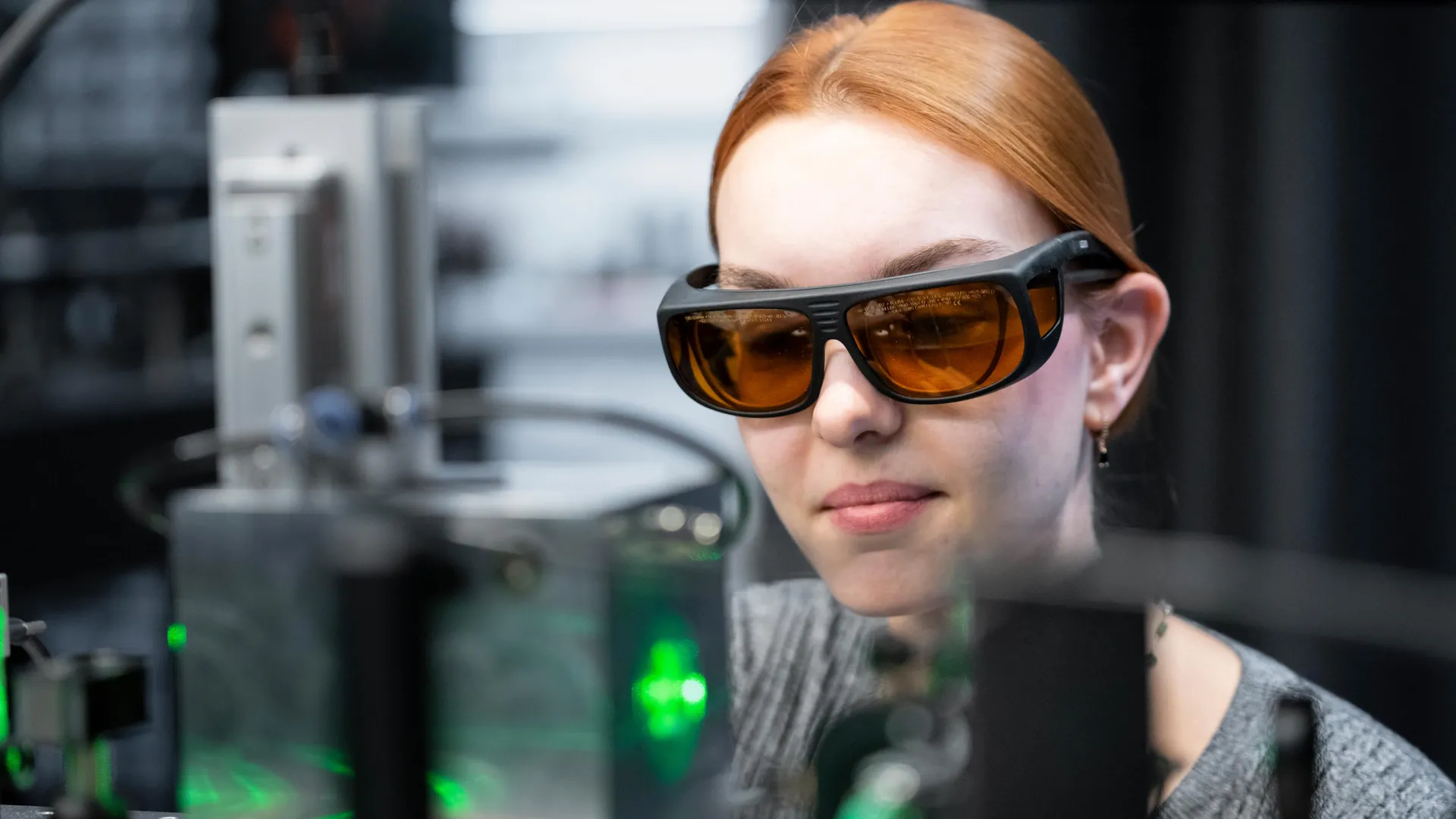
Andrea Stöllner works at a large laboratory table filled with polished metal components. Green laser beams cross the space, bouncing from mirror to mirror. A slow, steady hissing noise comes from the table, similar to air leaking from a tire. “It’s an anti-vibration table,” Stöllner says, pointing out how it protects the lasers from small disturbances in the room or from nearby equipment, which is essential for extremely precise measurements.
The beams travel through a series of aligned parts before converging into two narrow streams that enter a sealed container. Where they meet, they create a concentrated point of light that can hold small particles in place. These “optical tweezers” keep drifting aerosols suspended long enough to study them. When a particle is caught, a bright green flash appears, confirming that the trap has successfully grabbed a glowing, perfectly round aerosol particle.
“The first time I caught a particle, I was over the moon,” Stöllner recalls of her breakthrough moment two years earlier, just before Christmas. “Scott Waitukaitis and my colleagues rushed into the lab and took a short glimpse at the captured aerosol particle. It lasted exactly three minutes, then the particle was gone. Now we can hold it in that position for weeks.”
Achieving this level of control took nearly four years. The experiment began with an earlier version developed by Lenton. “Originally, our setup was built to just hold a single particle, analyze its charge, and figure out how humidity changes its charges,” Stöllner says. “But we never came this far. We found out that the laser we are using is itself charging our aerosol particles.”
How Lasers Knock Electrons Loose
Stöllner and her colleagues discovered that the particles gain charge through a “two-photon process.”
Aerosol particles usually carry almost no net charge, with electrons (negatively charged entities) orbiting within each atom. Laser beams are made of photons (particles of light traveling at the speed of light). When two photons strike the particle at the same moment and are absorbed together, they can remove a single electron. Losing that electron gives the particle one unit of positive charge, and with continued exposure, the particle becomes progressively more positively charged.
For Stöllner, identifying this process has opened new opportunities. “We can now precisely observe the evolution of one aerosol particle as it charges up from neutral to highly charged and adjust the laser power to control the rate.”
As the charge builds, the particle also begins to lose charge again in sudden, short bursts. These spontaneous discharges hint at behaviors that may occur naturally in the atmosphere.
High above, cloud particles may undergo similar cycles of charge buildup and release.
Searching for Lightning’s First Spark
Thunderstorm clouds contain a mix of ice crystals and larger chunks of ice. As these collide, they trade electrical charges. Over time, the cloud becomes so electrically imbalanced that lightning forms. One idea is that the earliest spark of a lightning bolt could arise directly from charged ice crystals. Yet the exact mechanism behind lightning formation remains unresolved. Other theories propose that cosmic rays start the process because the charged particles they produce accelerate within existing electric fields. According to Stöllner, the current scientific view is that, in both scenarios, the electric field inside clouds appears too weak to initiate lightning on its own.
“Our new setup allows us to explore the ice crystal theory by closely examining a particle’s charging dynamics over time,” Stöllner explains. While natural ice crystals in clouds are much larger than the silica particles used in the lab, the team hopes that understanding these small-scale effects will reveal the larger processes that create lightning. “Our model ice crystals are showing discharges and maybe there’s more to that. Imagine if they eventually create super tiny lightning sparks — that would be so cool,” she adds with a smile.