

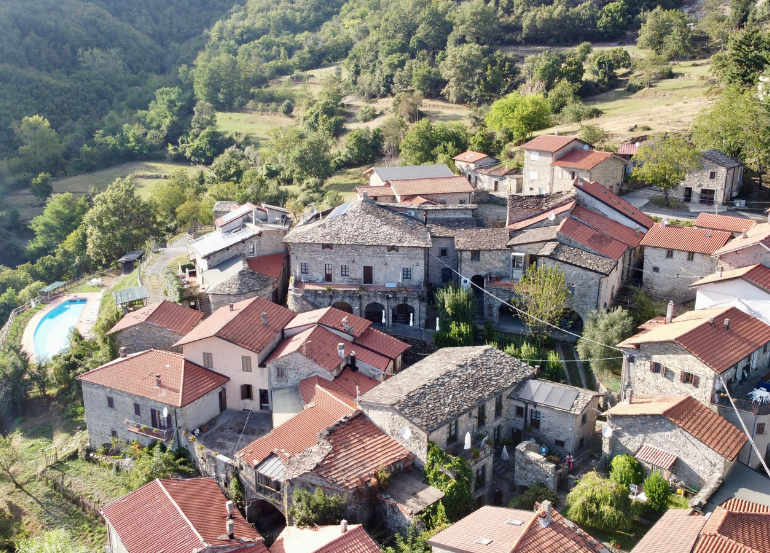
If you wander deep enough into the Appennino Tosco-Emiliano National Park in Northern Tuscany, you’ll find the village of Apella. It is a place where the air smells of chestnut trees and wild rosemary, and the “Zero-KM” philosophy is a way of life. At the Montagna Verde agritourism complex, the honey is local, the meat is raised on-site, and the history is etched into 800-year-old stone walls.
But until recently, there was one thing you couldn’t find in this medieval paradise, no matter how hard you looked: cellular signal.
In the tech world, we often talk about the “digital divide” as a theoretical problem. For Barbara Maffei, the owner of Montagna Verde, it was a threat to her heritage. In a world where 15,000 annual visitors expect to share their “work-vacation” sunsets on Instagram and waiters need tablets to send orders to the kitchen, being a “dead zone” was no longer a romantic escape—it was a business bottleneck.
In Tuscany, the most prized treasures are truffles, hidden deep beneath the forest floor. Finding them requires a specialized “nose.” Similarly, bringing internet to a remote mountain peak 50 miles from the nearest city required a specialized kind of networking.
Traditional fiber was out of the question; you can’t exactly dig trenches through a protected UNESCO Biosphere Reserve without disturbing the very nature guests come to see. Cellular coverage was non-existent, blocked by the rugged, forested terrain. Montagna Verde needed a “digital truffle hunter”—something that could sniff out a path through the trees and over the ridges without a single wire.
The solution came in the form of a fiber-like wireless backbone. By establishing a 15 km radio bridge from a nearby mountain summit to the ancient Tower of Apella, the team created a stable entry point. But the real magic happened on-site with Cisco Ultra-Reliable Wireless Backhaul (URWB).
When you’re operating a 140-seat restaurant, you don’t just need speed—you need predictability. As Alessandro Erta, the project’s IT Lead, puts it: “Predictability is more important than raw performance. It is better to have reliability than high peak performance.”
Using Cisco URWB, the estate created a point-to-multipoint network that acts like an invisible web over the village. This high-capacity “pipe” feeds 21 Wi-Fi access points. Whether a guest is standing behind an 80 cm-thick stone wall in a restored medieval bedroom or walking through a field of olive trees, the connection remains seamless.
To ensure the system could survive the Tuscan elements—from humid summers to freezing mountain winters—the team deployed Cisco Industrial Ethernet switches. These aren’t your average office switches; they are ruggedized warriors designed to thrive in the mud and the mist. By using Power over Ethernet (PoE), they even managed to power the entire system through single cables, avoiding invasive electrical work on historic structures.
Beyond providing tourists with faster Wi-Fi, this digital harvest ensures the survival of a community. Depopulation acts as a silent killer in many rural Italian regions, forcing young people to seek employment and better infrastructure in the cities.
By blending historic agriculture with modern tourism, Montagna Verde has become an engine for regional growth. Today, the estate provides stable jobs for 28 local young people. These employees aren’t just serving pasta; they are using tablets connected to a wireless backbone to transmit real-time orders, monitoring high-definition security cameras, and managing a complex digital ecosystem that keeps the estate running.
“Without people, there is no future,” says Barbara Maffei. “And without a balance between man and nature, there is no heritage to preserve.”
At Montagna Verde, they’ve proven that tradition and technology are the perfect pairing—much like a bold Chianti and a plate of handmade pappardelle. By using Cisco’s industrial wireless technology to bridge the digital divide, they haven’t just modernized a hotel; they’ve protected a way of life.
The next time you’re in Northern Tuscany, you can enjoy the silence of the mountains and the taste of “Zero-KM” olive oil, all while staying perfectly connected to the world you left behind. It turns out that with the right technology, you really can have the best of both centuries.
For now, you can read the full customer story to learn more about this fascinating location and the Cisco solution.