

Researchers at BESSY II have, for the first time, experimentally confirmed that a material can exhibit truly one-dimensional electronic properties. The team studied short chains of phosphorus atoms that naturally arrange themselves at specific angles on a silver surface. By applying advanced measurement and analysis techniques, they separated the signals coming from chains aligned in different directions. This careful work showed that each individual chain behaves as a genuine one-dimensional electronic system.
The findings also point to a dramatic shift in behavior depending on how closely the chains are spaced. When the chains are farther apart, the material acts as a semiconductor. If packed tightly together, however, calculations predict it would behave like a metal.
From Two-Dimensional Materials to One Dimension
All materials are built from atoms that bond together in different patterns. In most solids, atoms connect both within a plane and vertically. Some elements, such as carbon, can form graphene, a two dimensional (2D) hexagonal network in which atoms bond only within a single layer. Phosphorus is also capable of forming stable 2D structures.
Two-dimensional materials have attracted intense interest because of their unusual electronic and optical properties. Theoretical studies suggest that shrinking materials down even further into one-dimensional structures could produce even more remarkable electro-optical effects.
Self-Assembled Phosphorus Chains on Silver
Under carefully controlled conditions, phosphorus atoms can organize themselves into short, straight lines on a silver substrate. Structurally, these lines appear one-dimensional. However, neighboring chains may still interact with one another from the side. Those lateral interactions can alter the electronic structure and potentially disrupt true one-dimensional behavior. Until now, researchers had not been able to clearly measure whether the electrons themselves were confined to a single dimension.
“Through a very thorough evaluation of measurements at BESSY II, we have now shown that such phosphorus chains really do have a one-dimensional electronic structure,” says Professor Oliver Rader, head of the Spin and Topology in Quantum Materials department at HZB.
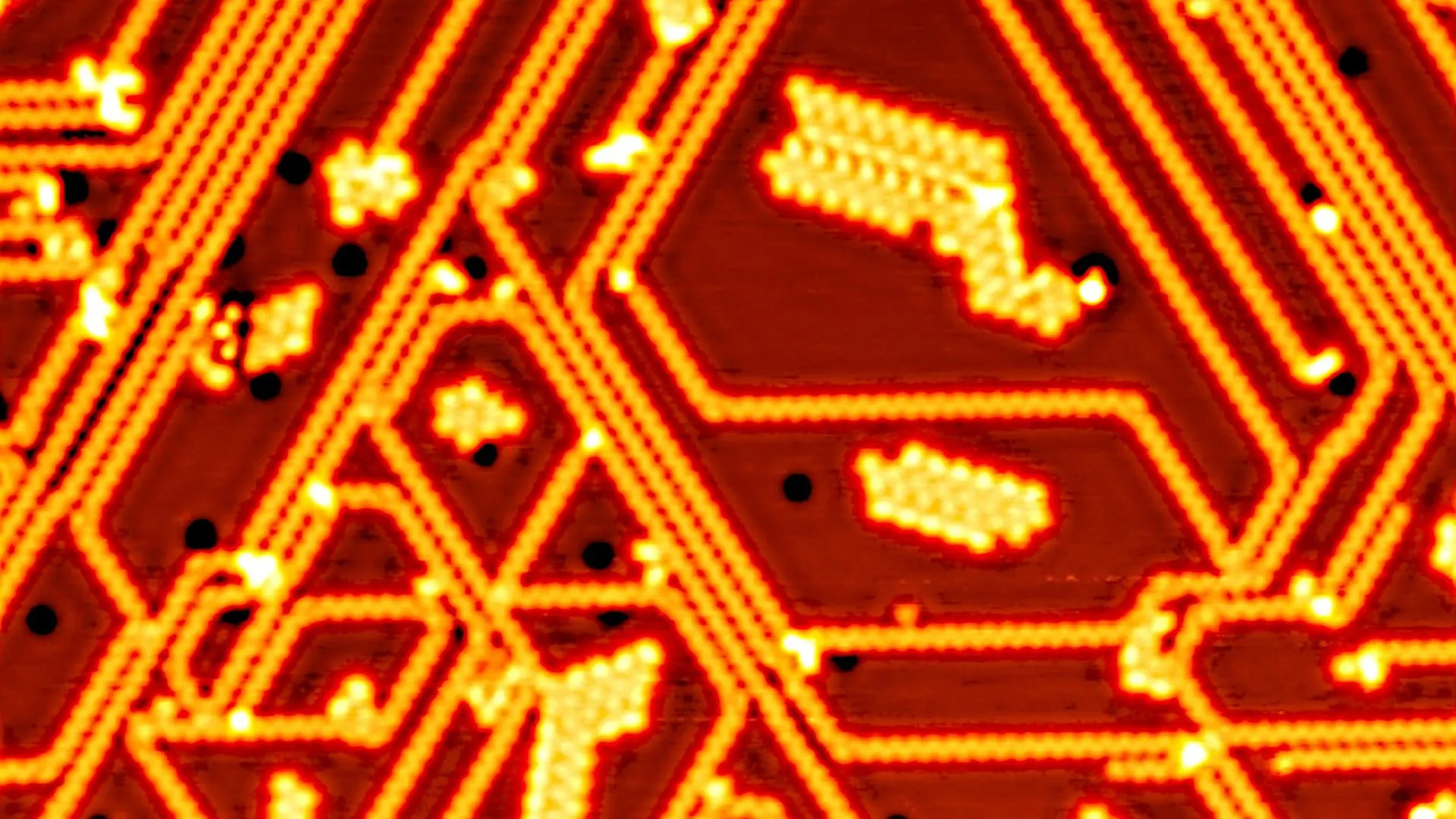
Dr. Andrei Varykhalov and colleagues first created and examined the phosphorus chains using a cryogenic scanning tunnelling microscope (STM). The images revealed short phosphorus chains forming in three distinct directions across the silver surface, each separated by 120 degree angles.
ARPES Reveals True 1D Electronic Structure
“We achieved very high-quality results, enabling us to observe standing waves of electrons forming between the chains,” says Varykhalov. The team then mapped the electronic structure using angle-resolved photoelectron spectroscopy (ARPES) at BESSY II, a technique in which they have extensive expertise.
Predicted Semiconductor-to-Metal Phase Transition
Dr. Maxim Krivenkov and Dr. Maryam Sajedi played a key role in interpreting the data. By carefully separating the contributions from the three differently oriented chain domains, they were able to isolate each chain’s electronic signature. “We could disentangle the ARPES signals from these domains and thus demonstrate that these 1D phosphorus chains actually possess a very distinct 1D electron structure too,” says Krivenkov.
Calculations based on density functional theory support the experimental results and suggest an important shift as the chains move closer together. Stronger interactions between neighboring chains are predicted to trigger a phase transition from semiconductor to metal as chain density increases. In other words, if the chains form a tightly packed two-dimensional array, the material would behave as a metal.
“We have entered a new field of research here, uncharted territory where many exciting discoveries are likely to be made,” says Varykhalov.